 The extreme 2023 drought leads to the first record of Euglena sanguinea Ehrenberg blooms in Amazon lakes
ABSTRACT
Climate extremes are imposing several threats to Amazonian ecosystems. In 2023, an extreme drought occurred in the Amazon basin and several impacts were documented in the Tefé and Coari lakes, including unprecedented river dolphin mortality and phytoplankton blooms. Here, we report the first documented bloom of Euglena sanguinea in the Amazon, providing morphological and molecular identification of the species and evidence of the presence of its toxin, euglenophycin. This bloom reached high densities in both lakes, likely favored by elevated temperatures of up to 38 °C, combined with intense solar radiation and sediment resuspension, factors that may have triggered the heterotrophic nutritional strategy of E. sanguinea. In Tefé lake, the phytoplankton community was composed of Chlorophyceae, Bacillariophyceae, and Cyanophyceae, with an emphasis on the potentially toxic species Dolichospermum sp. and Planktothrix sp., which, despite not having developed blooms during the extreme drought, serve as early warning indicators. Our findings indicate that extreme drought conditions linked to climate change can trigger novel bloom events in natural Amazonian lakes, underscoring the urgency of enhanced phytoplankton monitoring to anticipate ecological risks and safeguard local communities.
KEYWORDS:
harmful algae; euglenophycin; phytoplankton; climate change; toxins
RESUMO
Eventos climáticos estão impondo diversas ameaças aos ecossistemas amazônicos. Em 2023, uma seca extrema ocorreu na bacia amazônica e diversos impactos foram documentados nos lagos Tefé e Coari, incluindo mortalidade sem precedentes de botos e florações de fitoplâncton. Aqui, relatamos a primeira floração documentada de Euglena sanguinea na Amazônia, fornecendo identificação morfológica e molecular da espécie e evidências de sua toxina, a euglenoficina. Essa floração atingiu altas densidades em ambos os lagos, provavelmente favorecida por temperaturas elevadas de até 38 °C, combinadas com intensa radiação solar e ressuspensão de sedimentos, fatores que podem ter desencadeado a estratégia nutricional heterotrófica de E. sanguinea. No lago Tefé, a comunidade fitoplanctônica era composta por Chlorophyceae, Bacillariophyceae e Cyanophyceae, com destaque para as espécies potencialmente tóxicas Dolichospermum sp. e Planktothrix sp., que, apesar de não terem desenvolvido florações durante a seca extrema, servem como indicadores de alerta precoce. Nossas descobertas indicam que condições extremas de seca associadas às mudanças climáticas podem desencadear novos eventos de floração em lagos naturais da Amazônia, ressaltando a urgência de um monitoramento aprimorado do fitoplâncton para antecipar riscos ecológicos e proteger as comunidades locais.
PALAVRAS-CHAVE:
algas nocivas; euglenoficina; fitoplâncton; mudanças climáticas; toxinas
INTRODUCTION
Earth’s climate has changed dramatically in recent decades (IPCC 2023; Falk et al. 2024). Human-induced climate change has reduced the resilience of Amazon ecosystems much faster than the environmental changes that have occurred naturally in the past (Albert et al. 2023). Approximately 38% of Amazonian forests have been impacted by rising temperatures, edge effects, logging, fires, and extreme droughts (Lapola et al. 2023). The Amazon region has also been directly affected by an increase in extreme floods and droughts in recent years, with significant implications for human livelihoods and biodiversity (Marengo and Espinoza 2016; Espinoza et al. 2021, 2024; Fleischmann et al. 2023; Silva et al. 2023; Terassi et al. 2024), including the record-breaking 2021 flood and the 2023 and 2024 droughts (Espinoza et al. 2021, 2024).
These climate changes, such as extreme droughts, can increase the size, frequency, and duration of blooms of photosynthetic organisms. The occurrence of harmful cyanobacterial blooms in various regions worldwide has been associated with rising temperatures, decreasing water levels, and excessive nutrient enrichment in aquatic environments (Igwaran et al. 2024). For instance, three intense summer heat waves lead to cyanobacteria proliferation in Lake Taihu in China (Li et al. 2022), due increased air temperatures, higher levels of photosynthetically active radiation, and reduced wind speed. However, no studies conducted in the Amazon region have yet linked phytoplankton blooms to the direct impacts of climate change.
In 2023, the Amazon experienced a basin-wide extreme drought, significantly disrupting its environmental and social dynamics (Espinoza et al. 2024). Hundreds of thousands of people, particularly those in riverine communities, were isolated, resulting in a significant reduction in their access to potable water, food, medicines, essential services and markets in nearby urban areas. A mass mortality (330 individuals found dead between Sep and Oct 2023) of river dolphins (Inia geoffrensis and Sotalia fluviatilis) occurred in Tefé lake, and mortality extended until November in the Coari lake, linked to temperatures as high as 41oC (Marmontel et al. 2024). During the same time, another unprecedented phenomenon occurred in both lakes: a significant proliferation of reddish algae.
Algal proliferation has the potential to cause environmental damage, including eutrophication, dissolved oxygen depletion, fish mortality, and toxin production (Dokulil and Teubner 2011). However, in the Amazon, algae blooms by cyanobacteria have been recorded mainly in urban environments, by cyanobacteria in fish farming tanks, public supply reservoirs and eutrophic bodies of water close to the city (Fonseca et al. 2015; Pinheiro et al. 2023). The only existing record of potentially toxic blooms in natural Amazonian systems involves an intense proliferation of cyanobacteria, specifically Anabaena sp. and Microcystis sp., in the Tapajós River, a clear water body in Eastern Amazonia (Sá et al. 2010). Although the concentrations of the microcystin-LR toxin were below the maximum limits allowed by Brazilian legislation for drinking water, in-situ observations indicated that the blooms occupied approximately 10 cm of the water column, which could potentially cause skin irritation for individuals bathing in the river (Sá et al. 2010). To document any potentially toxic bloom in the Amazon is thus very relevant for a system that undergoes multiple environmental stressors.
Euglena sanguinea is potentially ichthyotoxic, i.e., they pose risks to fish and, as a result, to the entire aquatic ecosystem (Zimba et al. 2010, 2017). Therefore, their blooms should alert aquatic ecologists and public health and water resources managers in the region. In this study, we present and discuss the unprecedented occurrence of Euglena sanguinea blooms in Amazonian waters, highlighting their potential environmental impacts. We also surveyed the phytoplankton composition during the period of extreme drought, which coincided with the emergence of the bloom. We highlight the relevance of the finding of these potentially harmful microalgae in natural Amazonian environments, providing new information into the impacts of extreme climate events on the ecology of the region.
MATERIAL AND METHODS
Study area
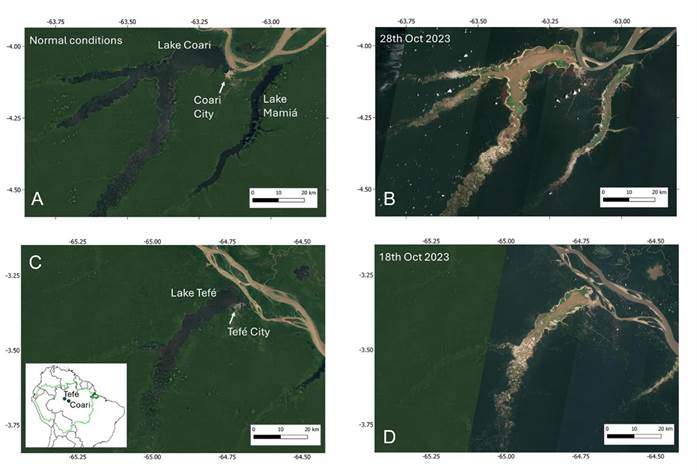
Tefé and Coari (Figure 1) are “ria” lakes (also known as blocked fluvial valleys), a particular type of lake in the Amazon associated with the backflooding of tributaries close to their confluences with the Amazon River (Irion et al. 2010; Latrubesse 2012). The lakes are formed at the downstream end of the Tefé and Coari rivers, where the rivers widen near their confluence with the Amazon River. Although the lakes are black-water systems, they receive sediments from the Amazon during some specific periods of the year. During extreme drought conditions, resuspension of bottom sediments leads to very turbid waters in both lakes (Figure 1). At their downstream ends, a short channel connects the lakes to the Amazon River (known as the Solimões River in Brazil). Both are large lakes, with surface areas of 379 km² (Tefé) and 869 km² (Coari) during periods without the influence of El Niño (Wang et al. 2023). However, during the 2023 drought, their surface areas were reduced by 75% (Tefé) and 78% (Coari).
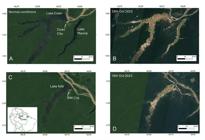
Satellite images from PlanetScope of Tefé and Coari lakes in the Amazon. (A) Coari lake during a non-extreme dry period; (B) Coari lake on October 28, 2023 (extreme drought); (C) Tefé lake during a non-extreme dry period; (D) Tefé lake on October 18, 2023 (extreme drought). The location of the two lakes within the Amazon River basin (green polygon) and in the South American continent is presented in the bottom left figure detail.
Water quality, hydrology and meteorology
We measured water levels continuously at a gauge station located at the Mamirauá Institute’s floating station, from 23rd Sep 2023 onward, where a local observer recorded the level twice a day (7 h and 17 h local time). The station is located in front of the city of Tefé. Water characteristics (water temperature, pH, dissolved oxygen, electrical conductivity and Secchi disk) were measured daily (around 16h local time) from Sep 28 to Nov 9, with a Hannah HI 98194 multiparameter probe at the surface, 50% of the water column depth, and near the bottom. Additionally, water temperature data were continuously recorded with a Hobo Pendant MX2201 logger located at the Mamirauá Institute’s floating station, at a 30 cm depth - during the drought, the whole water column was fully mixed, and the isotherm temperature was observed (same temperature in the whole water column).
In late September, a major dolphin mortality event started, which culminated with the death of 209 dolphins dead in the lake over a short period of a few weeks (Marmontel et al. 2024). For this reason, water quality measurements started being collected at the October. We analyzed turbidity, color, total nitrogen and total phosphorus in four water surface samples, from Oct 1 to 11, with Hanna H7011 turbidimeter, spectrophotometer Hach at a wavelight of 365 nm.
Phytoplankton analysis
In October 2023, we collected samples of the ‘red spot’ from Tefé lake (3°20′45.38″ S, 64°44′48.70″ W), at a site where the bloom was recurrently observed. In the Coari lake, we collected samples from the ‘red spot’ in the center of the main lake (4°02’37.8”S 63°11’48.8”W) channel in November 2023. Qualitative samples were collected using horizontal tows with a conical plankton net (20 µm mesh size). At least five replicate tows were conducted at each site where the red patch was observed. These samples were preserved with Transeau solution at a 6:3:1 ratio (Bicudo and Menezes, 2006).
For quantitative collections, we used a 5-liter graduated container, shook the sample, removed a 300 mL subsample and preserved it with 0.3% Lugol’s solution. In the laboratory, we analyzed the samples using successive slides under a standard optical microscope with 10x and 40x objectives. We selected 10 cells of each shape (elongated and round/oval) from each lake and measured the sizes of the E. sanguinea cells using a standard optical microscope equipped with a micrometric eyepiece (10x objective). For quantitative analyses, we counted the number of cells in a Sedgewick-Rafter chamber. The final number of cells per volume was estimated with the following formula:
Where, C = number of cells counted, A = field area, DE = field depth, F = number of fields counted.
In addition to the samples collected directly from the red spot, we also collected samples at four sites in Tefé lake to evaluate the phytoplankton composition outside the bloom area. Samples from site 1 (3°21’03.7”S 64°47’00.3”W), site 2 (3°19′06.7″ S, 64°46′37.5″ W), site 3 (3°20′45.38″ S, 64°44′48.70″ W), and site 4 (3°21′00.9″ S, 64°41′03.6″ W) were collected and preserved following the same procedures described above.
DNA extraction, amplification and sequencing
To check for the presence of Euglena sanguinea in the bloom sample, we used the molecular marker nSSU rDNA (nuclear Small Subunit ribosomal DNA) species-specific for Euglena sanguinea, as described in Kulczycka et al. (2018). The target region for the external primer was located between Helix 29 and 45 in the secondary structure of nSSU rDNA (sangF0: CTGYGGGCGCCACGCCCCCTTG and sangR0: ACGGACTTGCRGGGTTTCCCAGC) and for the internal primers between Helix 30 and 45 (sangF1: CGCCCCCTTGACCGAGAAATCCG, sangR1: GCCRGGGCCCRCAGAARACGAGG).
We used three types of templates: (1) DNA isolated from a Euglena sanguinea bloom from Tefé lake (species previously identified by microscopy); (2) DNA isolated from an environmental sample (Pampulha reservoir, Minas Gerais State, Brazil, with presence of Euglena species, but not Euglena sanguinea); (3) DNA isolated from a Euglena sp. culture (strain 463, CCMA UFSCar culture collection, Brazil). Total genomic DNA from cell cultures and environmental samples was extracted and purified with a DNA/RNA extraction Sample Flex Phot Kit (Phoneutria), according to the fabricant protocol.
The PCR amplification was performed as follows: a 25-μL reaction mixture contained 0.2 U DNA Polymerase, 0.2 mM dNTPs, 1.5 mM MgCl2, 5 pmol of each primer, reaction buffer and DNA template (10-20 ng). The PCR protocol consisted of two different rounds for a Nested PCR. The first round ran with the sangF0/R0 external primers, starting with 2 min at 98 °C, followed by nine initial cycles comprising the following steps: 30 s at 98 °C, 30 s at 62°C and 20s at 72 °C. For the second round, with the sangF1/R1 internal primers, 1 μL of the mixture from the first round was used and followed a similar protocol, starting with 2 min at 98 °C, followed by 39 cycles comprising steps of 15 s at 98 °C, 15 s at 60 °C (instead of 62°C), and 20 s at 72 °C. The final extension step was performed for 5 min at 72 °C. The PCRs were performed in a C-1000 Touch Thermal Cycler (Bio-Rad). The amplification PCR products were visualized in 1.2 % agarose gel stained with ethidium bromide, then they were purified (PCR purifying Kit Phoneutria) and sequenced by Fiocruz (Brazil) for the biomolecular confirmation of Euglena sanguinea species identity.
Sequence processing and phylogenetic analysis
The DNA sequence from the Tefé lake bloom was compared by a BlastN search across public databases, including the National Center for Biotechnology Information (NCBI) and the Joint Genome Institute. From this search, sequences from four Euglena sanguinea strains and four different species of Euglena were selected and aligned using Muscle (Edgar 2004) alongside the Tefé lake bloom sequence. The species Trachelomonas echinata was used as the reference outgroup to root the tree. The phylogenetic tree was constructed using maximum parsimony (MP) analysis, with 1000 bootstrap replications. The construction of the tree was performed using the MEGA 11 (Molecular Evolutionary Genetics Analysis) software.
Toxin analysis
We performed analyses of the presence of euglenophycin in the lakes’ water samples. For chemicals, methanol (MeOH >99.9%) was purchased from Tedia (Fairfield, USA) and water was purified in a Milli-Q® system (Merck Millipore, USA) to a resistance of 18.2 MΩ cm. Regarding sample preparation, water samples were filtered using a glass filter system connected to a vacuum pump. Glass microfiber filters from Whatman, with porosities of 2.7 and 0.7 µm, were used to facilitate filtration, especially for samples with high particulate content. The extraction of euglenophycin from water was performed using solid-phase extraction (SPE) cartridges with a polymeric phase (Strata-X 33 µm, 500 mg/6 mL). The cartridges were initially conditioned with 6.0 mL of MeOH, equilibrated with 6.0 mL of purified water, and then loaded with 1.0 L of the water sample. After loading, the sample was eluted with 6.0 mL of MeOH. The extracts were dried under a gentle flow of nitrogen gas, redissolved in 1.0 mL of MeOH, and filtered through a polytetrafluoroethylene (PTFE) syringe filter (diameter 13 mm and pore size 0.45 μm) to remove suspended particles. The filtered extracts were then transferred to vials for chromatographic analysis. The analysis was conducted with Liquid Chromatography/High Resolution Mass spectrometry (LC/HRMS). Chromatographic separation was performed on an UltiMate 3000 ultra-high performance liquid chromatograph (Thermo Scientific, Germany) using a reversed-phase column (Shimpack XR-ODS III, 150mm length, 2.0 mm internal diameter, 2.2 µm particle size) at 40 ºC. The chromatographic method employed a flow rate of 0.5 mL/min, with a mobile phase composed of water (A) and methanol (B), both containing 0.1% formic acid. The gradient program was as follows: 0-2 min, 10% B, 2-10 min, 10-90% B, 10-13 min, 10% B, 13-15 min, 10% B. The chromatograph was coupled in line to an Orbitrap Exploris™ 240 mass spectrometer (Thermo Scientific, Germany). Acquisitions were conducted in positive electrospray ionization mode, with a capillary voltage of + 3000 V and a temperature of 300 ºC. Masses were scanned in the m/z 100-1000 range (240 K resolution at m/z 200), with an automatic gain control (AGC) set to accumulate 3 × 10⁶ ions and a maximum injection time of 100 ms. Tandem MS analysis was performed at a resolution of 17.5 K, with the AGC set to 105 and a maximum injection time of 50 ms, using an isolation window of m/z 1.0.
RESULTS
Euglena sanguinea blooms in Tefé and Coari lakes
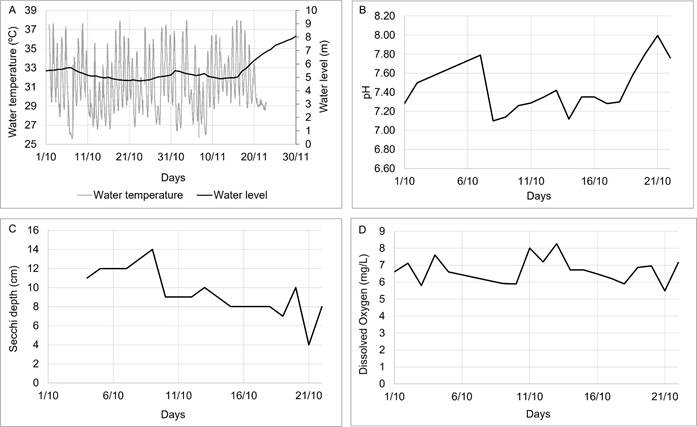
In Tefé lake, the peak flood level occurs in mid-June, and the minimum level of the dry season occurs in mid-October (Instituto de Desenvolvimento Sustentável Mamirauá, 2025). After reaching water levels within normality in June, the lake levels started to decrease sharply in September 2023, reaching a decreasing rate of around 30 cm/day. This led to the lake rapid change from a black water system into a very turbid one (Figure 1), with a Secchi depth of around 10 cm (Figure 2c). At the Mamirauá Institute’s floating station, temperatures as high as 38°C were measured (Figure 2a). Water levels started increasing considerably only by 16th November (Figure 2a). Dissolved oxygen concentrations were satisfactory, between 6 and 7 mg L-1 during most of the time (Figure 2d), as well as pH, between 7 and 8 (Figure 2b). The phosphorous concentration was up to 0.3 mg L-1 and the maximum value of nitrogen concentration was 0.37 mg L-1 (Table 1).
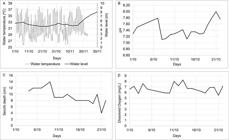
Dynamics of water parameters in Lake Tefé during the extreme 2023 drought: (A) Water level and temperature, (B) pH, (C) Secchi depth, and (D) Dissolved Oxygen.
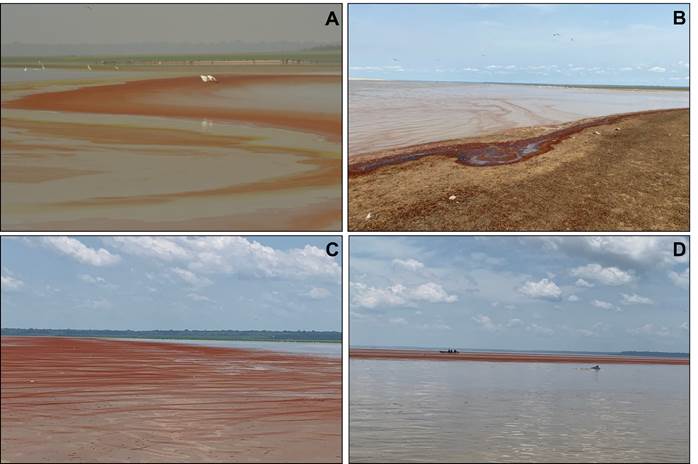
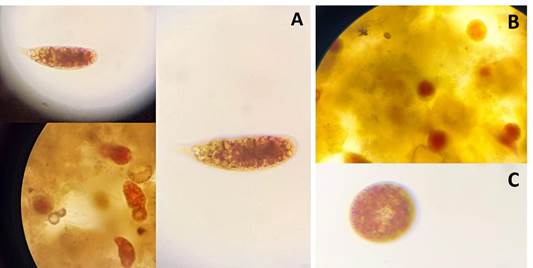
During this period of very low water levels, we observed a reddish bloom in both lakes (Figure 3). In situ observations began on October 4 and continued until the lake’s water levels rose significantly. The bloom was observed for four consecutive weeks, appearing each morning at 8:00 a.m., disappearing during the day, and reappearing the following morning. This red color was attributed to the predominance of the freshwater microalgae Euglena sanguinea Ehrenberg. The E. sanguinea cells exhibited elongated and round shapes, appearing in both green and red colors (Figure 4). In the Tefé lake, the elongated cells had an average size of 85.4 ± 10.6 µm, while the round cells had an average size of 38.1 ± 4.98 µm. In the Coari lake, the elongated cells had an average size of 64.9 ± 4.3 µm, and the round cells had an average size of 48.4 ± 5.5 µm. The density of E. sanguinea was 64,700 cells mL-1 in Tefé lake and 42,000 cells mL-1 in Coari lake. The phytoplankton community in Tefé lake comprised five classes across the four sampling sites (Table 2): Chlorophyceae (3 taxa), Cyanophyceae (3 taxa), Bacillariophyceae (4 taxa), Zygnemaphyceae (7 taxa), and Euglenophyceae (1 taxon).
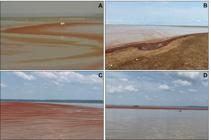
Blooms of Euglena sanguinea in Tefé lake (A and B, credit: André Zumak) and Coari lake (C and D, credit: Waleska Gravena).
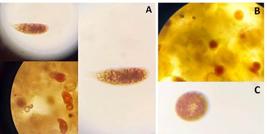
Microphotographs of Euglena sanguinea from a Tefé lake l sample. Magnification: 40 X. (A) Elongated cells of E. sanguinea. (B, C) Oval/encysted cells of E. sanguinea.
Phytoplankton composition at four sampling sites in the Tefé lake during the extreme drought of 2023.
Molecular identification of Euglena sanguinea
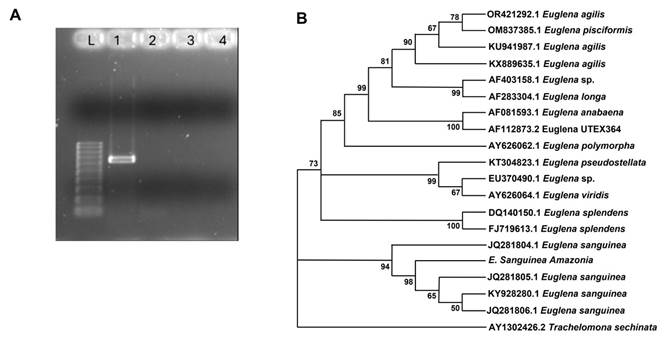
The presence of an organism that was amplified with the species-specific primer for Euglena sanguinea was detected by the molecular analysis of samples from the Tefé lake (column 1 of Figure 5a). The two next columns (2 and 3) do not show any band and represent samples from Pampulha lake (2) and from a Euglena sp. culture (3), respectively, confirming the absence of any E. sanguinea in these samples. The negative control (column 4) also does not show any band.
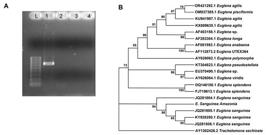
A) Agarose electrophoresis gel profile of the nSSU rDNA amplification region, using the species-specific nSSU rDNA primers for Euglena sanguinea. L - Ladder 100pb; 1 - Bloom sample from Tefé lake (Amazonas, Brazil); 2 - Environmental sample from Pampulha lake (Minas Gerais, Brazil); 3 - Culture of Euglena sp.; 4 - Negative control. B): Phylogenetic tree (maximum parsimony) based on 18S rRNA Euglena sequences. The E. sanguinea sequence found in the Tefé lake bloom is aligned with the other sequences obtained from GenBank. Trachelomonas echinata was selected as the outgroup taxon. Support bootstrap values are indicated at the nodes.
The phylogenetic tree (Figure 5b) shows that the E. sanguinea strains clustered in separated branches from other Euglena species and confirmed the presence of E. sanguinea in the bloom sample of Tefé lake. The bootstrap value of the entire E. sanguinea clade was 94%, considered a very good and robust value that confers strong support and confidence for the clade and the likelihood to represent an evolutionary relationship among strains. The E. sanguinea clade included strains from Argentina (JQ281804), Europe (JQ281806) and USA (JQ281805 and KY928280).
Toxin detection
The LCHRMS analysis indicated the presence of euglenophycin in all of the water samples collected from Tefé lake on different days. Although a standard for euglenophycin was not available, the compound was tentatively identified based on its exact mass and fragmentation pattern (Figure 6). The molecular ion was detected at m/z 306.2793 (mass error of 0.65 ppm), with major product ions detected at m/z 288.2688 (mass error of 0.69 ppm), 274.2530 (mass error of 0.36 ppm), 262.2530 (mass error of 0.38 ppm), 248.2374 (mass error of 0.40 ppm), and 246.2217 (mass error of 0.40 ppm). The product ion at m/z 288, resulting from the neutral loss of H2O (18 u), was previously reported as a predominant ion for euglenophycin extracted and purified from Euglena sanguinea cultures (Gutierrez et al. 2013). This loss was also highly favored in our analysis. The other product ions identified were observed as minor fragments and resulted from various possible neutral losses of alcohol. Specifically, the loss of CH3OH (32 u) from euglenophycin produces the product ion at m/z 274, the loss of CH2CHOH (44 u) results in the ion at m/z 262, the loss of CH3CHCHOH (58 u) gives the ion at m/z 248, and the loss of CH3CH2CH2OH (60 u) produces the ion at m/z 246.
DISCUSSION
The bloom in Tefé and Coari lakes
Euglena sanguinea belongs to the class Euglenophyceae, a group of flagellated microalgae characterized by the distinctive “cell deformation movement” known as “metaboly” or “euglenoid motion” (Leander et al. 2017). This species has the ability to develop thick-walled resistant cysts, which enhance its long-term viability and enable survival under harsh or fluctuating environmental conditions, thereby supporting its persistence within aquatic ecosystems (Hindák et al. 2000). Under favorable environmental conditions, such as temperatures above 25 °C and high solar radiation, these organisms can form blooms on the water’s surface, which may appear reddish or green (Jahn 1946). The blood-red color results from the presence of granules called hematochromes, which protect the chlorophyll in the cells when exposed to intense solar radiation (Gojdics 1939; Jahn 1946; Lee 2008). The dispersion of hematochromes throughout the cells causes them to turn red, making the bloom visible to the naked eye on the water’s surface (Wołowski et al. 2024).
During the study period the concentration of nitrogen and phosphorus in Tefé lake was within the typical levels found in blackwater lakes in the Amazon (Schmidt 1976; Rai and Hill 1981), thus not indicating eutrophication or nutrient imbalance. Therefore, it was not considered a determining factor for the bloom. Euglenas are mixotrophic organisms, capable of alternating between autotrophy (photosynthesis) and heterotrophy (absorption/ingestion of organic matter), depending on environmental conditions (Rosowski 2003). Thus, we consider plausible that this bloom occurred through the activation of heterotrophic metabolism, using available organic sources such as organic acids (e.g., acetate), amino acids, soluble polysaccharides, and vitamins resulting from the decomposition of plant and animal material, due to the reduction in water levels, which led to a high concentration of suspended sediments. Associated with that, high solar radiation, along with elevated temperatures exceeding 37 °C in Tefé lake, possibly were the triggers of hematochromes’ production. Moreover, Euglenas have positive phototaxis, causing them to move towards light to optimize energy capture for photosynthesis (Gerber and Häder 1994). The high number of these algae, their activated hematochome production and migration towards light thus led to the surface bloom.
The ability to produce temporary, reproductive, and resistant cysts contributes to the rapid development of blooms (Wołowski et al. 2024). Euglena commonly forms rounded or oval cysts with thick walls (Rosowski, 2003). Under stressful conditions, they may develop different palmelloid stages resulting from rapid cell divisions. These stages enable a reduction in metabolic activity and ensure survival during adverse periods, allowing a return to the active vegetative form once environmental conditions become favorable (Hindák et al., 2000; Wołowski et al., 2024). Overall, the observed variations in cell size among lakes (large and elongated in Tefé, small and elongated in Coari) suggest a reduction in the metabolic activity of E. sanguinea, accompanied by the onset of encystment, a strategy commonly associated with survival under adverse environmental conditions. Therefore, these morphological variations may represent adaptive strategies that favor the survival of the E. sanguinea under different environmental conditions, while simultaneously influencing its population dynamics and competitive role within Amazonian phytoplankton communities.
Molecular identification of Euglena sanguinea
With the primers selected in this study it was possible to successfully validate the identification of E. sanguinea in the environmental bloom sample of Tefé lake. The choice of an appropriate molecular marker can be instrumental in the identification of this species, since morphological identification of E. sanguinea may pose a challenge, even for experts in the field (Karnkowska-Ishikawa et al. 2013). In this study, we employed specific primers targeting the nSSU rDNA region of E. sanguinea. These primers were specifically designed and validated in the study conducted by Kulczycka et al. (2018) and were found to be highly effective for the precise molecular identification of E. sanguinea. In the literature, more than 150 species have been described for the genus Euglena (Mullner et al. 2001) and they have been grouped differently based on several criteria, mostly morphological (for example, Bourrelly 1970). However, more recent studies using the SSU rDNA gene suggested that some of these traditional classifications are not supported by molecular results (Linton et al. 2000). Therefore, phylogenetic and molecular studies using the SSU rDNA gene may be very useful to better establish taxonomic identifications in euglenoids (Müllner et al. 2001). Because of the potential toxicity of this species (Zimba et al. 2010), correct identification is especially important.
Phytoplankton blooms in a changing Amazon: perspectives and monitoring gaps
The phytoplankton community composition observed in Tefé lake during the extreme drought of 2023 showed similarities to that reported for other Amazonian lakes during dry periods (Melo et al., 2005; Raupp et al., 2009; Silva et al., 2013). In addition to E. sanguinea, potentially toxic species such as Dolichospermum sp. and Planktothrix sp. were recorded, both recognized in the literature as producers of hepatotoxins and neurotoxins (Rantala et al. 2006). However, no Cyanophyceae bloom was observed in the studied lakes, only their presence within the phytoplankton community. As blooms of Cyanophyceae species are generally associated with high nutrient concentrations, particularly nitrogen and phosphorus, the findings suggest that under extreme drought conditions the environment was more favorable to the proliferation of euglenas than cyanobacteria. This highlights that many phytoplankton species remain in the water column and may emerge under environmental stress or disturbance.
Several studies on phytoplankton blooms suggest that, when nutrients and temperatures are optimal, changes in the river’s hydrological regime become the primary factors driving blooms, with cumulative and long-term effects (Cheng et al. 2019; Xia et al. 2019). In the current context, where river water level variations are being strongly impacted by climate change, we may observe either adaptation of the current phytoplankton community, composed of species that are not harmful to other food chain levels, or negative changes, such as proliferations of toxic aquatic microalgae characterized as harmful algal blooms (HABs) - may become more common. HABs have become a global problem due to increasing nutrient levels, global climate change, and the introduction of invasive species, which can harm other links in the food chain (Reid et al. 2024).
Harmful algal blooms have been reported worldwide, with impacts on health, ecosystems, and economies (Anderson et al., 2021; Karlson et al., 2021; McKenzie et al., 2021). In the Amazon, such events in natural freshwater systems are becoming more frequent and may pose significant socioeconomic risks for local food security, underscoring the need for continuous phytoplankton monitoring. Such a monitoring program would allow the identification of potentially harmful species, such as those that produce toxins. Moreover, it is essential to invest in remote sensing techniques specifically adapted to the white- and black-water systems of the Amazon, as these approaches enable the monitoring of large areas in less time than traditional field sampling and laboratory analyses and are already well established in oceanic aquatic ecosystems (Wang et al., 2024). Monitoring enables: (i) rapid decision-making by allowing early detection of blooms and the issuance of alerts before they reach dangerous levels; and (ii) the prevention of risks to human health, given that not only E. sanguinea but also Cyanophyceae species produce toxins, and that during the dry season the local population depends directly on lake water for consumption.
CONCLUSIONS
This study reports, for the first time, the occurrence of Euglena sanguinea blooms in Tefé and Coari lakes during an extreme drought in the Amazon. Elevated temperatures, combined with intense solar radiation and sediment resuspension, were likely the primary factors that triggered this event. The detection of euglenophycin represents a warning for aquatic organisms and potentially for public health, given the toxic nature of this substance. These findings suggest that warming and extreme events associated with climate change may enhance the likelihood of bloom occurrences in Amazonian aquatic environments.
ACKNOWLEDGEMENTS
ASF and the Mamirauá Institute’s Geosciences Research Group were funded by Fundação de Amparo à Pesquisa do Estado do Amazonas (FAPEAM), Secretaria de Estado de Desenvolvimento Econômico, Ciência, Tecnologia e Inovação (SEDECTI) and the Governo do Estado do Amazonas - EDITAL N.º 006/2022 (Project “Climate change and water resources in the Solimões floodplains”), Gordon and Betty Moore Foundation (Advancing the understanding of methane emissions from tropical wetlands), National Science Foundation (CNH2-L project), Conselho Nacional de Desenvolvimento Científico e Tecnológico (CNPq) PCI Program, and Fundo Nacional de Desenvolvimento Científico e Tecnológico (FNDCT). Melack, Zhou and MacIntyre received support from the US National Science Foundation (Division of Environmental Biology, grant number 1753856). We would like to thank the Central Analítica do Centro de Apoio Multiusuário (CAM) of the Universidade Federal do Amazonas (UFAM), represented by Dr. Felipe Moura Araújo da Silva, who performed the preliminary analyses for the identification of the toxin. We would also like to thank the Centro Multiusuário para Análise de Fenômenos Biomédicos (CMABio) of the Universidade Estadual do Amazonas (UEA), represented by Dr. Hector Henrique Ferreira Koolen, who performed the confirmatory analyses for the identification of the toxin. We also thank WWF-Brasil for providing the water temperature HOBO sensors used during the dolphin Unusual Mortality Event.
REFERENCES
- Albert, J.S.; Carnaval, A.C.; Flantua, S.G.A.; Lohmann, L.G.; Ribas, C.C.; Riff, D. et al 2023. Human impacts outpace natural processes in the Amazon. Science 80: 379.
- Anderson, D.M.; Fachon, E.; Pickart, R.S.; Lin, P.; Fischer, A.D.; Richle, L. et al 2021. Evidence for massive and recurrent toxic blooms of Alexandrium catenella in the Alaskan Arctic. Arctic Institute of North America 118: e2107387118.
- Bicudo, C.E.M.; Menezes, M. 2006. Gêneros de Águas Continentais do Brasil - chave de identificação e descrições, 2ª ed. São Carlos: Rima Editora. 502 p.
- Bourrelly, P. 1970. Les Algues d’Eau Douce. Troisiéme partie - Euglénophytes 3º ed. Nouvelle Édition Boubée & Cie, Paris. 512p.
- Cheng, B.; Xia, R.; Zhang, Y.; Yang, Z.; Hu, S.; Guo, F. et al 2019. Characterization and causes analysis for algae blooms in large river systems. Sustainably Cities and Society, 51: 101707.
- Dokulil, M.T.; Teubner, K. 2011. Eutrophication and climate change: Present situation and future scenarios. In: Ansari, A.A., Gill, S.S., Lanza, G.R., Rast, W. (Eds.), Eutrophication: Causes, Consequences and Control Springer Science+Business Media B.V., New York, p.1-16.
- Edgar, R.C. 2004. MUSCLE: multiple sequence alignment with high accuracy and high throughput. Nucleic Acids Research 32: 1792-1797.
- Espinoza, J.-C.; Marengo, J.A.; Schongart, J.; Jimenez, J.C. 2021. The new historical flood of 2021 in the Amazon River compared to major floods of the 21st century: Atmospheric features in the context of the intensification of floods. Weather Climate Extremes 35: 100406.
- Espinoza, J.-C.; Jimenez, J.C.; Marengo, J.A.; Schongart, J.; Ronchail, J.; Lavado-Casimiro, W. et al 2024. The new record of drought and warmth in the Amazon in 2024 related to regional and global climatic features. Scientific. Report 14: 8107
- Falk, J.; Gleick, P.H.; Asayama, S.; Attig-Bahar, F.; Behera, S.; Braum, J.V. et al 2024. Critical hydrologic impacts from climate change: addressing an urgent global need. Sustainability Science, 19: 241-244.
- Fleischmann, A.S.; Papa, F.; Hamilton, S.k.; Fassoni-Andrade, A.; Wongchuig, S.; Espinoza, J.-C. et al, 2023. Increased floodplain inundation in the Amazon since 1980. Environmental. Research Letters 18: 034024.
- Fonseca, J.R.; Vieira, P.C.S.; KujBida, P.; Costa, I.A.S. 2015. Cyanobacterial occurrence and detection of microcystins and saxitoxins in reservoirs of the Brazilian semiarid. Acta Limnologica Brasiliensia 27: 78-92.
- Gerber, S.; Häder, D.-P. 1994. Effects of enhanced UV-B irradiation on the red coloured freshwater flagellate Euglena sanguinea FEMS Microbiology Ecology 13: 177-184.
- Gojdics, M. 1939. Some observation on Euglena sanguinea Ehrb. Transactions of the American Microscroscopical Society 58: 241-248.
- Gutierrez, D.B.; Rafalski, A.; Beauchesne, K.; Moeller, P.D.; Triemer, R.E.; Zimba, P.V. 2013. Quantitative mass spectrometric analysis and post-extraction stability assessment of the euglenoid toxin euglenophycin. Toxins 5: 1587-1596.
- Hindák, F.; Wołowski, K.; Hindakova, A. 2000. Cysts and their formation in some neustonic Euglena species. Annales Limnologie 36: 83-93.
- Igwaran, A.; Kayode, A.J.; Moloantoa, K.M.; Khetsha, Z.P.; Unuofin, J.O. 2024. Cyanobacteria Harmful Algae Blooms: Causes, Impacts, and Risk Management. Water Air Soil Pollution 235: 71.
-
IDSM. 2025. Instituto de Desenvolvimento Sustentável Mamirauá. Informações sobre o monitoramento do clima e dos recursos hídricos. ( (https://www.mamiraua.org.br/fluviometrico-na-reserva ). Acessado em 16 de setembro de 2025.
» https://www.mamiraua.org.br/fluviometrico-na-reserva - IPCC, 2023. Sections. In: Climate Change 2023: Synthesis Report. Contribution of Working Groups I, II and III to the Sixth Assessment Report of the Intergovernmental Panel on Climate Change [Core Writing Team; Lee, H.; Romero, J. (eds.)]. IPCC, Geneva, Switzerland, p. 35-115.
- Irion, G.; Mello, J.A.S.N.; Morais, J.; Piedade, M.T.F.; Junk, W.J.; Garming, L. 2010. Development of the Amazon valley during the middle to late quaternary: sedimentological and climatological observations. In: Junk, W., et al (Eds.), Amazonian Floodplain Forests Springer Science+Business Media B.V. p. 1-23.
- Jahn, T.L. 1946. The euglenoid flagellates. Quartely Review Biology 21: 246-274.
- Karlson, B.; Andersen, P.; Arneborg, L.; Cembella, A.; Eikrem, W.; John, U. et al 2021. Harmful algal blooms and their effects in coastal seas of Northern Europe. Harmful Algae 102:101989.
- Karnkowska-Ishikawa, A.; Milanowski, R.; Triemer, R.E.; Zakryś, B. 2013. A redescription of morphologically similar species from the genus Euglena: E. laciniata, E. sanguinea, E. sociabilis, and E. splendens Journal of Phycology 49: 616-626.
- Kulczycka, A.; Łukomska-Kowalczyk, M.; Zakryś, B.; Milanowski, R. 2018. PCR identification of toxic euglenid species Euglena sanguinea Journal of Applied Phycology 30: 1759-1763.
- Lapola, D.M.; Pinho, P.; Barlow, J.; Aragão, L.E.O.C.; Berenguer, E.; Carmenta, R. et al 2023. The drivers and impacts of Amazon forest degradation. Science 379: eabp8622.
- Latrubesse, E. 2012. Amazon Lakes. In: Bengtsson, L.; Herschy, R.; Fairbridge, R. (Eds). Lakes and Reservoirs Springer Verlag, Austin, USA. p.13-26.
- Leander, B.S.; Lax, G.; Karnkowska, A.; Simpson, A.G.B. 2017. Euglenida. In: Archibald, J.M.; Simpson, A.G.B.; Slamovits, C.H. (Ed.). Handbook of the Protists Springer International Publishing, Cham, Switzerland. p. 1-32.
- Lee, R.E. 2008. Phycology, 4th ed. Cambridge University Press, Cambridge. 547 p.
- Li, N.; Zhang, Y.; Zhang, Y.; Shi, K.; Qian, H.; Yang, H. et al 2022. The unprecedented 2022 extreme summer heatwaves increased harmful cyanobacteria blooms. Science of the Total Environment 896: 165312.
- Linton, E.W.; Nudelman, M.A.; Conforti, V.; Triemer, R.E. 2000. A molecular analysis of the Euglenophytes using SSU rDNA. Journal Phycology 36: 740-746.
- Marengo, J.A.; Espinoza, J.C. 2016. Extreme seasonal droughts and floods in Amazonia: causes, trends and impacts. International Journal Climatology 36: 1033-1050.
- Marmontel, M.; Fleischmann, A.; Val, A.; Forsberg, B. 2024. Safeguard Amazon’s aquatic fauna against climate change. Nature 625: 450-450.
- McKenzie, C.H. 2021. Three decades of Canadian marine harmful algal events: Phytoplankton and phycotoxins of concern to human and ecosystem health. Harmful Algae 102:101852.
- Melo, S.; Rebelo, S.R.M.; Souza, K.F.; Menezes, M.; Torgan, L.C. 2005. Fitoplâncton. In: Santos-Silva, E.N.; Aprile, F.M.; Scudeller, V.V.; Melo, S. (Eds.), Biotupé: Meio Físico, Diversidade Biológica e Sociocultural do Baixo Rio Negro, Amazônia Central Editora INPA, Manaus. 246 p.
- Müllner, A.N.; Angeler, D.G.; Samuel, R.; Linton, E.W.; Triemer, R.E. 2001. Phylogenetic analysis of phagotrophic, phototrophic and osmotrophic euglenoids by using the nuclear 18S rDNA sequence. International Journal Systematic Evolutionary Microbiology 51: 783-791.
- Pinheiro, M.M.L. et al 2023. First monitoring of cyanobacteria and cyanotoxins in freshwater from fish farms in Rondonia state, Brazil. Heliyon 9: 218518.
- Rai, H.; Hill, G. 1981. Physical and chemical studies of Lago Tupé, a central Amazonian blackwater “Ria Lake”. Hidrobiology Hydrography 66: 37-82.
- Rantala, A.; Rajaniemi-Wacklin, P.; Lyra, C.; Lepistö, L.; Rintala, J.; Mankiewicz-Boczek, J. et al 2006. Detection of microcystin-producing cyanobacteria in finnish lakes with genus-specific microcystin synthetase gene E (mcyE) PCR and associations with environmental factors. Applied and Environmental Microbiology 72: 6101 - 6110.
- Raupp, S.V.; Torgan, L.; Melo, S. 2009. Planktonic diatom composition and abundance in the Amazonian floodplain Cutiuaú Lake are driven by the flood pulse. Acta Limnologica Brasiliensia 21: 227-234.
- Reid, N.; Reyne, M.I.; O’Neill, W.; Greer, B.; Burdekin, O.; McGrath, J.W.; Elliott, C.T. 2024. Unprecedented harmful algal bloom in the UK and Ireland’s largest lake associated with gastrointestinal bacteria, microcystins and anabaenopeptins presenting an environmental and public health risk. Environmental International 190: 108934.
- Rosowski, J.R. 2003. Photosynthetic euglenoids. In: Wehr, J.D.; Sheath, R.G. (Eds.), Freshwater Algae of North America: Ecology and Classification Academic Press, San Diego. p. 383-422.
- Sá, L.L.C.; Vieira, J.M.S.; Mendes, R.A.; Pinheiro, S.C.C.; Vale, E.R.; Alves, F.A.S. et al 2010. Occurrence of toxic cyanobacterial bloom in the left margin of the Tapajós river, in the Municipality of Santarém (Pará State, Brazil). Revista Pan-Amazonica de Saúde 1: 159-166.
- Schmidt, G.W. 1976. Primary production of phytoplankton in three types of Amazonian waters. IV. On the primary productivity of phytoplankton in a Bay of the lower Rio Negro (Amazonas, Brazil). Amazoniana 5: 517-528.
- Silva, I.G.; Moura, A.N.; Dantas, E.W. 2013. Phytoplankton community of Reis Lake in the Brazilian Amazon. Anais Academia Brasileira Ciência 85: 649-663.
- Silva, S.S. et al 2023. Amazon climate extremes: Increasing droughts and floods in Brazil’s state of Acre. Perspective Ecology Conservation 21: 311-317.
- Terassi, P.M.B.; Galvani, E.; Gobo, J.P.A; Oscar Jr, A.C.; Silva, W.L.; Sobral, B.S. et al 2024. Exploring climate extremes in Brazil’s Legal Amazon. Stochastic Environmental Research Risk Assessment 38: 1403-1422.
- Wang, X.; Shi, K.; Zhang, Y.; Qin, B.; Zhang, Y.; Wang, W. et al. 2023. Climate change drives rapid warming andincreasing heatwaves of lakes. Science Bulletin, 68: 1574 - 1584.
- Wang, Y.; Xu, C.; Lin, Q.; Xiao, W.; Huang, B.; Lu, W.; Chen, N.; Chen, J. 2024. Modeling of algal blooms: Advances, applications and prospects. Ocean Coastal Management 255: 107250.
- Wołowski, K.; Duangjan, K.; Dempster, T.; Tsarenko, P.; Poniewozik, M.; Koreiviene, L. 2024. Color range of euglenoid (Euglenophyceae) blooms. Plant Fungal System 69: 99-108.
- Xia, R.; Zhang, Y.; Wang, G.; Zhang, Y.; Dou, M.; Hou, X. et al 2019. Multi-factor identification and modelling analyses for managing large river algal blooms. Environmental Pollution 254: 113056.
- Zimba, P.V.; Moeller, P.D.; Beauchesne, K.; Lane, H.E; Triemer, R.E. 2010. Identification of euglenophycin-a toxin found in certain euglenoids. Toxicon 55: 100-104.
- Zimba, P.V.; Huang, I.S.; Gutierrez, D.; Shin, W.; Bennett, M.S.; Triemer, R.E. 2017. Euglenophycin is produced in at least six species of euglenoid algae and six of seven strains of Euglena sanguinea Harmful Algae 63: 79-84.
Data availability
All data supporting the results of this study are included in the article.
Edited by
-
ASSOCIATE EDITOR:
Flávia Costa https://orcid.org/0000-0002-9600-4625