
 Miconia kallei (Miconieae, Melastomataceae), a new Amazonian species with longitudinal anther dehiscence
ABSTRACT
Miconia kallei has been collected twice, in the Brazilian states of Amazonas and Rondônia. The most prominent character in this species is the longitudinal anther dehiscence, which also appears in 14 other species in Brazil. It differs from these other species by the leaves that are sessile or with very small petioles up to 3 mm, with a cordate base, and stellate-stipitate or dendritic trichomes on the abaxial surface, inflorescences with accessory branches, the truncate calyx with a 0.6-0.8 mm long tube and the adaxial surface covered with tiny glandular projections, and the stamens with the connective prolonged below the thecae, bearing complex appendages, and the dehiscence area comprising 100% of the thecae length. The small number of collections is insufficient to suggest an extinction risk assessment but for “data deficient”.
KEYWORDS:
Chaenanthera
; Taxonomy; Scanning electron microscopy; Anther morphology; Neotropical flora
RESUMO
Miconia kallei foi coletada duas vezes, nos estados brasileiros do Amazonas e Rondônia. O caráter mais proeminente desta espécie é a deiscência longitudinal das anteras, característica que também ocorre em outras 14 espécies no Brasil. Ela difere dessas outras espécies pelas folhas sésseis ou com pecíolos muito pequenos, de até 3 mm, com base cordada e tricomas estrelado-estipitados ou dendríticos na superfície abaxial; inflorescências com ramos acessórios; cálice truncado com tubo de 0,6-0,8 mm de comprimento e superfície adaxial coberta por pequenas projeções glandulares; estames com o conectivo prolongado abaixo das tecas, portando apêndices complexos e a área de deiscência correspondendo a 100% do comprimento das tecas. O pequeno número de coletas é insuficiente para propor uma avaliação de risco de extinção diferente de “dados deficientes”.
PALAVRAS-CHAVE:
Chaenanthera
; Taxonomia; Microscopia eletrônica de varredura; Morfologia das anteras; Flora neotropical
INTRODUCTION
According to its recently proposed re-circumscription (see Michelangeli et al. 2022a), Miconia Ruiz and Pav. is the biggest genus in Melastomataceae, with about 1901 species restricted to the Neotropics (Ulloa Ulloa et al. 2022). It is also the richest genus among Brazilian angiosperms, with 566 species (Goldenberg et al. 2025a), and the richest genus in Amazonia as a whole, with about 240 species (Cardoso et al. 2017).
Since we still lack a comprehensive infrageneric classification for the genus, we still use Miconia’s traditional sections (Cogniaux 1888, 1891) as a proxy for determination purposes. The species described here fits the traditional (but not the modern) circumscription of Miconia sect. Chaenanthera Naudin (as Miconia sect. Hypoxanthus DC. in Goldenberg 2000), due to its “rimose” anthers. This small group with 16 species (Goldenberg 2000) is actually polyphyletic (Goldenberg et al. 2018), since the “rimose” anthers evolved more than once in the genus. Most species in the family have poricidal anthers, which are related to nectarless flowers that are buzz pollinated by bees (Renner 1989), despite exceptions (Dellinger et al. 2019). In all species in traditionally circumscribed and polyphyletic Miconia sect. Chaenanthera, the anthers dehisce through longitudinal openings that do not differ, from a structural point of view, from all poricidal species: the dehiscence mechanism is exactly the same, but the shape of the opening is long and ventrally inclined (Goldenberg et al. 2003; Cortez et al. 2014; Judd et al. 2022). This small difference in the dehiscence of the anthers apparently allowed a significant change in the pollination, from “specialized” buzz pollination by bees to less specialized pollination by a broad spectrum of insect groups (including buzzing bees) that are not required to vibrate the anthers in order to remove the pollen from the anthers (Goldenberg et al. 2008; Kriebel and Zumbado 2014; Brito et al. 2016).
Considering that the anthers longitudinal dehiscence is so uncommon, since it occurs in only 14 species out of the 556 in Miconia “sensu latu” in Brazil, the recognition of the species presenting this character is quite uncomplicated. Motivated by the discovery of an undescribed species of Miconia that fits within this group, we present, apart from the description itself, a table comparing the species of Miconia with stamens dehiscing through longitudinal openings in Brazil.
MATERIALS AND METHODS
The description of the species is based on specimens deposited in the herbaria INPA, UPCB, and US, which were seen in loco. Additional specimens in HSL, SP, and TUR were checked through images (all acronyms following Thiers, continuously updated). Additional isotypes will be sent to NY and RB.
We understand that a species consists of one or several metapopulations that represent a separately evolving lineage (De Queiroz 2007). The recognition of a new species, according to this concept, may follow operational criteria; due to the limited information that we have about the lineage described here, the main lines of evidence based on which we recognize M. kallei are morphological cohesion (and discontinuity when compared to the other morphologically similar species) and geographical coherence.
The description was built following recent publications of new species in Miconia (Goldenberg et al. 2020, 2023; Michelangeli and Goldenberg 2018, 2020). Morphological definitions and terms follow Judd et al. (2022), while the morphology of trichomes follows Wurdack (1986). Comparisons between the species described here and the morphologically close ones, as presented in Table 1, were based on Goldenberg (2000, 2004, 2009), Bacci and Goldenberg (2015), Bacci et al. (2016), and Goldenberg et al. (2025b), and also on the analysis of specimens at BR, C, COL, F, G, H, INPA, K, L, MBM, MG, MO, NY, R, RB, S, SP, U, UEC, UPCB (all acronyms following Thiers, continuously updated).
Comparative features among Miconia kallei and its morphological relatives, i.e., species with anthers dehiscing through longitudinal openings. PL: petiole length; TAbL: types of trichomes on the abaxial surface of the leaf; LD: leaf pocket domatia (i.e., the bases of the main veins joined by a membrane) on the abaxial surface of the leaf; LB: Leaf base; IAdB: Inflorescences with additional lateral branches; IAcB: Inflorescence nodes with accessory branches; CL: calyx lobes, if definite (+) or absent (-), i.e., the calyx a truncate tube without definite lobes; CA: Connective appendages, whether present (+) or absent (-); C/T (%): proportion between the stamen connective length and thecae length; D/T (%): proportion between the stamen dehiscence length and thecae length.
For scanning electron microscopy (SEM) analyses, samples of leaves and flowers of dried specimens were rehydrated in water, dehydrated in an ethanol series, critically point dried, mounted on aluminum stubs, coated with gold, and photographed using a Mira3 Tescan scanning electron microscope. The occurrence map was prepared using QGIS software version 3.44.2-Solothurn (QGIS Development Team 2025). A preliminary conservation assessment was proposed according to the IUCN Red List Categories and Criteria (IUCN 2024). The Extent of Occurrence (EOO) and Area of Occupancy (AOO) from the known collection points were calculated based on the GeoCAT tool (Bachman et al. 2011).
RESULTS
Miconia kallei R.Goldenb. & Ferreira-Alves, sp. nov. (Figures 1-4)

Images from the holotype and paratypes of Miconia kallei. A. Fertile branch. B. Leaf apex. C. Leaf base. D. Inflorescence. E. Detail of an inflorescence branch. F. Detail of the inflorescence unit. A-C from Nee 34847 (UPCB); D-F from Ruokolainen et al. 17167 (UPCB).
Type: BRAZIL. Amazonas: Lábrea. Old growth terra-firme forest on a flat terrain of loamy soil; tree, height 9 m, DBH 6 cm; stem cross-section +/- round; petals white. 7º28’S, 64º35’W. Elev. 65-85m. Fl. buds. 26 May 2016, K. Ruokolainen, G. Moulatlet & K.S. Gonçalves 17617 (Holotype UPCB 0092314!; Isotype TUR).
Diagnosis: Miconia kallei differs from M. dolichorrhyncha Naudin by the leaves that are sessile or with very small petioles up to 3 mm (vs. with distinct petioles 8-25 mm long), with a cordate base (vs. rounded, obtuse, acute or abruptly and shortly attenuate), inflorescences always terminal (vs. terminal plus additional lateral branches on the axils of the second pair of leaves), and the calyx with a longer, 0.6-0.8 mm long tube (vs. 0.15-0.3 mm), the adaxial surface covered with tiny glandular projections (vs. calyx glabrous), and the stamens with complex connective appendages (vs. connectives unappendaged or only with a dorsal spur or only with two ventral lobes, in both cases distinctly smaller than in M. kallei).
Description: Tree, 9-13 m tall. Branches terete, densely covered with stipitate-stellate trichomes 0.5-1 mm long, with arms 0.2-0.5 mm long. Leaves opposite, slightly anisophyllous in each pair; sessile or with a very short petiole up to 3 mm long (Figure 1a); blade (7-)10-20 × (4-)5-9 cm, elliptic to broadly elliptic, apex acuminate or shortly and abruptly caudate (Figure 1b), base cordate (Figure 1c), margin entire and ciliate with stipitate-stellate trichomes similar to the ones on the adaxial surface, concolorous, green on both surfaces but darker on the adaxial surface (in dry specimens), sub-chartaceous, nerves 3 + 2, acrodromous, basal, adaxial surface sparse to moderately covered with stipitate-stellate trichomes 0.2-0.7 mm long, arms 0.2-0.5 mm long, abaxial surface moderately covered with stipitate-stellate trichomes 0.2-1.5 mm long, its arms 0.2-0.6 mm long, these denser on the nerves, both surfaces with very sparse glandular projections ca. 0.05 mm long (Figures 3a-e). Inflorescences terminal panicles (Figure 1a), 13-17 × 7.5-13 cm, each node with one or two pairs of accessory branches, these seldom lacking (Figure 1d), distal branching dichasial (not secund nor glomerulate; Figures 1e, 1f), the branches densely covered with sessile stellate or stipitate-stellate trichomes 0.1-0.3(-0.7), arms 0.09-0.3; bracts ca. 8.5 × 3-3.5 mm, oblong, apex rounded, both surfaces glabrous, early caducous; bracteoles 2, ca. 1 mm long, narrowly triangular, apex subulate, early caducous. Flowers sessile or pedicellate, pedicels up to 0.2 mm long (Figures 2a, b), 5-merous. Hypanthium 1.5-2 × 1.5-1.8 mm, green, terete, sparsely covered with sessile stellate or very short stellate-stipitate trichomes, arms 0.05-0.1 mm long (Figure 2c). Calyx persistent, truncate (i.e., lacking distinct lobes or sepals), lacking external projections. tube 0.6-0.8 mm long (Figures 2c, d), adaxial surface covered with the same trichomes as the hypanthium, often denser at the apex and its margins, adaxial surface covered with glandular projections 0.02-0.05 mm long (Figure 3g). Petals 2.6-2.9 × 0.9-1.4 mm, white, oblong or oblanceolate, apex rounded, margin entire (Figure 2d), papillose, both surfaces densely papillose (Figure 3f). Stamens 10, white, dimorphic, glabrous; antesepalous with filaments ca. 1.3-1.5 mm long, thecae ca. 1-1.5 mm long, oblong, dehiscent through a longitudinal opening comprising the whole length of the thecae, connective prolonged ca. 0.5-0.7 mm long below the thecae (50-60% of the thecae length), with a skirt-like, continuous appendage dorso-basally projected 0.5-0.6 mm from the filament insertion, and ventrally projected into 0.3-0.4 mm long lobes, the margins irregularly ornamented (Figures 2f, g), antepetalous with filaments 0.8-1 mm long, thecae ca. 0.8-1 mm long, oblong, dehiscent through a longitudinal opening comprising the whole length of the thecae, connective prolonged 0.5-0.7 mm long below the thecae, with a distinct dorso-basal spur 0.2-0.3 mm long and lateral hemicircular lobes with a 0.15-0.2 mm radius, the margins irregularly ornamented (Figure 2e). Ovary ca. 1.4 × 1 mm, 3-celled, 1/2-2/3 inferior, the apex papillose and very sparse trichomes less than 0.1 mm long; style ca. 2.5 mm long, filiform, with minute glandular trichomes at the base ca. 0.05 mm long and a few unbranched trichomes ca. 0.1 mm long; stigma ca. 0.4 mm diam, punctiform (Figure 2d). Fruits not seen. Seeds not seen.

Inflorescence and flower details of Miconia kallei. A. Inflorescence unit with five flower buds. B. Inflorescence unit with nine flower buds. C. Flower bud, lateral view. D. Flower bud, longitudinal section. E. Antepetalous stamen, lateral view (L) and ventral/lateral view (R). F. Antesepalous stamen, ventral/lateral view (L) and lateral/dorsal view (R). G. Antesepalous stamen, dorsal view (L) and ventral view (R). All from Ruokolainen et al. 17167 (UPCB). Illustration by Diana Carneiro.

Scanning Electron Microscope images of the leaf, calyx and petal surfaces, and flowers of Miconia kallei. A. Leaf, abaxial surface. B. Lead midvein, abaxial surface. C. Leaf abaxial surface, stellate-stipitate trichome. D. Leaf abaxial surface, glandular projection. E. Leaf margin and adaxial surface. F. Flower, longitudinal section, detail with the petal margin and its adaxial surface. G. Flower, longitudinal section, with petals and stamens removed, showing the adaxial surface of the calyx and hypanthium, and a detail of calyx adaxial surface. All from Ruokolainen et al. 17167 (UPCB). Scale bars: A = 1 mm; B, C = 500 µm; D = 20 µm; E, F = 1 mm; Zoomed-in areas in F = 50 µm; G = 500 µm; Zoomed-in areas in G = 50 µm.
Additional specimens examined: BRAZIL. Rondônia: Porto Velho, along hwy. BR 364, 16km, ENE of junction with hwy. BR 325, 19km. (by air) ESSE of Abuna. Medium tall tropical evergreen forest, flat, the soil clay-silt; with Phenakospermum guyanense, Scheelea, Orbignya phalerata;small tree 13m tall, 12cm in diam.; bark tight, finely fissured; inner bark dark brown; wood brown, medium hard; buds white. 9º44’S, 65º11’W. Elev. 140m. 15 April 1987, M. Nee 34847 [HFSL 924 (now RON), INPA 180918!, SP 004712, UPCB 0020653!, UPCB 0049153!, US 01917179!].
Distribution and habitat: Miconia kallei has been collected twice, in the Brazilian states of Amazonas and Rondônia (Figure 4), the two localities about 260 km apart in a straight line. Both plants were collected in mature terra-firme rainforest on flat terrain and loamy soil (silt and clay, and high organic matter). This species is likely present in Bolivia, as Nee 34847 was found about 15 km from the Brazil-Bolivia border.
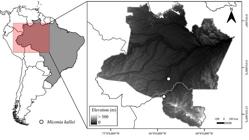
Map with the distribution of Miconia kallei in the states of Amazonas and Rondônia, in Brazil.
Phenology: Collected with flower buds in April, and pre-anthesis flower buds in May.
Etymology: The species honors Dr. Kalle Ruokolainen, botanist and ecologist from Finland. Kalle’s knowledge about Amazonian melastomes makes him one of the best species determiners of these plants, which is not an easy task. This knowledge comes from a vast field experience in the whole of Amazonia, which resulted in a considerable list of publications on distribution and ecology of Melastomataceae (Ruokolainen et al. 1997, 2007, 2022; Tuomisto and Ruokolainen 1994; Tuomisto et al. 2002, among others)
Preliminary IUCN conservation assessment: Miconia kallei is known from only two collections, resulting in a calculated Area of Occupancy (AOO) of 8 km². Despite the low AOO, which would place the species in a threatened category, we suggest it as Data Deficient (DD). In the vast and botanically underexplored Amazon region, it is often uncertain whether a species is genuinely rare or simply under-collected. Additional populations may exist in remote areas of Brazil or even in adjacent countries with similar habitats, such as Bolivia. For a conclusive analysis, additional information on its distribution, specific threats, and population size are required.
DISCUSSION
Miconia kallei is morphologically similar to M. dolichorrhyncha (incl. M. solmsii Cogn., M. stellipilis Cogn., M. pilgeriana Ule, M. buntingii Wurdack; all synonyms according to Goldenberg 2000 and Goldenberg et al. 2013). Both have young branches and inflorescence axes with dendritic or stellate-stipitate trichomes (albeit usually shorter in the latter); inflorescences with 1-2(-3) pairs of accessory branches in each node; stamens with the connective prolonged below the anthers (50-60% of the thecae length in the former, 50-100% in the latter, which is considerable for Miconia standards) and anthers with a longitudinal dehiscence comprising 50-100% of the thecae length. Miconia kallei differs from M. dolichorrhyncha by the characters listed in the diagnosis. According to the tree presented by Michelangeli et al. (2022b), Miconia dolichorrhnycha apparently belongs to clade “Miconia IV”, as defined by Goldenberg et al. (2008), but we cannot be certain that M. kallei also fits there.
While Ruokolainen 17617 was originally distributed as Miconia barbinervis (Benth.) Triana, Nee 34847 was also determined with the same name in the herbarium SP. Miconia barbinervis has indeed a similar indument with long dendritic or stellate-stipitate trichomes, and broad leaves sometimes with short petioles and obtuse to subcordate bases. Nevertheless, it differs from M. kallei by the inflorescences without accessory branches, much larger flowers and a calyx with distinct sepals and also external projections, both absent in the latter.
The distinction between M. kallei and the other species occurring in Brazil that have anthers dehiscing through longitudinal openings is presented in Table 1. Among these species, only the leaves of M. elaeodendron (DC.) Naudin and M. valentinensis Bacci & R.Goldenb. are also consistently sessile or provided with very short petioles up to 3 mm long; the other species have leaves with distinctly longer petioles, but for M. tentaculifera Naudin and M. trianae Cogn., which may show short petioles down to 3 mm. However, these occur in some small leaves that are always mixed in the same plant with bigger leaves bearing longer petioles. As for the indumentum on the leaf blades, only M. dolichorrhyncha and M. urophylla DC. also have stellate-stipitate or long dendritic trichomes on the abaxial surface of the leaf, while all others either have glabrous surfaces or these covered with simple (unbranched), stellate, lepidote, arachnoid or short-dendritic trichomes (the last one only in M. valentinensis, fide Bacci and Goldenberg 2015). A few species differ from M. kallei by the pocket domatia (i.e., the bases of the main veins joined by a membrane) on the abaxial surface of the leaf, as in M. elaeodendron, M. picinguabensis R.Goldenb. & A.B.Martins, M. rimalis Naudin, M. sellowiana (DC.) Naudin, M. tentaculifera, M. trianae and M. valentinensis, and also in most specimens of M. pusilliflora (DC.) Naudin and M. urophylla. In this group, cordate leaf bases occur only in M. kallei and M. valentinensis, while all other species have either acute, rounded, obtuse, attenuate, or decurrent bases. Inflorescence features also help distinguish M. kallei from the others: M. dolichorrhyncha, M. latecrenata (DC.) Naudin, and sometimes M. elaeodentron have additional lateral branches on the second pair of leaves, apart from the terminal inflorescence, while M. chrysophylla (Rich.) Urb., M. elaeodendron, M. hypoleuca (Benth.) Triana, M. picinguabensis, M. pusilliflora, M. regelli Cogn., M. sellowiana, and M. tentaculifera do not have accessory branches at each node. Truncate calyx tubes, lacking definite lobes such as the ones in M. kallei, occur only in M. picinguabensis, M. regelii and sometimes in M. dolichorrhyncha, where sometimes tiny lobes can be seen (Goldenberg et al. 2000). Connective appendages are a bit difficult to track, since some species where connectives are mostly unappendaged may have very small projections (Goldenberg 2000); nevertheless, distinct and complex appendages such as the ones in M. kallei are absent from the other species that were listed here. Still regarding the stamen connectives, the robust projection below the tecae, i.e, at least half or longer than the total thecae length, is absent in several species, such as M. elaeodendron, M. picinguabensis, M. pusilliflora, M. regelii, M. rimalis, M. sellowiana, and M. tentaculifera. This last character motivated Goldenberg (2000) to divide the polyphyletic section Chaenanthera (as proposed by Cogniaux 1891) in two groups, from which at least one of them is consistent: all species listed by Goldenberg (2000) as belonging to his “Miconia pusilliflora group”, except M. regelii, have short connective projections and belong to the actual monophyletic section Chaenantera (Goldenberg et al. 2018), along with other species that have small, apical pores (not longitudinal openings). On the other hand, none of the remaining species, i.e., the ones with robust connective projections below the thecae, such as the ones found in M. kallei, belong to the actual Miconia sect. Chaenanthera.
As for the character that has been repeatedly mentioned here - the relative length of the longitudinal dehiscence - it varies a lot. Despite being always distinctly ventral, it may be quite short, being as short as 30 % of the thecae length in M. regelii and M. sellowiana up to 100% of the thecae length, as in M. kallei, M. hypoleuca, M. pusilliflora, M. rimalis, and M. tentaculifera. As already explained, the longitudinal dehiscence in Miconia seems to be homoplastic (Judd et al. 2022) and the relative length of the openings apparently follows the same pattern (Goldenberg 2000; Goldenberg et al. 2018).
The paratype Nee 34847 was annotated by John J. Wurdack in US as “not matched at US, flowers at anthesis needed”, suggesting a potentially undescribed species. Since Nee’s main collections are in NY, we expect that there should be a duplicate there, but it has not been found. There is a wood sample of this collection at INPA (INPAW 10268).
Identifying species of Miconia in the field in the Amazon is always a difficult task, even when the plants are fertile. To confirm that the plant is a Miconia, one must ensure that the fruits are fleshy, that the flowers are not subtended by two pairs of involucrate bracts (as in Blakea), and the leaf mesophyll lacks the long raphid crystals (mostly visible to the naked eye in Bellucia and Henriettea). Among its congeners, M. kallei is quite distinctive: its leaves are sessile or have a very short petiole (up to 3 mm long), lack formicaria, and have a cordate base with stipitate-stellate trichomes on the abaxial surface (Figure 5 a,c). Additionally, the inflorescences are distinctly terminal and consistently feature accessory branches at the nodes (Figure 5 a,b). The calyx is truncate (i.e., without distinct lobes or sepals), and the petals have a rounded apex. In the southwestern Amazon, these features are generally sufficient for its recognition; however, to be certain, a glimpse of the stamens aided by hand lenses will unmistakably show the distinctive anthers with longitudinal dehiscence.

Photos of Miconia kallei in the field. A. Fertile branch. B. Detail of the inflorescence. C. Leaf, abaxial surface. D. Stem. All photos by Kalle Ruokolainen. From Ruokolainen et al. 17167 (UPCB).
CONCLUSIONS
Knowledge gaps in the Amazonian flora have been widely recognized and discussed. In the last decade, 18 new records for species and two new records for genera (Barbosa-Silva et al. 2016; Silva et al. 2023; Marcusso et al. 2025; Goldenberg et al. 2026), plus the description of 12 new species and one new genus (Almeda et al. 2016; Michelangeli and Goldenberg 2016; Lima et al. 2016; Goldenberg and Hinoshita 2017; Meirelles and Bacci 2017; Meirelles et al. 2017, 2021; Rocha et al. 2017; Goldenberg and Michelangeli 2021; Goldenberg et al. 2025c; Silva et al. 2024, 2026) have considerably impacted the taxonomy of Melastomataceae in the Amazon. The new species described here add another building block to this construction, and reinforces the necessity for new collections, identification of herbarium specimens, and, above all, the continuity of taxonomic work in such a biodiverse biome.
ACKNOWLEDGEMENTS
We thank Kalle Ruokolainen for sending the type specimen, the photos of the plants in the field, and images of the specimens at TUR Herbarium; Maria Cândida Mamede for sending an image of a specimen from SP Herbarium, and Marília Locatelli for the help with the specimens at UPCB Herbarium. We also thank the Centro de Microscopia Eletrônica da Universidade Federal do Paraná for the SEM analyses. This study was partially funded by Conselho Nacional de Desenvolvimento Científico e Tecnológico (CNPq) through the project Distribuição e biogeografia de Melastomataceae na Amazônia brasileira a partir de uma abordagem filogenômica (CNPq 408365/2023-4). CNPq also funded RG and JKZ through grants, respectively Produtividade em Pesquisa (10912/2021-0), and Pós-Doutorado Junior (150662/2024-6). Coordenação de Aperfeiçoamento de Pessoal de Nível Superior (CAPES ; Finance Code 001) provided a PhD grant to RFA.
REFERENCES
- Almeda F.; Michelangeli, F.A.; Viana, P.L. 2016.Brasilianthus (Melastomataceae), a new monotypic genus endemic to ironstone outcrops in the Brazilian Amazon. Phytotaxa 273: 269-282.
- Bacci, L.F.; Goldenberg, R. 2015. Miconia valentinensis (Melastomataceae: Miconieae), a new species from Espírito Santo, Brazil. Phytotaxa 195: 272-278.
- Bacci, L.F.; Caddah, M.K.; Goldenberg, R. 2016. The genus Miconia Ruiz and Pav. (Melastomataceae) in Espírito Santo, Brazil. Phytotaxa 271: 1-92.
- Bachman, S.; Moat, J.; Hill, A.W.; de la Torre, J.; Scott, B. 2011. Supporting Red List threat assessments with GeoCAT: geospatial conservation assessment tool. ZooKeys 150: 117-126.
- Barbosa-Silva, R.C.; Labiak, P.H.; Gil, A.S.B.; Goldenberg, R.; Michelangeli, F.A.; Martinelli, G.; Coelho, M.A.N.; Zappi, D.C. R.; Forzza, R.C. 2016. Over the hills and far away: new plant records for the Brazilian Guayana Shield. Brittonia 68: 397-408.
- Brito, V.L.G.; Fendrich, T.G.; Smidt, E.C.; Varassin, I.G.; Goldenberg, R. 2016. Shifts from specialized pollination systems to generalized ones in Miconieae (Melastomataceae) and their relation with anther and seed morphology. Plant Biology 18: 585-593.
- Cardoso, D.; Sarkinen, T.; Alexander, S.; Amorim, A.; Bittrich, V.; Celis, M.; et al. 2017. Challenging checklists: counting plant species in the Amazon. Proceedings of the National Academy of Sciences 114: E11019-E11028.
- Cogniaux, C.A. 1888. Melastomataceae. Tribus VI. Miconieae. In: Martius, C.F.P. et al. (Eds.), Flora Brasiliensis, vol. 14. F. Fleischer, Munich. p. 64-558.
- Cogniaux, C.A. 1891. Mélastomacées. In: Candolle, A.; Candolle, C. (Eds.), Monographiae Phanerogamarum, vol. 7. G. Masson, Paris. p. 1-1256.
- Cortez, P.A.; Caetano, A.P.; Carmello-Guerreiro, S.M.; Teixeira, S.P. 2014. Elucidating the mechanism of poricidal anther dehiscence in Miconia species (Melastomataceae). Flora 209: 571-602.
- De Queiroz, K. 2007. Species concepts and species delimitation. Systematic Biology 56: 879-886.
- Dellinger, A.S.; Chartier, M.; Fernández-Fernández, D; Penneys, D.S.; Alvear, M.; Almeda, F.; Michelangeli, F.A.; Staedler, Y.; Armbruster, W.S.; Schönenberger, J. 2019. Beyond buzz-pollination - departures from an adaptive plateau lead to new pollination syndromes. New Phytologist 221: 1136-1149.
- Goldenberg, R. 2000. O gênero Miconia Ruiz & Pav. (Melastomataceae): I. Listagens analíticas; II. Revisão taxonômica da seção Hypoxanthus (Rich. ex DC.) Hook.f. Ph.D. Thesis. Universidade Estadual de Campinas, Brazil.
- Goldenberg, R. 2004. O gênero Miconia (Melastomataceae) no estado do Paraná. Acta Botanica Brasilica 18: 927-947.
- Goldenberg, R. 2009. 18. Miconia Ruiz and Pav. In: Wanderley, M.G.L.; Shepherd, G.J.; Melhem, T.S.; Giulietti, A.M.; Martins, S.E. (Eds.). Flora Fanerogâmica do Estado de São Paulo FAPESP, São Paulo. p. 73-10.
- Goldenberg, R.; Teixeira, S.P.; Martins, A.B. 2003. Anther dehiscence and circumscription of Miconia sect. Hypoxanthus (Melastomataceae). Kew Bulletin 58: 195-203.
- Goldenberg, R.; Hinoshita, L.K.R. 2017. Two new species of Miconia (Melastomataceae, Miconieae) from the Brazilian northern border and adjacent French Guiana. Brittonia 69: 635-643.
- Goldenberg, R.; Michelangeli, F.A. 2021. A new species of Macrocentrum (Melastomataceae: Merianieae) from Pará, Brazil. Rodriguésia 72: e02382019.
- Goldenberg, R.; Penneys, D.; Almeda, F.; Judd, W.S.; Michelangeli, F.A. 2008. Phylogeny of Miconia (Melastomataceae): patterns of stamen diversification in a megadiverse Neotropical genus. International Journal of Plant Sciences 169: 963-979.
- Goldenberg, R.; Caddah, M.K.; Martins, A.B.; Meirelles, J.; Michelangeli, F.A.; Weiss, M. 2013. Nomenclator botanicus for the neotropical genus Miconia (Melastomataceae). Phytotaxa 106: 1-171.
- Goldenberg, R.; Reginato, M.; Michelangeli, F.A. 2018. Disentangling the infrageneric classification of megadiverse taxa from Mata Atlântica: phylogeny of Miconia section Chaenanthera (Melastomataceae, Miconieae). Taxon 67: 537-551.
- Goldenberg, R.; Silva, J.C.; Amorim, A.M. 2020. Miconia bahiana (Melastomataceae, Miconieae), a new species from semideciduous forest in Bahia, Brazil. Plant Ecology and Evolution 153: 152-159.
- Goldenberg, R.; Michelangeli, F.A.; Ziemmer, J.K.; Amorim, A.M. 2023. Miconia dianae (Melastomataceae), a new species from Bahia (Brazil) with notes on leaf and hypanthium surfaces. Brazilian Journal of Botany 46: 31-40.
-
Goldenberg, R.; Baumgratz, J.F.A.; Michelangeli, F.A.; Guimarães, P.J.F.; Romero, R.; Versiane, A.F.; et al. 2025a. Melastomataceae in Flora do Brasil 2020. Jardim Botânico do Rio de Janeiro. Accessible at: Accessible at: http://floradobril.jbrj.gov.br/reflora/floradobrasil/FB161 Acessado em 01 Sep. 2025.
» http://floradobril.jbrj.gov.br/reflora/floradobrasil/FB161 -
Goldenberg, R.; Bacci, L.F.; Caddah, M.K. 2025b. Miconia in Flora do Brasil 2020. Jardim Botânico do Rio de Janeiro. Accessible at: Accessible at: http://floradobrasil.jbrj.gov.br/reflora/floradobrasil/FB9666 Acessado em 01 Sep. 2025.
» http://floradobrasil.jbrj.gov.br/reflora/floradobrasil/FB9666 - Goldenberg, R.; Bigio, N.C.; Mendes-Silva, I.; Medeiros, H.; Koch, A.K.; Ziemmer, J.K.; Meyer, F.S. 2025c. Tibouchina triprovincialis, a new species of Melastomataceae from the Southwestern Amazonian grasslands Phytotaxa 796: 61-73.
-
Goldenberg, R.; Bacci, L.F.; Forzza, R.C.; Labiak, P.H.; Medeiros, H.; Michelangeli, F.A.; Obermüller, F.O.; Ruokolainen, K.; Sobral, M.G.; Caddah, M.K. 2026. “Flora & Funga do Brasil” makes the unknown clear: First record of Alloneuron and other distributional updates for 26 species of Melastomataceae in the Brazilian Amazon. Systematic Botany Access through https://www.ingentaconnect.com/content/aspt/sb/pre-prints/content-2400028
» https://www.ingentaconnect.com/content/aspt/sb/pre-prints/content-2400028 -
IUCN Standards and Petitions Committee. 2024. Guidelines for Using the IUCN Red List Categories and Criteria. Version 16. Prepared by the Standards and Petitions Committee. IUCN Accessible at: Accessible at: https://www.iucnredlist.com/documents/RedListGuidelines.pdf Acessado em 01 Sep. 2025.
» https://www.iucnredlist.com/documents/RedListGuidelines.pdf - Judd, W.S.; Majure, L.C.; Michelangeli, F.A.; Goldenberg, R.; Almeda, F.; Penneys, D.S.; Stone, R.D. 2022. Morphological variability within the Melastomataceae (Myrtales), including a discussion of the associated terminology. In: Goldenberg, R.; Michelangeli, F.A.; Almeda, F. (Eds.). Systematics, Evolution, and Ecology of Melastomataceae Springer, Cham. p. 45-85.
- Kriebel, R.; Zumbado, M.A. 2014. New reports of generalist insect visitation to flowers of species of Miconia (Miconieae: Melastomataceae) and their evolutionary implications. Brittonia 66: 396-404.
- Lima, L.F.G.; Baumgratz, J.F.A; Nic Lughadha, E.; Santos, J.U.M. 2016. Two new species of Graffenrieda (Melastomataceae, Merianieae) from the Amazon Rainforest. Phytotaxa 267: 077-083.
- Marcusso, G.; Azevedo, I.H.F.; Biral, L.; Demarchi, L.O.; Forzza, R.C.; Goldenberg, R.; Marinho, L.; Michelangeli, F.A.; Teles, A.; Zartman, C.E. 2025. Botanical novelties from the Serra do Divisor National Park, extreme western Brazilian Amazon. Acta Amazonica 55: e55bc25076.
- Meirelles, J.; Bacci, L.F. 2017.Miconia renatogoldenbergii(Miconieae, Melastomataceae), a new species from savanna enclaves in southern Amazonia, Brazil. Phytotaxa 298: 187-193.
- Meirelles, J.; Boelter, C.R.; Goldenberg, R. 2017. Miconia rondoniensis (Melastomataceae): a new species from the Southern Amazon of Brazil. Brittonia 69: 470-476.
- Meirelles, J.; Sartor, M.F.; Chagas, R.L.; Caddah, M.K. 2021. Miconia waimiri-atroari(Miconieae, Melastomataceae): a new species from the Brazilian Amazon Forest. Phytotaxa 521: 203-211.
- Michelangeli, F.A.; Goldenberg, R. 2016. Miconia papillosperma (Melastomataceae: Miconieae): a new species from Amazonas, Brazil. Phytokeys 63: 31-40.
- Michelangeli, F.A.; Goldenberg, R. 2018. New and noteworthy Melastomataceae from the Yanachaga-Chemillén National Park and surrounding areas in Oxapampa, Peru. Phytotaxa 374: 185-210.
- Michelangeli, F.A.; Goldenberg, R. 2020. A revision of the florbella group of Miconia (Melastomataceae, Miconieae) with description of three new species. Brittonia 73: 85-105.
- Michelangeli, F.A.; Nicolas, A.N.; Ocampo, G.; Goldenberg, R.; Almeda, F.; Judd, W.S.; et al. 2022a. Why recognize Miconia as the only genus in tribe Miconieae (Melastomataceae)? In: Goldenberg, R.; Michelangeli, F.A.; Almeda, F. (Eds.). Systematics, Evolution, and Ecology of Melastomataceae Springer, Cham . p. 235-254.
- Michelangeli, F.A.; Nicolas, A.N.; Ocampo, G.; Goldenberg, R.; Almeda, F.; Judd, W.S.; et al. 2022b. Historical biogeography of the Neotropical Miconieae (Melastomataceae) reveals a pattern of progressive colonization out of lowland South America. In: Goldenberg, R.; Michelangeli, F.A.; Almeda, F. (Eds.). Systematics, Evolution, and Ecology of Melastomataceae Springer, Cham . p. 629-644.
-
QGIS Development Team. 2025. Open-Source Geospatial Foundation Disponível em: Disponível em: http://www.qgis.org Accessed 30 Sep. 2025.
» http://www.qgis.org - Renner, S.S. 1989. A survey of reproductive biology in Neotropical Melastomataceae and Memecylaceae. Annals of the Missouri Botanical Garden 76: 496-518.
- Rocha, K.C.J.; Goldenberg, R.; Viana, P.L.; Meyer, F.S. 2017. A new species of Pleroma (Melastomataceae) endemic to ironstone outcrops in the Brazilian Amazon. Phytotaxa 329: 233-242.
- Ruokojalanen, K.; Linna, A.; Tuomisto, H. 1997. Use of Melastomataceae and pteridophytes for revealing phytogeographic patterns in Amazonian rain forests. Journal of Tropical Ecology 13: 243-256.
- Ruokolainen, K.; Tuomisto, H.; Macía, M.J.; Higgins, M.A.; Yli-Halla, M. 2007. Are floristic and edaphic patterns in Amazonian rain forests congruent for trees, pteridophytes and Melastomataceae? Journal of Tropical Ecology 23: 13-25.
- Ruokolainen, K.; Suominen, L.; Tuomisto, H. 2022. Distributions of Amazonian Melastomataceae species along a soil gradient. In: Goldenberg, R.; Michelangeli, F.A.; Almeda, F. (Eds.), Advances in Melastomataceae Systematics and Biology Springer, Cham . p. 689-705.
- Silva, D.N.; Braga, J.M.A.; Afonso, E.A.L.; Reinales, S.; Cantuária, P.C.; Rocha, M.J.R.; Guimarães, E.F.; Guimarães, P.J.F. 2023. New records for different lineages of Melastomataceae in the Brazilian Amazon. Acta Amazonica 53: 336-346.
- Silva, D.N.; Rocha, M.J.R.; Guimarães, E.F.; Guimarães, P.J.F. 2024. Comolia paraensis (Melastomataceae), a striking new species of Marcetieae endemic to Pará, Brazil. Phytotaxa 646: 181-192.
- Silva, D.N.; Demarchi, L.O.; Fernandes, G.E.A.; Pastore, M.; Guimarães, P.J.F. 2026. Taxonomic notes on Aciotis (Melastomataceae) from the Brazilian Amazon: A new species and the updated distribution of Aciotis ferreirana, a rarely collected species. Phytotaxa 750: 071-085.
- Tuomisto, H.; Ruokolainen, K. 1994. Distribution of Pteridophyta and Melastomataceae across an edaphic gradient in non-flooded rain forest in Peruvian Amazonia. Journal of Vegetation Science 5: 25-34.
- Tuomisto, H.; Ruokolainen, K.; Poulsen, A.D.; Moran, R.C.; Quintana, C.; Cañas, G.; Celi, J. 2002. Distribution of pteridophytes and Melastomataceae along edaphic gradients in Yasuni National Park, Ecuadorian Amazonia. Biotropica 34: 516-533.
- Ulloa Ulloa, C.; Almeda, F.; Goldenberg, R.; Kadereit, G.; Michelangeli, F.A.; Penneys, D.S.; Stone, R.D.; Veranso-Libalah, M.C. 2022. Melastomataceae: global diversity, distribution, and endemism. In: Goldenberg, R.; Michelangeli, F.A.; Almeda, F. (Eds.). Systematics, Evolution, and Ecology of Melastomataceae Springer, Cham . p. 3-28.
- Wurdack, J.J. 1986. Atlas of hairs for neotropical Melastomataceae. Smithsonian Contributions to Botany 63: 1-80.
Data availability
The data that support the findings of this study were published in this article.
Edited by
-
ASSOCIATE EDITOR:
Maria-Beatriz Caruzo https://orcid.org/0000-0002-8393-214X


