
 Acaricidal, insecticidal, acetylcholinesterase, and antioxidant activities of essential oil from Piper bartlingianum and Piper goeldii
ABSTRACT
Essential oils derived from species of the genus Piper are widely recognized for their diverse chemical profiles and broad spectrum of biological properties, making them promising candidates for various applications in agriculture, pharmacology, and natural product research. This study describes, for the first time, the chemical composition of the essential oil of Piper goeldii, and evaluated the antioxidant activity, inhibition of acetylcholinesterase (AChE), and the acaricidal (Tetranychus urticae) and insecticidal (Plutella xylostella) action of the essential oils from leaves of P. goeldiiandP. bartlingianum. Extraction was performed by hydrodistillation. The oil from P. bartlingianum had a greater yield. The major constituents according to a chemical analysis (GC-MS) were β-selinene (23.99 ± 0.93%) and iso-caryophyllene (20.43 ± 1.11%) for the P. bartlingianum oil, and terpinolene (20.18 ± 0.96%) and β-caryophyllene (18.23 ± 0.86%) for the P. goeldii oil. Irrespective of the agricultural pest, the oil from P. goeldii was approximately twice as toxic as the oil from P. bartlingianum and also exhibited greater antioxidant activity. The AChE inhibition potential of the P. bartlingianum oil was 1.5-fold greater than that of the P. goeldii oil. Toxicity tests against non-target organism demonstrated that the oils were not toxic to Artemia salina. The results suggest a correlation between acaricidal/insecticidal activity and both DPPH and ABTS radical scavenging in both oils. Our findings indicate that the essential oil from P. goeldii has potential for use as an active ingredient in a product for the control of T. urticae and P. xylostella.
KEYWORDS:
chemical composition; Artemia salina; DPPH; ABTS; Tetranychus urticae; Plutella xylostella
RESUMO
Óleos essenciais derivados de espécies do gênero Piper são amplamente reconhecidos na literatura científica por sua diversidade química e amplo espectro de propriedades biológicas, tornando-os candidatos promissores para diversas aplicações na agricultura, farmacologia e pesquisa em produtos naturais. Este estudo descreve, pela primeira vez, a composição química do óleo essencial de Piper goeldii, e avaliou a atividade antioxidante, inibição da acetilcolinesterase (AChE) e ação acaricida (Tetranychus urticae) e inseticida (Plutella xylostella) dos óleos essenciais das folhas de P. goeldii e P. bartlingianum. Análise química por CG-EM do óleo de P. bartlingianum permitiu identificar β-selineno (23,99 ± 0,93%) e iso-cariofileno (20,43 ± 1,11%) como constituintes majoritários. Por outro lado, terpinolene (20,18 ± 0,96%) e β-cariofileno (18,23 ± 0,86%) foram identificados como majoritários no óleo de P. goeldii. Independente da praga, o óleo de P. goeldii foi cerca de 2 vezes mais tóxico do que o óleo de P. bartlingianum e também foi o que apresentou maior atividade antioxidante. O potencial de inibição da enzima AChE do óleo de P. bartlingianum foi 1,5 vezes maior do que o óleo de P. goeldii. Testes de toxicidade contra organismo não alvo mostraram que os óleos não foram tóxicos a Artemia salina. Os resultados obtidos para os óleos de Piper sugerem uma correlação entre a atividade acaricida/inseticida and DPPH and ABTS radical scavenging test. Estes resultados sugerem que o óleo de P. goeldii é promissor para uso como ingrediente ativo na formulação de um produto para o controle de T. urticae e P. xylostella.
PALAVRAS-CHAVE:
composição química; Artemia salina; DPPH; ABTS; Tetranychus urticae; Plutella xylostella
INTRODUCTION
Plants of the family Piperaceae stand out among species of potential use for the pharmaceutical industry and agriculture, and are widely distributed in tropical and subtropical regions. In Brazil, 297 species of the genus Piper are distributed throughout the country, 185 of which occur in the Amazon region (Guimarães et al. 2022).
Species of Piper are traditionally used in the treatment of venereal diseases, intestinal problems, epilepsy, and as contraceptive methods (Schultes et al. 1975), as well as for the control of arthropods (Schultes and Raffauf 1990). The leaves of Piper umbellatum, P. hispidum, and P. auritum, which occur in the northeastern Brazilian Amazon, are used by indigenous peoples for the prevention of malaria and for combatting lice (Schultes 1980). Overall, however, few species of Amazonian Piper have had their phytochemical and biological properties prospected (Morais et al. 2007; Santana et al. 2022; Araujo et al. 2021).
Piper goeldii C.DC., a shrub endemic to the Amazon biome for which no traditional use is known, has not yet been the object of chemical or biological studies. Piper bartlingianum (Miq.) C. DC., another shrub native to the northeastern, mid-western and northern regions of Brazil, is traditionally used by fishing communities to temporarily immobilize fish in stream sections, facilitating capture (Acevedo-Rodriguez 1990). The benzene extract and essential oil obtained from the leaves of P. bartlingianum collected in the Brazilian Amazon contained the amide dihydropiplartin (Kijjoa et al. 1982), as well as sesquiterpenes (Santos et al. 1998), as main components, respectively. The biological properties of the essential oil of these species have not yet been studied.
The aim of this study was to determine, for the first time, the chemical composition of the essential oil obtained from the leaves of P. goeldii. Additionally, the study evaluated the biological activity of the essential oils from P. goeldii and P. bartlingianum against two significant agricultural pests, Tetranychus urticae Koch and Plutella xylostella Linnaeus. The oils were also assessed for their potential as acetylcholinesterase inhibitors, as well as for their antioxidant and cytotoxic effects.
MATERIAL AND METHODS
Collection of plant material
Fresh leaves were collected from three wild specimens of Piper bartlingianum at a forest edge in the city of Manaus (02°39’04”S; 60°02’29”W) and from three wild specimens of Piper goeldii at the forest edge in the city of Manacapuru (03°11,186’S; 60°26’48”W), in Amazonas state, Brazil. The plants were identified by botanist M.R. Pereira (Instituto Nacional de Pesquisas da Amazônia - INPA) and registered in the Brazilian National System for Management of Genetic Heritage and Associated Traditional Knowledge (Sistema Nacional de Gestão do Patrimônio Genético e do Conhecimento Tradicional Associado) (SisGen accession code # A335599). Vouchers of both samples were deposited in the INPA herbarium under numbers INPA 702 (P. bartlingianum) and INPA 695 (P. goeldii).
Essential oil extraction
The essential oil from fresh leaves (100 g) of the three plants of each species was obtained separately by hydrodistillation in a modified Clevenger-type apparatus for 2 h. The oil layers were separated and dried over anhydrous sodium sulfate, stored in hermetically sealed glass containers, and kept at a low temperature (-5 ºC) until the acaricidal assays and analysis. The oil yields and chemical composition percentages were expressed as the mean ± standard deviations separately for each of the three specimens of each species. Due to the chemical similarity among the three samples within species, we used a single sample of each essential oil per species for all biological essays.
Chemicals
All monoterpenes (β-pinene, ρ-cymene, limonene, 1,8-cineole, and terpinolene) and sesquiterpenes (β-caryophyllene, α-humulene, and spathulenol) were purchased from Sigma-Aldrich, Brazil. The insecticides Azamax®, Decis®, Ortus®, and Lannate®, and the chemotherapy drug cyclophosphamide were used as positive controls in the bioassays and were purchased locally in the city of Recife, Pernambuco, Brazil.
Gas chromatography FID analysis
Quantitative GC-FID analysis was carried out using a Shimadzu Nexis GC-2030 apparatus equipped with a flame ionization detector (FID) and a non-polar DB-5 fused silica capillary column (30 m x 0.25 mm x 0.25 μm) (J & W Scientific). The oven temperature was programmed from 60 to 240 °C at a rate of 3°C min-1. Injector and detector temperatures were 260 °C. Hydrogen was used as the carrier gas at a flow rate of 1 mL min-1 in split mode (1:30). The injection volume was 0.5 µL of a diluted solution (1/100) of oil in n-hexane. The percentage of each compound was obtained from GC-FID peak areas in the order of the DB-5 column elution and expressed as the relative percentage of the area of the chromatograms. Analyses were conducted in triplicate.
Gas chromatography-mass spectrometry analysis
The GC-MS analysis of the essential oil samples was carried out using a Varian 220-MS IT GC system with a mass selective detector, mass spectrometer in EI 70 eV with a scanning interval of 0.5 s and fragments from 40 to 550 Da fitted with the same column and temperature program as for the GC-FID analysis: carrier gas = helium; flow rate = 1 mL min-1; split mode (1:30); injected volume = 1 µL of diluted solution (1/100) of oil in n-hexane.
Identification of components
The components were identified based on GC-MS retention indices with reference to a homologous series of C8-C40 n-alkanes calculated using the Van Den Dool and Kratz equation (Van Den Dool and Kratz 1963) by computer matching against the mass spectral library of the GC-MS data system (NIST version 21 and WILEY version 21), and co-injection with authentic standards as well as other published mass spectra (Adams 2017). Area percentages were obtained from the GC-FID response without the use of an internal standard or correction factors.
Rearing of Tetranychus urticae and Plutella xylostella
Specimens of Tetranychus urticae (Acari: Tetranychidae) were originally collected from grapevine (Vitis vinifera L.) in the municipality of Petrolina, (09º12′43″S; 40º29′12″W), and adult, pupae, larvae, and eggs of Plutella xylostella (Lepidoptera: Plutellidae) were originally collected from collard greens (Brassica oleracea var. acephala L.) in the city of Recife (08º01’08.3”S, 34º56’45.5”W), both localities in the state of Pernambuco, Brazil. Both organisms were since maintained in the laboratory at the Agronomy Department of Universidade Federal Rural de Pernambuco - UFRPE, reared at a temperature of 25 ± 1 ºC, relative humidity of 65 ± 5%, and a 12-h photoperiod, without any exposure to acaricides or insecticides, respectively. The T. urticae breeding method was carried out according to Melo et al. (2018). Specimens of P. xylostella used for the bioassays were reared on collard greens (B. oleracea var. acephala) and the breeding method was carried out according to Bandeira et al. (2013).
Residual effect bioassay with T. urticae
The leaf disc painting method described by Silva et al. (2020) was used to test the action of the essential oils and positive controls by contact toxicity. The experiments were performed with open Petri dishes (10 cm in diameter). Leaf discs (2.5 cm in diameter) were cut from leaves of greenhouse-grown Canavalia ensiformis (L.) DC. To determine the appropriate concentrations for the experiments, preliminary tests were conducted using the essential oils at concentrations of 0.01, 1.0, 10, and 100 µg mL⁻¹. Based on the analysis of these initial results, the concentration ranges for further testing were selected. The essential oils of P. goeldii and P. bartlingianum were tested at concentrations of 1.0, 2.5, 5.0, 10.0, 15.0, 20.0, 25.0, and 30.0 µg mL⁻¹ and 1.0, 2.0, 5.0, 10.0, 20.0, 40.0, 60.0, and 70.0 µg mL⁻¹, respectively. The positive control was the broad-spectrum botanical acaricide/insecticide azadirachtin (Azamax® 12 g a.i./L EC, E.I. Parry), tested at concentrations of 0.05, 0.10, 0.15, 0.30, 0.50, 0.60, and 0.70 µg mL⁻¹, and the conventional acaricide fenpyroximate (Ortus® 50 g a.i./L SC, Arysta), tested at concentrations of 0.01, 0.05, 0.10, 0.15, 0.20, 0.25, 0.30, and 0.40 µg mL⁻¹. For the negative control, the discs were immersed only in water. The discs were immersed for 30 s in the solutions prepared with essential oil and set to dry on a paper towel at room temperature for 1 min. Each disc was individually placed at the bottom of a Petri dish atop a disc of filter paper (10 cm in diameter) wetted with distilled water. Ten adult female mites were placed into each Petri dish. Mortality was determined under a dissecting microscope 24 h after treatment. Mites were considered dead if the appendages did not move when prodded with a fine paintbrush. All treatments were replicated three times. To estimate the curve slopes and lethal concentration for 50% of the population (LC50) with a 95% confidence level, mortality data from each treatment and control were submitted to PROBIT analysis using the SAS software (version 9.0).
Larvicidal effect bioassay with P. xylostella
The residual effect bioassays were based on the method described by Silva et al. (2020). The experiments were performed with open Petri dishes (10 cm in diameter). Leaf discs (2.5 cm in diameter) cut from collard greens were immersed for 30 s in solutions prepared with the essential oil and positive controls diluted in aqueous solution and set to dry on a paper towel at room temperature for 1 min. To determine the appropriate concentrations for the experiments, preliminary tests were conducted using the essential oils at concentrations of 0.01, 1.0, 10, and 100 µg mL⁻¹. Based on the analysis of these initial results, the optimal concentration ranges for further testing were selected. The essential oils ofP. goeldiiandP. bartlingianumwere tested at concentrations of 5.0, 10.0, 15.0, 20.0, 30.0, 40.0, 45.0 and 50.0 µg mL⁻¹ and 10.0, 20.0, 30.0, 40.0, 60.0, 70.0, 80.0 and 100.0 µg mL⁻¹, respectively. The positive control was the broad-spectrum botanical acaricide/insecticide azadirachtin (Azamax® 12 g a.i/L EC E.I. Parry), tested at concentrations of 1.0, 2.0, 4.0, 6.0, 8.0, 10.0 and conventional insecticide deltramethrin (Decis® 25 g active ingredient/L EC Bayer CorpScience) tested at concentrations of 10.0, 20.0, 30.0, 40.0, 60.0, 70.0, 80.0 and 100.0 µg mL⁻¹. Negative control disks were immersed only in 1.0% polyoxyethylene sorbitan monolaurate + 0.1% dodecylbenzene sulfonic acid. After drying, the discs were transferred to Petri dishes containing filter paper slightly moistened with distilled water. Thirty instar P. xylostella larvae were placed in each dish. Mortality was recorded after 48 h of exposure. The experimental design was entirely randomized, with four repetitions, totaling 120 larvae per treatment and control. To estimate the curve slopes and LC50 with a 95% confidence level, mortality data from each treatment and control were submitted to PROBIT analysis using the SAS software (version 9.0).
Acetilcolinesterase inhibition
The inhibition of acetylcholinesterase (AChE) was determined following the colorimetric method described by Ellman (1961). Solutions containing 50.0 μL of phosphate buffer (50 mM), pH 7.4, 125.0 μL of dithionitrobenzoic acid (DTNB, 3 mM in phosphate buffer, pH 7.4, 25.0 μL of acetylcholinesterase (electric eel AChE 1 U/mL in phosphate buffer, pH 7.4), and 25.0 μL of essential oil diluted in MeOH were added to a 96-well microplate and incubated for 15 min at 25 °C. Next, 25.0 μL of acetylthiocholine iodide (ACTI 15 mM in phosphate buffer, pH 7.4) were added. AChE activity was analyzed in an ELISA EZ Read 2000 microplate reader with absorbance at 405 nm every 13 seconds five times. The essential oils and positive control were analyzed at concentrations of 400 to 0.80 µg mL-1. Lannate® (methomyl), which is an insecticide of the carbamate class that has acetylcholinesterase inhibitors as its mode of action, was used as a positive control. The negative control was only MeOH, without the oil. Each treatment and control was tested in triplicate, that is, each concentration of the oils, independently prepared, as well as the negative and positive controls, was added separately into three wells of a 96-well microplate. After normalization of the data, a nonlinear regression curve was created using the GraphPad Prism v7.01 statistical program.
Toxicity against Artemia salina
The brine shrimp, Artemia salina Leach was selected to determine the effect of the essential oils in a fast, low-cost bioassay involving a non-target organism for the assessment of the toxicity of a botanical insecticide/acaricide with potential use for the control of agricultural pests. The lethality bioassay was performed following the procedure described by Melo et al. (2012). The growth medium was prepared with filtered sea water in a small tank divided into two compartments (one covered and one open). Shrimp eggs were added to the covered compartment and a lamp was placed above the open compartment to attract the hatched shrimp through perforations in the partition wall. After 48 h, the hatchlings matured as nauplii and were used in the assay. Stock test solutions were made by dissolving the essential oil in Tween 80® 0.5% (v/v) and seawater was added to complete 5 mL of the total volume. Appropriate volumes were then added to tubes with seawater containing 10 nauplii to enable different concentrations of essential oil and the positive control. The concentrations of Piper goeldii and Piper bartlingianum oils ranged from 50.0 to 650.0 µg mL-1 (50.0, 100.0, 200.0, 400.0, 500.0, 600.0 and 650.0 µg mL⁻¹) and 50.0 to 600.0 µg mL-1 (50.0, 100.0, 200.0, 400.0, 500.0 and 600.0 µg mL⁻¹), respectively. Cyclophosphamide was used as positive control at concentrations ranging from 2 to 45 μg mL-1 (2.0, 5.0, 10.0, 20.0, 30.0, 40.0 and 45.0 µg mL⁻¹). Negative control samples contained sea water and Tween 80®. Each treatment and control was tested in triplicate. After 24 h of incubation under light, the number of dead and surviving brine shrimp in each tube was counted. Mortality data obtained from each treatment and control were submitted to Probit analysis using the SAS software (version 9.0) for the determination of the LC50 with a 95% confidence level. The toxicity grade of the essential oil was ascribed according to the criteria by Dolabela (1997): LC50 values below 80 μg mL-1 were considered highly toxic; values between 80 and 250 μg mL-1 were regarded as moderately toxic; and values exceeding 250 μg mL-1 were classified as non-toxic.
Antioxidant assay
DPPH˙ radical scavenging - The antioxidant activity of the essential oil of the leaves of the two Piper species was determined using the free radical DPPH, following the method described by Araujo et al. (2021). Stock solutions were prepared from the essential oils at different concentrations (0.10 to 5.0 µg mL-1). After a preliminary analysis, appropriate quantities of stock solutions of the essential oil and 450 µL of the solution of DPPH˙ (23.6 mg mL-1 in EtOH) were transferred to 0.5-mL Eppendorf tubes and the volume was completed with EtOH, following homogenization. Samples were sonicated for 30 min and the amount of DPPH˙ was recorded in a UV-vis device (Biochrom EZ Read 2000) at a wavelength of 517 nm in a 96-well plate. The negative control was only MeOH, without the oil. The scavenging of the DPPH free radicals was expressed as the mean effective concentration (EC50) (the concentration of antioxidant required to reduce the original amount of the radicals by 50%). The lower the EC50 value, the better the antioxidant potential. Ascorbic acid was used as the positive control. Each treatment and control was tested in triplicate, that is, each concentration of the oil, independently prepared, as well as the negative and positive controls, was added separately into three wells of a 96-well microplate.
ABTS˙+radical cation - The antioxidant activity from the essential oil of the leaves of the two Piper species was determined with the radical cation ABTS˙+, following the method described by Araujo et al. (2021) in a UV-vis device (Biochrom EZ Read 2000), using Trolox as the standard compound. The initial concentrations of the essential oil solutions were 1.0 to 400.0 µg mL-1, with the addition of 450 µL of the radical ABTS˙+ solution to give final concentrations of 2.5 to 100.0 µg mL-1. The negative control was only MeOH, without the oil. The positive control was 6-hydroxy-2,5,7,8-tetramethylchroman-2-carboxylic acid (Trolox). The solutions were protected from light and sonicated for 6 min. The different concentrations of oils, negative control (MeOH) and positive control (Trolox) were distributed in a 96-well microplate and the absorbance was measured at a wavelength of 734 nm. The scavenging of ABTS˙+ was expressed as the mean effective concentration (EC50). Each treatment and control was tested in triplicate, that is, each concentration of the oils, as well as the controls, was added separately into three wells of the 96-well microplate. Antiradical efficiency was established using linear regression analysis with a 95% confidence interval (p < 0.05) using the GraphPad Prism 5.0 statistical program.
RESULTS
Hydrodistillation of the leaves of both species yielded yellowish oils with a citric aroma. Yields were 0.28 ± 0.02% for P. bartlingianum and 0.18 ± 0.01% for P. goeldii. The chemical analysis by GC-MS enabled the identification of 43 compounds in the oils, 28 in the P. bartlingianum oil and 24 in the P. goeldii oil, corresponding to 97.30 ± 1.16% and 96.38 ± 1.08% of the chemical composition of the oils, respectively (Figure 1; Table 1).
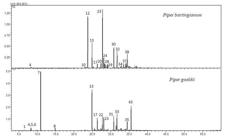
GC-MS chromatogram of the essential oil of Piper bartlingianum and Piper goeldii leaves. The number of each peak in the chromatogram corresponds to the number displayed in Table 1.
Chemical composition of the essential oil from leaves of Piper bartlingianum and Piper goeldii. The relative percentage of each compound obtained from GC-FID peak areas is presented in the order of the DB-5 column elution (Nr.). Values are the mean ± standard deviation based on three plants of each species.
The P. goeldii oil was mainly composed of monoterpenes (23.58 ± 0.97%) and sesquiterpenes (72.80 ± 0.90%). The major constituents were terpinolene (20.18 ± 0.96%), β-caryophyllene (18.23 ± 0.86%), (Z)-α-trans-bergamotol (10.78 ± 0.36%), and spathulenol (9.15 ± 0.22%). The oil from P. bartlingianum was mainly composed of sesquiterpenes (96.84 ± 1.16%). β-selinene (23.99 ± 0.93%), iso-caryophyllene (20.43 ± 1.11%), β-caryophyllene (9.40 ± 0.18%), cis-sesquisabinene hydrate (7.25 ± 0.26%), and β-vetivenene (7.79 ± 0.34%) (Table 1).
Toxicity differed between the oils, the test organism T. urticae being more susceptible to both oils than P. xylostella (Table 2). Irrespective of the agricultural pest, the oil from P. goeldii was approximately twice as toxic than that from P. bartlingianum. Neither of the two oils was more toxic to T. uritcae than the commercial acaricide used as positive control. However, the essential oil of P. goeldii proved to be more toxic to P. xylostella than the positive control. When compared to the positive control, the oils of P. goeldii and P. bartlingianum did not exhibit toxicity to the non-target organism (A. salina).
Toxicity of essential oils from leaves of Piper bartlingianum and Piper goeldii against Tetranychus urticae and Plutella xylostella by residual contact and toxicity to a non-target organism (Artemia salina). N = total number of organisms tested; LC5095% CI) = estimated mean lethal concentration (μg mL-1) and its 95% confidence interval. Slope ± SE = mean linear coefficient of the dose-response curve and its standard error; χ2 (DF) = chi-square test statistic and its degree of freedom (P > 0.05).
The AChE inhibition potential of the P. bartlingianum oil was 1.5-fold greater than that of the P. goeldii oil, but 5.4 times lower than that of the positive control Lannate® (Table 3). The antioxidant capacity ofP. goeldiioil, as evaluated by the DPPH and ABTS assays, was nearly twice as high as that ofP. bartlingianumoil in both tests. However, its activity was significantly lower compared to the positive controls used in the study (Table 3).
Inhibition concentration (IC50) of acetylcholinesterase (AChE) and antioxidant activity (EC50) by DPPH and ABTS tests of Piper bartlingianum and Piper goeldii essential oils and positive controls. Values are presented as mean ± standard deviation (n = 3).
DISCUSSION
A similar yield for the essential oil from the leaves of P; bartlingianum was reported from the municipality of Porto Velho in the state of Rondônia (northern Brazil) (Santos et al. 1998). The yield of the essential oil from other Piper species from the region of Manaus was also similar to what we obtained for P. bartlingianum (Morais et al. 2007; Rameshkumar et al. 2011; Araújo et al. 2018).
While β-caryophyllene was present in the essential oil of P. bartlingianum from Manaus (this study) and Rondônia (Santos et al. 1998) in proportions <10%, the compounds with the highest proportions in Manaus (β-selinene and (Z)-caryophyllene) were not detected in Rondônia. In turn, the major constituents of the P. bartlingianum oil in Rondônia, the sesquiterpenes β-elemene (10.5%) and (E)-nerolidol (9.0%) (Santos et al. 1998) were not detected in our study. Kijjoa et al. (1982) reported the presence of dihydroplatin amide in the benzene extract of P. bartlingianum leaves collected by the Transamazonian Highway. However, in the present study, no nitrogenous compounds were detected. Differences in the chemical composition of the essential oil of a same species among collection sites may be explained by different geographic and climatic conditions, as well as genetic variability, which influence the production and accumulation of chemical constituents (da Camara et al. 2017).
No previous reports on the chemical composition of the essential oil of P. goeldii were found in the literature. Terpinolene (20.18 ± 0.96%), the main constituent of the P. goeldii oil, was also reported in proportions between 10 and 20% in Piper obliquum Ruiz & Pav. (Guerrini et al. 2009), Piper corcovadensis (Miq.) C.DC. (Silva et al. 2016), and Piper hispidinervum C.DC. (Filho et al. 2010).
This is the first report of acaricidal and insecticidal activity of essential oils from the leaves of P. bartlingianum and P. goeldii. The greater toxicity of the P. goeldii oil against the two tested arthropods may be attributed to the qualitative and quantitative differences in the chemical composition of the essential oils (Moraes et al. 2012). There are several reports on the effect of Piper essential oils on T. urticae and P. xylostella. The oil of P. aduncum L. (LC50 = 5.83 µg ml-1) from the state of Pernambuco (northeastern Brazil) (Araujo et al. 2020a) was more toxic to T. urticae than our Piper oils, which, in turn, were 2.5- to sixfold more toxic to T. urticae than the oil of Piper hispidinervum C. DC. from Manaus (Silva et al. 2019). The essential oil of P. capitarianum Yunck (LC50 = 0.21 µg mL-1) and P. krukoffi Yunck (LC50 = 0.37 µg mL-1) (Santana et al. 2022) were much more toxic to P. xylostella than our oils, which, in turn, were 37 to 78 times more toxic to P. xylostella than the extract of the fruit of P. aduncum from Indonesia (Ningsih et al. 2020). These differences in toxicity among Piper congeners may be related to the type of matrix studied, the chemical derivative (extract or essential oil), as well as qualitative and quantitative differences in the constituents of the essential oils (Araujo et al. 2020b; Santana et al. 2022).
There are few published studies on the toxicity of plant-derived substances to non-target organisms when the aim is to create a natural product as an alternative to conventional insecticides. The mean lethal concentration against the non-target A. salina obtained in our study suggests that the essential oils from P. bartlingianum and P. goeldii may be environmentally safe at concentrations that proved efficient in the tests with T. urticae and P. xylostella. However, to assess the environmental impact of these essential oils, it is necessary to conduct tests on other non-target organisms, such as pollinators, freshwater fish, natural enemies of pests, vertebrates, and other ecologically relevant species.
The AChE inhibition test provides information on the mode of action by which a mixture of chemical constituents such as in essential oils exerts biological effects on other organisms (Coban et al. 2016). Substances that inhibit the enzyme AChE promote hyperactivation, altered motor reflexes, respiration spasms, ataxia, and tremors, and can lead to the death of mammals and insects, depending on the degree of poisoning (Coban et al. 2016). Our results suggest that the essential oil from P. bartlingianum contains a higher concentration of substances that inhibit AChE activity compared to P. goeldii. Consequently, it is likely to induce higher mortality in both target and non-target organisms than the essential oil from P. goeldii.
The better antioxidant activity of the oil from P. goeldii may be explained by the presence of oxygenated constituents, such as elemol, spathulenol, γ-eudesmol, and (Z)-α-trans-bergamotol, which are known for their antioxidant properties (El-Gawad 2016; Nogueira Neto et al. 2013). Our results for antioxidant activity are similar to those reported for the essential oil from Piper brachypetiolatum Yunck (64.8 µg ml-1) and P. madeiranum Yunck (66.8 µg ml-1), which also occur in the region of Manaus (Araujo et al. 2021).
CONCLUSIONS
This is the first report of the chemical composition of the essential oil of Piper goeldii. Both the essential oil of P. goeldii and P. bartlingianum collected in the central Brazilian Amazon, were rich in sesquiterpenes. Our results suggest that the essential oils from P. goeldii and P. bartlingianum (especially the former) are promising as active ingredients in a product for the control of T. urticae and P. xylostella. Further studies are needed to establish the cost-benefit ratio for use in organic farming and to ascertain the environmental safety for other types of non-target organisms.
ACKNOWLEDGMENTS
The authors are grateful to Fundação de Amparo à Ciência e Tecnologia do Estado de Pernambuco (APQ-1033-1.06/21), Conselho Nacional de Desenvolvimento Científico e Tecnológico (PQ-2 306514/2022-2), Coordenação de Aperfeiçoamento de Pessoal de Nível Superior for awarding a grant (PNPD-88887.474239/2020-00) and Laboratório Multiusuário de Análises do Departamento de Química at Universidade Federal Rural de Pernambuco for the chromatographic analysis.
REFERENCES
- Acevedo-Rodriguez, P. 1990. The occurrence of piscicides and stupefactants in the plant kingdom. Advances in Economic Botany 8: 1-23.
- Adams, R.P. 2017. Identification of essential oil components by Gas Chromatography/Mass Spectrometry, 4th ed. Allured Publishing Corporation, Carol Stream, Illinois, 804p.
- Araujo, C.A.; da Camara, C.A.G.; de Moraes, M.M.; de Vasconcelos, G.J.; Pereira, M. R.; Zartman, C.E. 2021. Chemical composition of essential oils from four Piper species, differentiation using multivariate analysis and antioxidant activity. Natural Product Research 36: 436-439.
- Araujo, C.A.; Camara, C.A.G.; Moraes, M.M.; Vasconcelos, G.J.N.; Pereira, M.R.S.; Zartman, C.E. 2018. First record of the chemical composition of essential oil of Piper bellidifolium, Piper durilignum, Piper acutilimbum and Piper consanguineum from the Brazilian Amazon forest. Acta Amazonica 48: 330-337.
- Araújo, M.J.D.; Camara, C.A.D.; Moraes, M.M.; Born, F.S. 2020a. Insecticidal properties and chemical composition of Piper aduncum L., Lippia sidoides Cham. and Schinus terebinthifolius Raddi essential oils against Plutella xylostella L. Anais da Academia Brasileira de Ciências 92: 1-14.
- Araújo, M.J.C.; Moraes, M.M.; Born, F.S.; Camara, C.A.G. 2020b. Acaracidal property and repellent action against Tetranychus urticae Koch of essential oils from three species of Piper that occur in fragments of the Atlantic Forest in the state of Pernambuco, Brazil. Revista Virtual de Química 12: 629-638.
- Bandeira, G.N.; Camara, C.A.G.; Moraes, M.M.; Barros, R.; Muhammad, S.; Akhtar, Y. 2013. Insecticidal activity of Muntingia calabura extracts against larvae and pupae of diamondback, Plutella xylostella (Lepidoptera, Plutellidae). Journal of King Saud University Science 25: 83-89.
- Coban, A.; Carr, R.L.; Chambers, H.W.; Willeford, K.O.; Chambers, J.E. 2016. Comparison of inhibition kinetics of several organophosphates, including some nerve agent surrogates, using human erythrocyte and rat and mouse brain acetylcholinesterase.Toxicology Letters248: 39-45.
- Da Camara, C.A.G.; Moraes, M.M.; Melo, J.P.R.; da Silva, M.M.C. 2017. Chemical composition and acaricidal activity of essential oils from Croton rhamnifolioides Pax and Hoffm. in different regions of a Caatinga Biome in Northeastern Brazil. Journal of Essential Oil Bearing Plants 20: 1434-1449.
-
Dolabela, M. F. 1997. Triagem in vitro para atividade antitumoral e anti-Tripanossoma cruzi de extratos vegetais, produtos naturais e substâncias sintéticas. Master’s dissertation. Universidade Federal de Minas Gerais (UFMG), Brazil, 128p. (https://scirp.org/reference/referencespapers.aspx?referenceid=1416272)
» https://scirp.org/reference/referencespapers.aspx?referenceid=1416272 - El-Gawad, A.M.A. 2016. Chemical constituents, antioxidant and potential allelopathic effect of the essential oil from the aerial parts of Cullen plicata Industrial Crops and Products 80: 36-41.
- Ellman, G.L.; Courtney, D.; Andies, V.; Featherstone, R.M. 1961. A new and rapid colorimetric determination of acetylcholinesterase activity. Biochemical Pharmacology 7: 88-95.
- Filho, A.P.D.S.S.; Cunha, R.L.; Vasconcelos, M.A.M.D.; Zoghbi, M.D.G.B. 2010. Essential oil components of Pogostemon heyneanus Benth, Piper hispidinervum C. DC. and Ocimum americanum L. obtained in the Amazon. Journal of Essential Oil-Bearing Plants 13: 347-352.
- Guerrini, A.; Sacchetti, G.; Rossi, D.; Paganetto, G.; Muzzoli, M.; Andreotti, E.; et al 2009. Bioactivities of Piper aduncum L. and Piper obliquum Ruiz & Pavon (Piperaceae) essential oils from Eastern Ecuador. Environmental Toxicology and Pharmacology 27: 39-48.
-
Guimarães, E.F.; Medeiros, E.V.S.S.; Queiroz, G.A. 2022. Piper inFlora e Funga do Brasil. Jardim Botânico do Rio de Janeiro. ( (https://floradobrasil.jbrj.gov.br/FB12735 ). Accessed on 14 Sep 2022.
» https://floradobrasil.jbrj.gov.br/FB12735 - Kijjoa, A.; Giesebrecht, A.M.; Gottlieb, O.R. 1982. Dihydropiplartine from Piper bartlingianum Planta Medica 44: 188-188.
- Melo, J.P.R.; da Camara, C.A.G.; da Silva, L.G.; Moraes, M.M.; Alves, P.B. 2018. Acaricidal properties of the essential oil from Aristolochia trilobata and its major constituents against the two-spotted spider mite (Tetranychus urticae). Canadian Journal of Plant Science 98: 1342-1348.
- Melo, L.F.A.; da Camara, C.A.G.; Modesto, J. C.A.; Pérez, C.D. 2012. Toxicity against Artemia salina of the Zoanthid Palythoa caribaeorum (Cnidaria: Anthozoa) used in folk medicine on the coast of Pernambuco, Brazil.Biotemas25: 145-151.
- Moraes, M.M.; Camara, C.A.G.; Santos, M.L.; Fagg, C.W. 2012. Essential oil composition of Eugenia langsdorffii O. Berg.: Relationships between some terpenoids and toxicity against Tetranychus urticae Journal of the Brazilian Chemical Society 23: 1647-1656.
- Morais, S.M.; Facundo, V.A.; Bertini, L.M.; Cavalcanti, E.S.B.; dos Anjos Júnior, J.F.; Ferreira, S.A.; et al 2007. Chemical composition and larvicidal activity of essential oils from Piper species. Biochemical Systematics and Ecology 35: 670-675.
- Ningsih, F.K.; Aditiya, A.P.; Prijono, D. 2020. Laboratory effectiveness of some insecticides and Piper aduncum fruit extract against diamondback moth (Plutella xylostella [L.]) from Cisarua-Bogor and Pangalengan-Bandung. Earth and Environmental Science 468: 012003.
- Nogueira Neto, J.D.; Sousa, D.P.D.; Freitas, R.M. 2013. Avaliação do potencial antioxidante in vitro do nerolidol. Revista de Ciências Farmacêuticas Básica e Aplicada 34: 125-130.
- Rameshkumar, K.B.; Anu Aravind, A.P.; Mathew, P.J. 2011. Comparative phytochemical evaluation and antioxidant assay of Piper longum L. and Piper chaba Hunter used in Indian traditional systems of medicine. Journal of Herbs, Spices & Medicinal Plants 17: 351-360.
- Santana, M.L.G.; Melo, J.P.R.; Câmara, C.A.G.; Moraes, M.M.; Araujo, C.A.; Vasconcelos, G.J.N.; et al 2022. Lethal and sublethal effects of essential oils from Piper capitarianum Yunck and Piper krukoffii Yunck on Plutella xylostella L. Anais da Academia Brasileira de Ciências 94: 1-19.
- Santos, A.S.; Andrade, E.H.; Zoghbi, M.D.G.B.; Luz, A.I.; Maia, J.G. 1998. Sesquiterpenes of amazonian Piper species. Acta Amazonica 28: 127-127.
- Schultes, R.E. 1980. De plantis toxicariis e mundo novo tropicale commentationes XXVI: Ethnopharmacological notes on the flora of northwestern South America. Botanical Museum Leaflets, Harvard University 28: 1-45.
- Schultes, R.E.; Raffauf, R.F. 1990. Medicinal and toxic plants of the Indians of northwest Amazonia, Piperaceae. In: Schultes, R.E.; Raffauf, R.F. (Eds.). The Healing Forest: Medicinal and Toxic Plants of the Northwest Amazonia Historical, Ethno- & Economic Botany Series, v.2., Dioscoride Press, Portland, p.362-368.
- Schultes, R.F. 1975. De Plantis Toxicariis e Mundo Novo Tropicale Commentationes XII. Notes on biodynamic Piperaceous plants. Rhodora 77:165-170.
- Silva, L.S.; Mar, J.M.; Azevedo, S.G.; Rabelo, M.S.; Bezerra, J.A.; Campelo, P. H.; et al 2019. Encapsulation of Piper aduncum and Piper hispidinervum essential oils in gelatin nanoparticles: a possible sustainable control tool of Aedes aegypti, Tetranychus urticae and Cerataphis lataniae Journal of the Science of Food and Agriculture 99: 685-695.
- Silva, M.F.R.; Bezerra-Silva, P.C.; de Lira, C.S.; de Lima, B.N.A.; Neto, A.C.A.; Pontual, E. V.; et al 2016. Composition and biological activities of the essential oil of Piper corcovadensis (Miq.) C. DC (Piperaceae). Experimental Parasitology 165: 64-70.
- Silva, M.M.C.; da Camara, C.A.G.; Moraes, M.M.; de Melo, J.P.R.; Santos, R.B.; Neves, R.C. 2020. Insecticidal and acaricidal activity of essential oils rich in (E)-nerolidol from Melaleuca leucadendra occurring in the state of Pernambuco (Brazil) and effects on two important agricultural pests. Journal of the Brazilian Chemical Society 31: 813-820.
- Van Den Dool, H.; Kratz, P.D. 1963. A generalization of the retention index system including linear temperature programmed gas-liquid partition chromatography. Journal of Chromatography A 11: 463-471.
-
CITE AS:
Souza, S.C.; Lopes, F.A.M.H.; Monteiro, V.B.; Araujo, C.A.; Camara, C.A.G.; Moraes, M.M.; Vasconcelos, G.J.N.; Pereira, M.R.S.; Zartman, C.E. 2025. Acaricidal, insecticidal, acetylcholinesterase, and antioxidant activities of essential oil from Piper bartlingianum and Piper goeldii. Acta Amazonica 55: e55cp23390.
Data availability
The data that support the findings of this study are available, upon reasonable request, from the corresponding author, Claudio Augusto Gomes da Camara.

