 New morphological and micromorphological evidence supports a new Amazonian species of Scleria (Cyperaceae)
ABSTRACT
During a taxonomic review of Scleria sect. Hymenolytrum, herbarium specimens were analysed and identified as distinct from the currently accepted taxa within the section. Therefore, this study aimed to describe this new species - Scleria occulta L.Schneider & A.Gil, sp. nov., with emphasis on its morphoanatomical leaf traits. The original descriptions and nomenclatural types of the names involved were analysed together with morphological, anatomical, and micromorphological leaf data obtained from herbarium specimens, histological sections, clearing, and Scanning Electron Microscopy (SEM) images. The new species is known from only four specimens collected in Brazil and Venezuela, occurring in shaded environments within Ombrophilous forests. This study highlights the importance of integrative taxonomic approaches and access to virtual botanical collections for updating existing records and facilitating the description of new taxa. We identified new characters not previously highlighted as diagnostic for this group, including features of the staminate spikelets. Here, we provide illustrations and an identification key distinguishing the new species from morphologically similar taxa.
Keywords:
Amazon forest; herbarium collections; monocots; Poales; razor grasses; taxonomy
RESUMO
Durante uma revisão taxonômica de Scleria seção Hymenolytrum (Cyperaceae), espécimes de herbário foram analisados e identificados como distintos dos táxons atualmente aceitos dentro da seção. Portanto, este estudo teve como objetivo descrever essa nova espécie - Scleria occulta L.Schneider & A.Gil, sp. nov., com ênfase em suas características morfo-anatômicas foliares. As descrições originais e os tipos nomenclaturais dos nomes envolvidos foram analisados juntamente com dados morfológicos, anatômicos e micro-morfológicos das folhas, obtidos a partir de espécimes de herbário, cortes histológicos, diafanização e imagens de microscopia eletrônica de varredura (MEV). A nova espécie é conhecida por apenas quatro espécimes coletados no Brasil e na Venezuela, ocorrendo em ambientes sombreados dentro de florestas ombrófilas. Este estudo destaca a importância das abordagens taxonômicas integrativas e do acesso a coleções botânicas virtuais para atualizar registros existentes e facilitar a descrição de novos táxons. Identificamos novos caracteres não destacados anteriormente como diagnósticos para este grupo, incluindo características das espiguetas estaminadas. Aqui, fornecemos ilustrações e uma chave de identificação que distingue a nova espécie de táxons morfologicamente semelhantes.
Palavras-chave:
capim-navalha; coleções de herbários; floresta amazônica; monocotiledôneas; Poales; taxonomia
INTRODUCTION
Scleria P.J.Bergius is among the most diverse genera of Cyperaceae Juss., one of the largest families of monocots and a member of the order Poales (Bouchenak-Khelladi et al. 2014; Larridon 2022). It is recognized as a monophyletic taxon comprising approximately 260 species distributed pantropically (Larridon 2022). The genus is classified into four subgenera and 17 sections: Scleria subg. Browniae (C.B.Clarke) C.B.Clarke (1 section), S. subg. Hypoporum (Nees) C.B.Clarke (3 sections), S. subg. Scleria (12 sections), and S. subg. Trachylomia (Nees) Bauters (1 section) (Bauters et al. 2016, 2018). The species of Scleria exhibit distinctive morphological characteristics that are useful for recognizing subgenera and sections, such as the contraligule, inflorescence arrangement, spikelet type, hypogynium type, and fruit traits (Bauters et al. 2016; Schneider and Gil 2021). Other features are essential for species identification, such as the ligule, which in Scleria is formed by a band of dense trichomes (Camelbeke and Goetghebeur 1999). However, not all of these characters are easily observed in herbarium specimens, and some traits may remain unexplored. This is the case for the ligule, which was highlighted as a taxonomic character (Camelbeke and Goetghebeur 1999) more than 200 years after the genus was first circumscribed (Bergius 1765).
Once these characteristics have been clarified, already described species should be revisited to reassess them considering this information. For example, the reestablishment of Scleria cyperinoides C.B.Clarke was based mainly on the trichome ligule and the shape of the hypogynium (Schneider et al. 2024). This highlights the essential role of re-examining herbarium specimens. It is estimated that over 50% of herbarium specimens collected in the tropics may be misidentified (Davis 2023), what emphasises the importance of taxonomic revisions for examining, updating, and clarifying the diversity of tropical species, as well as for training new taxonomists (Christenhusz and Byng 2016).
Scleria sect. Hymenolytrum (Schrad. ex Nees) Core stands out as one of the twelve sections of the largest subgenus of Scleria, which includes species with overlapping and incomplete descriptions that require further study. In the course of a recent taxonomic review of Scleria sect. Hymenolytrum (Schneider et al. 2023, 2024), which occurs from southeastern Mexico to Argentina and in Tropical Africa, Madagascar, and the Comoros (Bauters et al. 2016; Galán Díaz et al. 2019), nomenclatural novelties were highlighted (Schneider et al. 2023, 2024), and herbarium specimens were identified that did not match any of the 14 species currently accepted in this section (Bauters et al. 2016; Schneider et al. 2023, 2024). From these specimens we describe here a new species of Scleria. We present its morphological, anatomical, and micromorphological diagnostic characters, compare it with morphologically similar species, and provide an identification key to distinguish among them.
MATERIAL AND METHODS
The material was examined from herbarium specimens, either in person (IAN, MG, and RB - Thiers 2025) or accessed online via institutional websites (MO, NY, RB, and US - Thiers 2025; NMNH 2025; Reflora 2025; Tropicos 2025). We reviewed the protologues of morphologically similar species and analysed their original descriptions and type specimens, accessed through dedicated databases (BHL 2025; JSTOR Global Plants 2025) and/or the specialised literature (e.g., Kunth 1837; Nees 1842; Steudel 1855; Core 1936; Camelbeke and Goetghebeur 2000; Schneider et al. 2023). The nomenclature rules adopted are in agreement with the International Code of Nomenclature for algae, fungi, and plants (ICN, Madrid Code; Turland et al. 2025).
We followed general morphological terminology from Harris and Harris (2001) and Gonçalves and Lorenzi (2011), while inflorescence and fruit terminology followed Ahumada and Vegetti (2009) and Espinoza et al. (2016), respectively. Distribution and habitat data were obtained from the examined material, specialised literature, and original descriptions, as cited above. Photographic illustrations of the spikelets and fruits were taken from herbarium specimens using a Leica® M205A stereomicroscope equipped with an MC170HD camera. The distribution map was produced with the open-source software QGIS (version 3.40 - 2025). The calculation of the extent of occurrence (EOO) and area of occupancy (AOO) to assess extinction risk was carried out using GeoCAT (Bachman et al. 2011). Preliminary conservation status assessment was undertaken following the IUCN Red List Categories and Criteria v.15.1 (IUCN 2022).
Leaf anatomical data were obtained from isolated fragments of the median portions of fully expanded leaf blades (midrib, lateral ribs, and margin). Samples were rehydrated (Smith and Smith 1942) and embedded in resin (2-hydroxyethyl methacrylate), following the manufacturer’s instructions. Samples were sectioned transversely (5 μm) using a rotary microtome with a steel blade. Sections were stained with 0.5% toluidine blue, pH 4.0 (Feder and O’Brien 1968). For epidermal analysis, samples were cleared with 30% sodium hypochlorite, rinsed in distilled water, and dehydrated through an ethanol gradient. They were then stained with 50% fuchsin diluted in ethanol (Shobe and Lersten 1967) and mounted in glycerinated gelatin (Kaiser 1880). Anatomical sections and epidermal specimens were analysed and photographed with a Leica DM6 photomicroscope equipped with a digital camera and Leica Application Suite software, version LAS V4.12.
Samples prepared for scanning electron microscopy (SEM) were rehydrated and subjected to a graded ethanol series for dehydration (Smith and Smith 1942), followed by critical point drying (Horridge and Tamm 1969), fixed on aluminium supports using double-sided carbon tape, and coated with 20 nm of gold in a metallizing chamber. SEM analyses and imaging were conducted using a Tescan Mira3 scanning electron microscope.
RESULTS
Scleria occulta L.Schneider & A.Gil, sp. nov. (Figures 1‒5).
Type material: Brazil. Amazonas, [Santa Isabel do Rio Negro], Iauareté, Uaupés river margin: Brasil-Colombia frontier, 0°38’S, 66°22’W, [ca. 120m], fl. and fr., 14 May 1975, Ribeiro, B.G.S. 928 (holotype: MG [050992]!; isotype: IAN [IAN149618]!).
Description: Herb approximately 2 m tall. Stem creeping (or not?), clustering not observed, interval between stems not observed, unbranched, surface glabrous, angles glabrous and armed. Leaf basal 2, cauline 1-7, papery. Leaf-sheath 10.2-14.7 × 0.7-1.2 cm, glabrous; unwinged proximally and winged distally, wings 5.5-11 × 0.1-0.2 cm, margins glabrous and armed. Ligule absent. Contraligule 0.6-1 mm long, rounded or cuneate, glabrous margin, membranous appendage absent. Leaf-blade 39.5-47.8 × 2-2.6 cm; abaxial surface glabrous, lateral rib glabrous and unarmed, midrib glabrous and armed; adaxial surface glabrous, lateral rib glabrous and unarmed, midrib glabrous, rarely glabrescent, and armed; base rounded, shape linear, ‘w’ in cross section, apex attenuated. Involucral bract leaf-like, 6-21.5 × 0.4-1.5 cm, linear. Inflorescence 11.3-27 × 7.7-8.1 cm, branched or not, internode 17.5 cm long. Primary panicle 1-2, 4.3-12.5 × 4-8.1 cm, 4th-5th order of branching, internode 1-5 mm long, rachis pubescent, margins ciliate and unarmed; branch bract lanceolate, apex aristate, awn 12-20 mm long; branch prophyll wide-triangular, apex obtuse. Staminate spikelets solitary or in fascicles of 2-3, (3.9-)5.5-7.1 × 1-1.5 mm, terete, pedicellate, pedicel (1-)6.5-10 mm long. Spikelet bract triangular, apex mucronate or aristate, mucron or awn 1-5 mm long. Spikelet prophyll wide-triangular, apex obtuse or rounded. Lower glume 1 (-2), (2.3-)2.7-3.1 × (1.5-)1.8-2.1 mm, oval to elliptical, apex mucronulate; middle glumes 2, 3.6-5.5 × 2.1-3 mm, oblong, apex mutic or mucronulate; mucron 0.2-0.4 mm long; upper glumes 8-12, 1.9-5.3 × 0.3-2.1 mm, oblong, apex mutic or mucronulate; brown-yellow with vinaceous spots or brown-yellow, glabrous, midrib glabrous and unarmed, margins ciliolate or glabrous. Flower 6-10 per spikelet, stamens 3 per flower, anther 1.7-2.6 mm long. Pistillate spikelets solitary, 6.5-9 × 1.3-2.3 mm, lanceolate, pedicellate, pedicel 1-2.2 mm long. Spikelet prophyll wide-triangular, apex obtuse or rounded. Lower glume 1, 3.3-4 × 2.5-3 mm, oval, apex mucronulate; middle glume 1, 5.3-5.9 × 2.5-3.6 mm, oblong, apex mucronulate or mucronate; upper glume 1, 5.9-7.2 × 3-4.1 mm, elliptical, apex mucronate; brown-yellow or brown-yellow with vinaceous spots and central vein green near the apex, puberulous to glabrous, central vein puberulous or glabrous, armed or not, margins ciliolate. Cupule entire and concave. Hypogynium trilobate, lobes triangular, apex entire, beige. Nutlet 3.3-4 × 2.8-2.9 mm, ovoid, triangular in cross-section, surface smooth, puberulous, apex attenuate-emarginate, light brown. Stylobase absent on the nutlet.
Leaf anatomy and micromorphology - Blade surface: Epidermis with longitudinal rectangular cells all over the blade and pentagonal to circular in the adaxial midrib; sinuous anticlinal walls. Stomata paracytic 27.4‒40.2 × 27.8‒39.9 µm, at the same level as the other epidermal cells, on both sides, more frequent on all abaxial side and sparse only on adaxial margins. Silica bodies in bands associated with vascular bundles. Tector trichomes like prickle (armed), present on the margins (62.4‒)127.9‒332.5 µm long, on the adaxial lateral rib, and abaxial midrib 37‒58.6 µm long; soft tector thricomes rarely present, only on adaxial midrib, ca. 20 µm long. Cross-sectional plane: Cuticle thick, 12‒19 µm adaxial and 10‒14 µm de abaxial, wavy on both sides. Epidermis uniseriate, adaxial cells 22‒43 × 31‒40 µm, abaxial cells 6‒10 × 13‒29 µm; buliform cells 26‒179 × 39‒57 µm, on adaxial midrib and lateral ribs. Translucent cells 19‒59 × 20‒54 µm, below the adaxial epidermis. Mesophyll asymmetrical, uniseriate palisade parenchyma, arm cells, and secretory cavities on the lateral ribs and margins. Idioblasts distributed along the mesophyll. Vascular bundle collateral; bundle sheath formed by an outer layer of parenchymatous cells and an inner layer of sclerenchymatous cells; in three orders, the largest 1st in the midrib and lateral ribs, the 2nd bundles medium-sized, and the 3rd bundles smaller, interspersed, with 3rd order bundles on the margins. Sclerenchymatous fiber bundles adjacent or not to the bundle sheaths, present in 1st order bundle sheath on the abaxial band and an adaxial sclerenchyma cap; on both sides on the 2nd order bundle sheaths, sometimes absent on the abaxial band in marginal bundle sheaths; absent on the 3rd order bundle sheaths; and in the leaf margins.
Diagnosis: Scleria occulta can be recognized by the unwinged proximally and winged distally leaf sheath, without ligule, contraligule without appendage, leaf blade glabrous, visible and pubescent inflorescence axis, long pedicellate staminate spikelet, and muticous or mucronulate apex of middle glumes of staminate spikelet. This species resembles Scleria cyperina Willd. ex Kunth and S. robusta Camelb. & Goetgh. (see discussion item below).
Paratypes: Brazil. Amazonas: [Japuá] Iauareté, SA19-VB, 0°36’12”S, 69°11’13”W, 155 m, 18 May 1975, fl. and fr., Ribeiro, B.G.S. 967 (IAN 149618, MG 0050992); Barcelos, Serra do Aracá, acampamento do paredão, 0°51’33”S, 63°20’01”W, 733 m, 19 Aug. 2011, fl. and fr., Quinet, A. 2743 (RB 00733096). Venezuela. Bolívar: [Sifontes] Río Chicanan, north portion of Cerro Uroi, [6°20’07.25”N, 61°53’07.25”W], 250‒400 m, 12 Sep. 1962, fl. and fr., Maguire, B. 53721 (US 88064).
Etymology: The epithet occulta alludes to the fact that the morphological features unique to this species were previously obscured within the taxonomic identity of other taxa of Scleria sect. Hymenolytrum, a group that lacks a membranous appendix, as revealed by a recent taxonomic review (Schneider et al. 2023, 2024).
Distribution: Brazil (Amazonas) and Venezuela (Bolívar). Elevation: 120‒733 m. Habitat: Ombrophilous forest, in shaded environments.
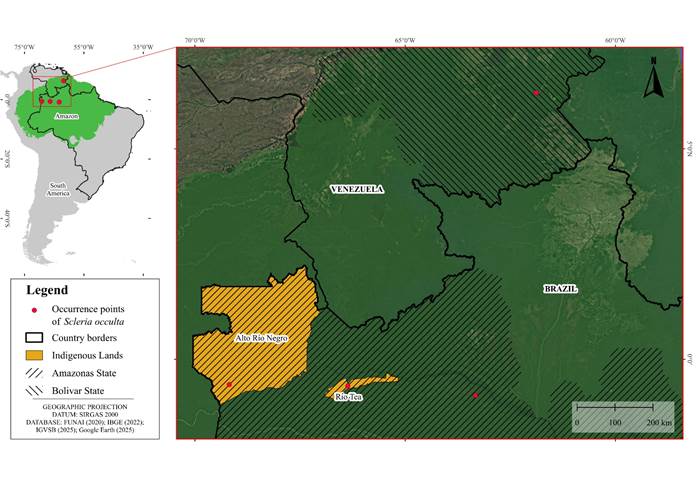
Preliminary conservation status: Scleria occulta has only been recorded from three localities in Amazonas State, Brazil, and one in Bolívar State, Venezuela (Figure 1). Of the four specimens, two were collected within the Indigenous Lands of Alto Rio Negro and Rio Tea, in the municipalities of Japurá and Santa Isabel do Rio Negro, Brazil, respectively (Figure 1). Agricultural activity has been recorded along the margins of the Cuiuri River, approximately 10 km from the third Brazilian record, in Barcelos municipality. Nevertheless, all recorded localities retain native vegetation according to satellite imagery (Google, 2025). Based on these specimens, the species is preliminarily estimated to have an Extent of Occurrence (EOO) of 265,366 km² and an Area of Occupancy (AOO) of 16 km². Although the AOO is small, no ongoing decline or immediate threats have been inferred; thus, the species is here assessed as Least Concern (LC) under the IUCN Red List Criteria (2022).
Identification key to Scleria sect. Hymenolytrum species without membranaceous appendage
1. Leaf-sheath winged; ligule present; hypogynium annular….….…………………………..... Scleria poeppigii
1’. Leaf-sheath unwinged proximally and winged distally; ligule absent; hypogynium trilobed ……………………… 2
2. Leaf-blade chartaceous; inflorescence rachis glabrous to glabrescent; nutlet 2.3‒3.2 × 1.9‒2.5mm.......… S. cyperina
2’. Leaf-blade papery; inflorescence rachis pubescent or puberulous; nutlet 3.3‒4 × 2.4‒3mm…….…………...… 3
3. Leaf-blade surface with soft trichomes; staminate spikelet pedicel (0.3‒)1‒3.2 mm, middle glumes aristate, arista 2‒3.5 mm long….……………..………….................. S. robusta
3’. Leaf-blade surface glabrous; staminate spikelet pedicel (1‒) 6.5‒10 mm, middle glumes mucronulate or mucronate, mucron 0.2‒0.4 mm long ……………….......… S. occulta
DISCUSSION
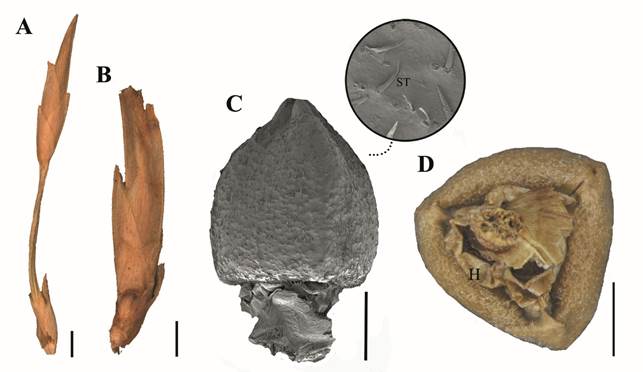
Scleria occulta is placed in Scleria sect. Hymenolytrum because it has the typical inflorescence of this section, characterized by female spikelets at the base of the branches (Figure 2c) and staminate spikelets on secondary branches with well-developed pedicels (Figure 2c, d) (Nees 1842; Bauters et al. 2016). This section is further characterized by a distinctive feature that gives it its name: the membranaceous appendage at the apex of the contraligule. However, this character is not present in all species, and until now, only three species have been described with it: Scleria cyperina, S. poeppigii (Nees) Steud. and S. robusta. Scleria tepuiensis Core was originally described as having a small membranous margin rather than an appendage (Core 1951); however, examination of its type specimen (Steyermark 58232 - F 1252938) revealed the presence of an appendage.

Scleria oculta illustrated from Ribeiro, B.G.S. 928.. A - Habit. B - Leaf sheath. C - Inflorescence branching (secondary panicle). D - Staminate spikelet. Abbreviations: BB - branch bract, BP - branch prophyll, CT - contraligule, LG - lower glume, MD - middle glume, PP - primary panicle, R - rachis, SB - spikelet bract, SP - spikelet prophyll, UG - upper glume. Illustration by Antônio E. da S. Rocha.
The specimens now assigned to Scleria occulta were previously identified as S. robusta and S. cyperina, a situation mainly attributed to the absence of the membranous appendix and other diagnostic features (Figure 1b; Table 1). The new species is more similar to S. cyperina and S. robusta because it lacks a ligule and has a trilobed hypogynium. However, S. occulta can be distinguished from S. cyperina by staminate spikelet characters that have not previously been emphasized in taxonomic studies of this group, including longer pedicels (Figures 2d, 3a), middle glumes with a mucronate or mucronulate apex (Figures 2d, 3a), and a larger number of upper glumes (Table 1). Furthermore, the rachis indumentum differs, being pubescent in S. occulta but puberulous in S. cyperina and S. robusta.
Diagnostic features between Scleria sect. Hymenolytrum species without membranaceous appendix and Scleria occulta.
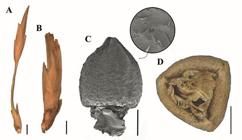
Scleria occulta images from Ribeiro, B.G.S. 928. A - Staminate spikelet. B - Pistillate spikelet. C - Nutlet lateral view and surface. D - Nutlet basal view. Abbreviations: H - hypogynium and ST - soft trichome. Scale = 1mm. Credits: Layla J. C. Schneider.
The last species described without an appendage in Scleria sect. Hymenolytrum was S. robusta, distinguished by its large inflorescence and broad leaf blades (Camelbeke and Goetghebeur 2000). Although both S. robusta and S. occulta have broad leaf blades more than 2 cm wide, S. robusta has staminate glumes with an aristate apex, whereas S. occulta lacks this feature (Table 1). A Venezuelan specimen was found exhibiting these characters (Maguire 27924 - US2335564), but, being sterile, it was excluded from the present description. Among the species lacking an appendage, S. poeppigii is the most distinctive, differing from the new species by the presence of a ligule with trichomes, narrower leaves (0.9-1.3 cm vs. 2-2.6 cm wide), and an annular hypogynium (Table 1).
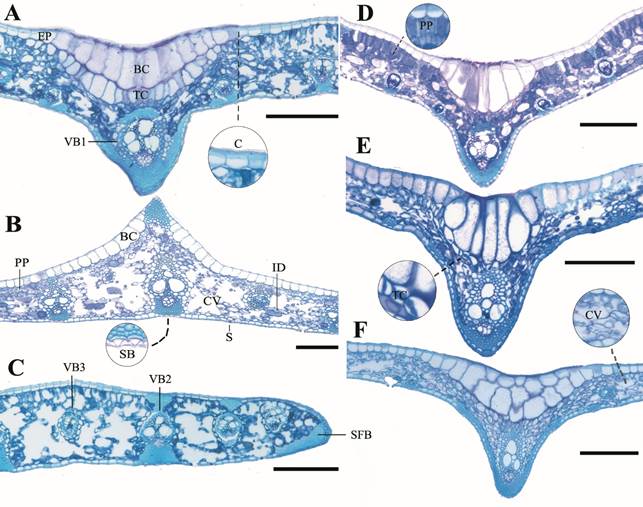
In morphologically similar species, additional data such as leaf anatomy and micromorphology are often required to supplement diagnostic characters (Kiaosanthie et al. 2018). Within Scleria sect. Foveolidia Raf., useful features include stomatal distribution, hypodermis presence/absence, radiating parenchyma, sclerenchyma, and the shape of the central vein and leaf margin (Kiaosanthie et al. 2018). Of these, only one character varied among the species and specimens analysed (Table 2): the hypodermis (here referred to as translucent cells; Figure 4a, 4d, 4f; Table 1), which requires ontogenetic study to clarify its developmental origin. Another relevant anatomical character was the palisade parenchyma, which consisted of one or two cell layers (Figure 4). Among these, Scleria cyperina is notable because it has up to two layers of translucent cells and biseriate palisade parenchyma (Table 1, Figure 4d), while the others have only one layer of both characteristics (Table 1, Figure 4).
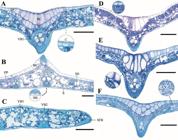
Leaf blade anatomy in cross-section of Scleria sect. Hymenolytrum species without membranaceous appendage. A-C. Scleria occulta. A - Midrib. B - Lateral rib. C - Margin. D - Midrib of S. cyperina. E - Midrib of S. poeppigii. F - Midrib of S. robusta. Abbreviations: BC - buliform cells, C - cuticle, CV - cavity, EP - epidermis in adaxial face, ID - idioblast, PP - palisade parenchyma, S - stomata, SB - silica body, SFB - sclerenchymatous fiber bundle, TC - translucent cells, VB1 - vascular bundle 1st order, VB2 - vascular bundle 2nd order, VB3 - vascular bundle 3rd order. Scale = 200 µm. a-c from Ribeiro, B.G.S. 928; d from Zappi, D.C. 4348; e from Farfan, J. 1125; and f from Lowrie, S.R. 21. Credits: Layla J. C. Schneider.
The translucent cell layer (epidermis or hypodermis) and the composition of the parenchyma are taxonomically informative characteristics in other genera (Bugg et al. 2013; Mallick and Ghosh 2018), but they may exhibit intraspecific variation and can also change in response to environmental conditions (Bugg et al. 2013). Therefore, it is essential to investigate which of those traits are variable or stable within the genus and the species, thereby improving the use of leaf anatomy in the taxonomy of Scleria.
Micromorphological analysis revealed that the distribution of trichomes is a relevant character for distinguishing species (Figure 5). Scleria occulta lacks soft trichomes on both leaf surfaces (Figure 5a-b), although a few may occasionally occur along the midrib (Figure 5e). Scleria cyperina presents trichomes on the adaxial surface (Figure 5g, j), while S. robusta bears trichomes on both surfaces (Figure 5i, l). Scleria poeppigii may or may not bear trichomes on the leaf blades (Figure 5i, l; Table 1), but it is distinguished by other organographic features (Table 1).

Leaf blade micromorphology of Scleria sect. Hymenolytrum species without membranaceous appendage. A-F - Scleria occulta: A - Adaxial surface and cells with sinuous anticlinal walls (arrow), B - Abaxial surface and silica bodies in evidence (arrow), C - Midrib adaxial surface, D - Midrib abaxial surface, and E-F - Margin adaxial surface. G and J - S. cyperina: G - Adaxial surface and J - Abaxial surface. H and K - S. poeppigii: H - Adaxial surface and K - Abaxial surface. I and L: S. robusta: I - Adaxial surface and L - Abaxial surface. Abbreviations: PT - prickle trichome, S - stomata, SB - silica body, ST - soft trichome. The structures mentioned are indicated by an arrow. Scale: 100 µm. A-F from Ribeiro, B.G.S. 928, G and J from Zappi, D.C. 4348; H and K from Farfan, J. 1125, I from Lowrie, S.R. 21, and L from Ayala, F. 2203. Credits: Layla J. C. Schneider.
The habitat of Scleria occulta is so far restricted to ombrophilous forest. The other species occur in forests as well, but typically along forest edges (Schneider and Gil 2021), and in the case of S. cyperina, also in open or human-modified areas (Schneider and Gil 2021, 2025). The growth form of the new species is distinctive, as recorded in Ribeiro’s collections, which described it as creeping, an unusual characteristic in Scleria. Within Scleria sect. Hymenolytrum, this growth form has only been reported in Scleria scabra Willd. (Schneider 2023).
This new species of Scleria is herein described based on herbarium material and a thorough taxonomic review, both crucial in species description. The world’s tropical regions, including the Amazon, are home to the greatest biodiversity, but they still contain areas that remain insufficiently explored and require fieldwork (Christenhusz and Byng 2016), which is often costly and logistically challenging. In this context, the digitization of herbarium specimens and open access to biodiversity data are therefore essential tools, allowing taxonomists to study biodiversity that is otherwise inaccessible or would require disproportionate effort to document (Eckert et al. 2024). This is particularly true for Scleria, as the Neotropical regions, mainly in Brazil and Venezuela, stand out as centers of diversity for the genus, including evolutionarily and ecologically distinct lineages and comprising areas of interest for conservation (Galán Díaz et al. 2025). In the case of Scleria occulta, digitized herbarium material revealed its occurrence in Venezuela, thereby supporting the taxonomic investigation, enabling comparative analysis with related species, and ultimately leading to its recognition as a new taxon within section Hymenolytrum. This corroborates the importance of the availability and accessibility of previously collected materials, especially in regions that are difficult to access, such as the Amazon.
CONCLUSIONS
The recognition of Scleria occulta highlights how integrative taxonomic revision, supported by expanded access to physical and digital collections, remain essential for elucidating the still insufficiently known Amazonian diversity. The description of this species reveals morphological and micromorphological traits previously underexplored within sect. Hymenolytrum, especially those related to staminate spikelets, thereby improving species diagnoses and delimitation among closely related taxa. It also demonstrates the potential of existing herbarium material to uncover overlooked lineages, particularly in regions that are difficult to access. By expanding the taxonomic knowledge of the group, this study provides an important foundation for future assessments of diversity within the genus Scleria.
ACKNOWLEGMENTS
This research was supported by Conselho Nacional de Desenvolvimento Científico e Tecnológico - Brasil (CNPq) and Fundação Amazônia de Amparo a Estudos e Pesquisas - Brasil (FAPESPA) under grant PRONEM - 052/2021; This study was financed in part by Coordenação de Aperfeiçoamento de Pessoal de Nível Superior - Brasil (CAPES) - Finance Code 001; CAPES scholarship grant (88887.633240/2021-00); and CNPq productivity grant (314271/2020-1). We thank Museu Paraense Emílio Goeldi (MPEG) and Universidade Federal Rural da Amazônia (UFRA) for the support, Coordenação de Botânica (COBOT) - MPEG for the leaf-blades anatomical images; Coordenação de Zoologia (COZOO) - MPEG and Coordenação de Ciências da Terra e Ecologia (COCTE) - MPEG for the spikelets, fruits, and SEM images, Juliene Maciel-Silva (UFRA/MPEG) for the photos of the type specimen at the Field Museum, and Elielson Rocha (MPEG) for the botanical illustration.
REFERENCES
- Ahumada, O.; Vegetti, AC. 2009. Inflorescence structure in species of Scleria subgenus Hypoporum and subgenus Scleria (Sclerieae-Cyperaceae). Plant Systematics and Evolution 281: 115-135.
- Bachman, S.; Moat, J.; Hill, AW; de la Torre, J.; Scott, B. 2011. Supporting Red List threat assessments with GeoCAT: geospatial conservation assessment tool. ZooKeys 150: 117-126.
- Bauters, K.; Asselman, P.; Simpson, DA; Muasya, AM; Goetghebeur, P.; Larridon, I. 2016. Phylogenetics, ancestral state reconstruction, and a new infrageneric classification of Scleria (Cyperaceae) based on three DNA markers. Taxon 65: 444-466.
- Bauters, K.; Goetghebeur, P.; Asselman, P.; Meganck, K.; Larridon, I. 2018. Molecular phylogenetic study of Scleria subgenus Hypoporum (Sclerieae, Cyperoideae, 17 Cyperaceae) reveals several species new to science. Plos One 13: e0203478.
- Bergius, P.J. 1765. Scleria Vetenskaps Academiens Handlingar 26: 142-144.
-
BHL. 2025. Biodiversity Heritage Library. ( (http://www.biodiversitylibrary.org/ ). Accessed on 22 Jun 2025.
» http://www.biodiversitylibrary.org/ - Bouchenak-Khelladi, Y.; Muasya, AM; Linder, HP. 2014. A revised evolutionary history of Poales: Origins and diversification. Botanical Journal of the Linnean Society 175: 4-16.
- Bugg, C.; Smith, C.; Blackstock, N.; Simpson, D.; Ashton, P.A. 2013. Consistent and variable leaf anatomical characters in Carex (Cyperaceae).Botanical Journal of the Linnean Society 172: 371-384.
- Camelbeke, K.; Goetghebeur, P. 1999. The Ligule, a new diagnostic character in Scleria (Cyperaceae). Systematics and Geography of Plants 68: 73-84.
- Camelbeke, K.; Goetghebeur, P. 2000. Scleria robusta, a new name for Scleria grandis Core (Cyperaceae). Novon 10: 359.
- Christenhusz, M.J; Byng, J.W. 2016. The number of known plant species in the world and its annual increase. Phytotaxa 261: 201-217.
- Core, E.L. 1936. The American species of Scleria Brittonia 2: 1-105.
- Core, E.L. 1951. Botanical exploration in Venezuela. Cyperaceae tribe Scleriae. Fieldiana28: 52.
- Davis, C.C. 2023. The herbarium of the future. Trends in Ecology & Evolution 38: 412-423.
- Eckert, I.; Bruneau, A.; Metsger, D.A.; Joly, S.; Dickinson, T.A.; Pollock, L.J. 2024. Herbarium collections remain essential in the age of community science. Nature Communications 15: 7586.
- Espinoza, P.; Chacón-Madrigal, E.; Sánchez, E.; Gómezlaurito, J. 2016. Key to the species of the genus Scleria (Cyperaceae) in Costa Rica based on the morphology of achenes. Phytotaxa 284: 81-107.
- Feder, N.; O’Brien, T.P. 1968. Plant microtechnique: some principles and new methods. American Journal of Botany 55: 123-142.
- Galán Díaz, J.; Bauters, K.; Rabarivola, L.; Xanthos, M.; Goetghebeur, P.; Larridon, I. 2019. A revision of Scleria (Cyperaceae) in Madagascar. Blumea: Journal of Plant Taxonomy and Plant Geography 64: 195-213.
- Galán Díaz, J.; Bachman, S.P.; Forest, F.; Escudero, M.; Rotton, H.; Larridon, I. 2025. Identifying conservation priorities of a pantropical plant lineage: a case study in Scleria (Cyperaceae). Ecosistemas 34: 2847.
- Gonçalves, E.G.; Lorenzi, H. 2011. Morfologia Vegetal: Organografia e Dicionário Ilustrado de Morfologia das Plantas Vasculares 2nd ed. Nova Odessa: Instituto Plantarum.
-
Google. 2025. Google Earth. ( (https://earth.google.com ). Accessed on 10 Apr 2025.
» https://earth.google.com - Harris, J.G.; Harris, M.W. 2001.Plant identification terminology: An illustrated glossary 2nd ed. Spring Lake Publishing, Spring Lake. 217p.
- Horridge, G.A.; Tamm, S.L. 1969. Critical point drying for scanning electron microscopy study of ciliary motion. Science 163: 817-818.
-
IUCN. 2022. Guidelines for Using the IUCN Red List Categories and Criteria. Version 15.1. IUCN Standards and Petitions Committee. ( (https://www.iucnredlist.org/documents/RedListGuidelines.pdf ). Accessed on 27 Apr 2025.
» https://www.iucnredlist.org/documents/RedListGuidelines.pdf -
Jstor Global Plants. 2025. Jstor Global Plants. ( (https://plants.jstor.org/ ). Accessed on 22 Mar 2025.
» https://plants.jstor.org/ - Kaiser, E. 1880. Verfahren zur herstellung einer tadellosen glycerin-gelatine. Botanisch Zentralblatt 180: 25-26.
- Kiaosanthie, W.; Chaisongkram, W.; Wangwasit, K. 2018. A new species of Scleria P.J.Bergius (Cyperaceae) from North-Eastern Thailand. Thai Forest Bulletin 46: 113-122.
- Kunth, K.S. 1837. Enumeratio Plantarum Omnium Hucusque Cognitarum 2nd ed. Stutgardiae: Sumtibus JG Cottae. 591p.
- Larridon, I. 2022. A linear classification of Cyperaceae. Kew Bulletin 77: 309-315.
- Mallick, T; Ghosh, A. 2018. Comparative study of foliage leaf and bract leaf anatomy of six species of Cyperaceae from West Bengal. Modern Phytomorphology 12: 106-116.
- Nees, C.G. 1842. Cyperaceae In: Martius, C.F. (ed.), Flora Brasiliensis, enumeratio plantarum in Brasilia hactenus detectarum: quas suis aliorumque botanicorum studiis descriptas et methodo naturali digestas partim icone illustratas München: Leipzig. Pp. 1-226.
-
NMNH - National Museum of Natural History. 2025. Botany collections; [acessed 2025 Apr 10]. https://collections.nmnh.si.edu/search/botany/
» https://collections.nmnh.si.edu/search/botany/ -
QGIS Development Team. 2022. QGIS Geographic Information System. QGIS Association. ( (https://www.qgis.org ) Accessed on 20 Aug 2025.
» https://www.qgis.org -
Reflora. 2025. Virtual Herbarium. ( (https://reflora.jbrj.gov.br/reflora/herbarioVirtual/ ). Accessed on 8 May 2025.
» https://reflora.jbrj.gov.br/reflora/herbarioVirtual/ - Schneider, L.J.C. 2023. Sistemática de Scleria subgênero Scleria seção Hymenolytrum (Cyperaceae): uma abordagem molecular, morfológica, anatômica e taxonômica. Doctoral thesis. Universidade Federal Rural da Amazônia (UFRA) and Museu Paraense Emílio Goeldi (MPEG), Brazil, 224p.
- Schneider, L.J.C.; Gil, A.S.B. 2021. Scleria (Cyperaceae) in the state of Pará, Amazon, Brazil. Acta Botanica Brasilica 35: 215-247.
-
Schneider, L.J.C.; Gil, A.S.B. 2025. Scleria in Flora e Funga do Brasil Jardim Botânico do Rio de Janeiro. ( (https://floradobrasil.jbrj.gov.br/FB7314 ). Accessed 8 May 2025.
» https://floradobrasil.jbrj.gov.br/FB7314 - Schneider, L.J.C.; Simões, A.O.; Dias, A.C.A.; Gil, A.B.S. 2023. Typifications in Scleria subgenus Scleria section Hymenolytrum (Cyperaceae). Phytotaxa 606: 170-184.
- Schneider, L.J.C.; Simões, A.O.; Dias, A.C.A.; Gil, A.B.S. 2024. Revisiting the tangled taxonomy of Scleria subgenus Scleria section Hymenolytrum: a lectotype replacement, a new synonym, and the reestablishment of Scleria cyperinoides as an accepted name. Acta Botanica Brasilica 38: e20230219.
- Shobe, W.R.; Lersten, N.R. 1967. A technique for clearing and staining gymnosperm leaves. Botanical Gazette 128: 150-152.
- Smith, F.H.; Smith, E.C. 1942. Anatomy of the inferior ovary of Darbya American Journal of Botany 29: 464-471.
- Steudel, E.G. 1855. Synopsis Plantarum Glumacerum, vol. 2. Stuttgartae: J. B. Metz, Stuttgart. 348p.
-
Thiers, B.M. 2025. Index herbariorum: a global directory of public herbaria and associated staff. New York Botanical Garden’s virtual herbarium. ( (http://sweetgum.nybg.org/science/ih/ ). Accessed on 10 Apr 2025.
» http://sweetgum.nybg.org/science/ih/ -
Tropicos. 2025. Missouri Botanical Garden. ( (https://www.tropicos.org/home ). Accessed on 10 Apr 2025.
» https://www.tropicos.org/home - Turland, N.J.; Wiersema, J.H.; Barrie, F.R.; Gandhi, K.N.; Gravendyck, J.; Greuter, W.; Hawksworth, D.L.; et al. 2025. International Code of Nomenclature for algae, fungi, and plants (Madrid Code) Regnum Vegetabile 162. University of Chicago Press, Chicago, USA.
Data availability
The data that support the findings of this study were published in this article.
Edited by
-
ASSOCIATE EDITOR:
Maria-Beatriz Caruzo https://orcid.org/0000-0002-8393-214X