 Two new species of pincer wasps (Hymenoptera: Dryinidae: Gonatopodinae) from blackwater floodplain forest (igapó) in the Brazilian Amazon
ABSTRACT
Two new species of pincer wasps (Hymenoptera: Gonatopodinae) are described: Gonatopus jadisi Martins sp. nov. and Pareucamptonyx igapoense Martins sp. nov., collected in blackwater forest (igapó) in Amazonas state, Brazil. The specimens studied come from an ecological survey of invertebrates conducted nearly 50 years ago and taken to the Max Planck Institute in Germany for study by Dr. Adis. In 2008, the samples were repatriated to the National Institute for Amazonian Research (INPA) and deposited in the same institute’s invertebrate collection. Additionally, a specimen of Gonatopus collected in the state of São Paulo was included in this study, forming part of the type-series of Gonatopus jadisi Martins sp. nov. In addition to the descriptions, identification keys, illustrations of the species and distribution maps are presented. These samples represent an unusual finding for a location with already well-known fauna, thus demonstrating the importance of the repatriated collection and its continued contribution to Amazonian biodiversity.
KEYWORDS:
Amazonas; Gonatopus; tree ecletor traps; ecological survey; Pareucamptonyx; scientific collections
RESUMO
Duas novas espécies de vespas-pinça (Hymenoptera: Gonatopodinae) são descritas: Gonatopus jadisi Martins sp. nov. e Pareucamptonyx igapoense Martins sp. nov., coletadas em uma floresta de águas pretas (igapó) no estado do Amazonas, Brasil. Os espécimes estudados provêm de uma amostragem ecológica de invertebrados conduzida há quase 50 anos e levada ao Instituto Max Planck, na Alemanha, para estudo pelo Dr. Adis. Em 2008, as amostras foram repatriadas ao Instituto Nacional de Pesquisas da Amazônia (INPA) e depositadas na coleção de invertebrados do mesmo instituto. Além disso, um espécime de Gonatopus coletado no estado de São Paulo foi incluído neste estudo, formando parte da série-tipo de Gonatopus jadisi Martins sp. nov. Além das descrições, são apresentadas chaves de identificação, ilustrações das espécies e mapas de distribuição. Essas amostras representam uma descoberta incomum para um local com fauna já bem conhecida, demonstrando assim a importância da coleção repatriada e sua contínua contribuição para a biodiversidade amazônica.
PALAVRAS-CHAVE:
Amazonas; Gonatopus; ecletor de árvore; Pareucamptonyx; amostragem ecológica; coleções científicas
INTRODUCTION
Insects represent the most diverse group of organisms on Earth, and many groups are poorly studied and even neglected due to a lack of specialists (Beutel et al. 2017; Constantino 2024). One of the lesser-known and understudied groups for the Amazon biome is that of parasitoid wasps belonging to the Dryinidae family (Hymenoptera: Chrysidoidea) (Olmi and Virla 2014; Martins 2025). The Dryinidae are parasitoids wasps and predators of Auchenorrhyncha (Hemiptera) from the superfamilies Fulgoroidea and Membracoidea (Guglielmino et al. 2013; Martins et al. 2020a). Representatives of this family are popularly known as pincer wasps due to the modification present in the first leg of the females, called chelae or pincer (Martins et al. 2024a,b; Celante et al. 2025), which allows them to hold and capture their hosts.
The family is considered a monophyletic group composed of 1,526 species, 56 genera, and 17 subfamilies, with a worldwide distribution, with its highest diversity in the Neotropical region (Martins and Melo 2024; Martins et al. 2024a,b). Among the subfamilies of Dryinidae, Gonatopodinae is considered one of the most diverse, comprising 11 genera and 560 known species, of which eight genera and 130 species are recorded for the Neotropical region and five genera from Brazil: Esagonatopus Olmi, 1984, Gonatopus Ljungh, 1810, Haplogonatopus Perkins, 1905, Neodryinus Perkins, 1905 and Pareucamptonyx Olmi, 1991 (Olmi and Virla 2014; Martins and Domahovski 2022; Martins et al. 2024a; Martins 2025). Among these genera, two are the focus of this study.
One of them, Gonatopus, is considered the most diverse genus of the subfamily, with worldwide distribution and divided into 12 numbered species-groups, of which nine are recorded in the Neotropical region (Olmi and Virla 2014). Among the Gonatopus species-groups, the seventh group has the most species (Olmi and Virla 2014; Martins et al. 2020a,b; 2024a). Currently, Gonatopus genus comprises 449 species worldwide, of which 123 are recorded in the Neotropical region and 35 in Brazil (Olmi and Virla 2014; Olmi et al. 2019; Martins et al. 2020a, Martins et al. 2024a,b; Celante et al. 2025; Martins 2025). The Neotropical fauna of Gonatopus was revised about 10 years ago by Olmi and Virla (2014). Since then, new species and updates to the identification key were published (Martins et al. 2015, 2020a; Celante et al. 2025). Twelve species of Gonatopus are currently known for the Amazon biome, of which only G. breviforcepsKieffer, 1904 has been recorded from Amazonas state, Brazil (Olmi and Virla 2014; Martins and Krinski 2016; Martins 2025). The genus Pareucamptonyx is restricted to the New World, and seven species are currently known, six of which are restricted to the Neotropics, and only P. townesi (Olmi 1984) has been recorded for the state of Mato Grosso (Brazil), in an Amazonian rainforest (Olmi and Virla 2014; Martins and Domahovski 2022; Martins 2025).
Amazonian floodplain forest is subject to periodic flooding, which produces a complex mosaic of habitats that contribute significantly to primary productivity and regional biodiversity. A type of Amazonian forest periodically flooded by blackwater rivers (known locally as igapó) is ecologically important because it naturally creates diverse habitats that serve as refuges for endemic and endangered species (Junk et al. 1989, 1997; Adis 1997). Producing more biological knowledge about igapó is therefore essential, as it expands knowledge about regional biodiversity and can contribute to the conservation of these habitats in the Amazon (Junk et al. 1997; Myster 2018; Melack and Coe 2021). With the aim of studying the diversity of arthropods in the floodplain and igapó forests near Manaus, an ecological survey carried out by the eminent entomologist Dr. Adis, in the 1970s, providing extensive knowledge about these invertebrates in these environments over more than two decades (Adis 1977, 1981, 1984, 1997, 2002).
Part of this survey (11,210 samples) collected by Adis was repatriated from Germany to Brazil in 2008 who was returned to Brazil from his following his untimely death. We managed and sorted the igapó samples, and fortunately, recovered two new species of pincer wasps (Hymenoptera: Dryinidae: Gonatopodinae), increasing the understanding of biodiversity for this very important ecosystem for the Amazon.
The present study aimed to describe these two new species of Gonatopodinae recorded for the igapó. The descriptions are based on specimens detected among the arthropods sampled in the Amazon by Dr. Adis and repatriated to INPA. We provide illustrations of the new species, distribution maps, and a discussion of the importance of studying the recovered material, contributing the first record of species and genera for the igapó habitat in the Amazon biome.
MATERIAL AND METHODS
Material studied
Five specimens of Gonatopodinae (Hymenoptera: Dryinidae) were studied: three belonging to the genus Gonatopus and two to Pareucamptonyx. Four specimens belonged to the material repatriated from Germany, which was incorporated into the invertebrate collection at the National Institute for Amazonian Research (INPA). The material was collected by Dr. Adis between 1976 and 1988 in igapó forest by the Tarumã Mirim River (03º02’S, 60º17’W) in the municipality of Manaus, Amazonas state, Brazil. The insects were collected using ground ecletor traps placed on the surface of the ground and leaf litter, and tree ecletor traps positioned 3.60 meters from the ground around the trunks of trees greater than 20 meters in height in the igapó. Originally, the open part of the tree ecletor was directed downwards or upwards on the tree trunks in order to detect the movement of fauna on the trunk towards the canopy or towards the ground throughout the period of seasonal fluctuation of the river. For more details on these methods, see Adis (1977, 1979,1981, 2002).
The specimens were found in the sorting process of the material from Germany carried out by the first author (EMRS). In addition, a specimen of Gonatopus collected in the state of São Paulo and coming from the entomological collection of the Federal University of Espírito Santo (UFES), in Vitória (Espírito Santo State, Brazil) was included in the type-series of the new species of the genus.
Taxonomic study
Females of Gonatopus and Pareucamptonyx were identified by the last author (ALM), using the key proposed by Olmi and Virla (2014) and Martins and Domahovski (2022), and compared with original descriptions of closely related species. In the description of the new species, the adopted terminology followed Olmi (1984), Olmi and Virla (2014), Martins and Domahovski (2022) and, for the integument sculpture, Harris (1979). The term rhinaria (sensu Olmi 1984) is interpreted herein as equivalent to “ADOs”, Antennal Dorsal Organs (sensuRiolo et al. 2016).
The following abbreviations were employed in the descriptions: POL, distance between the inner edges of the lateral ocelli; OL, distance between the inner edges of a lateral ocellus and the median ocellus; OOL, distance from the outer edge of a lateral ocellus to the compound eye; OPL, distance from the posterior edge of a lateral ocellus to the occipital carina; TL, distance from the posterior edge of an eye to the occipital carina.
Color images were captured using a LEICA DFC295 digital camera coupled to a stereomicroscope and stacked with Zerene Stacker software (version 1.04 build) at the Laboratory of Comparative Biology of Hymenoptera (LBCH) and at the invertebrate’s collection of INPA, using a LEICA DFC295 digital camera coupled to a Leica M205C stereomicroscope, and stacked with the Leica Application Suite V4.1. The figures were subsequently elaborated in Adobe Photoshop (version 11.0). Figures by Olmi and Virla (2014) and Martins and Domahovski (2022) are cited with a lowercase “f”. The distribution map was created using SimpleMappr (Shorthouse 2010). The labels of the specimens examined were transcribed as follows: a backslash ( \ ) indicates different lines on the same label, while two quotation marks (“ ”) indicate different labels on the same specimen.
RESULTS
Family Dryinidae Haliday 1833
Subfamily Gonatopodinae Kieffer, 1906
Genus Gonatopus Ljungh, 1810
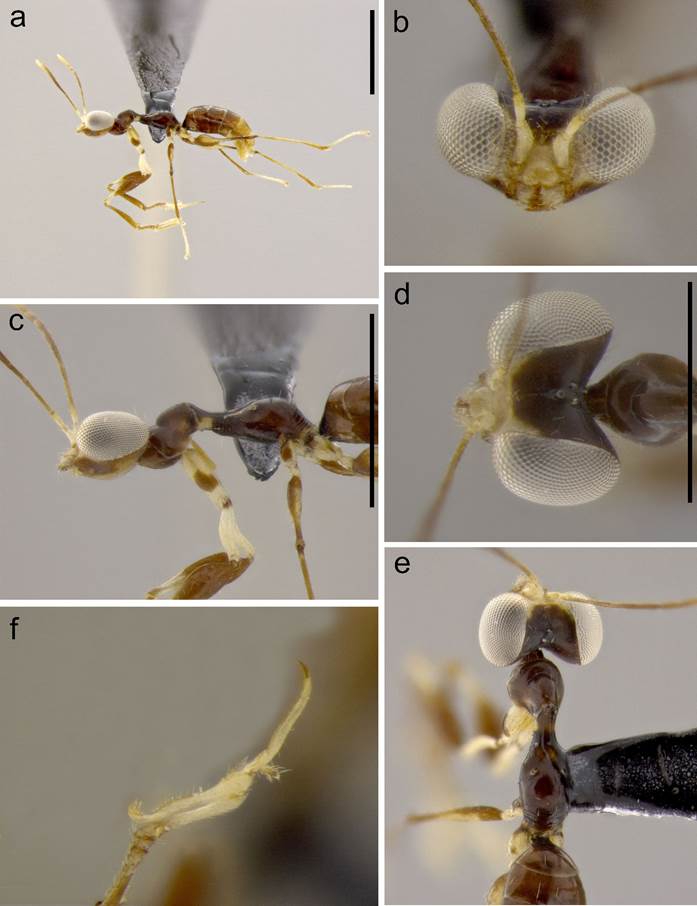
Gonatopus jadisi Martins sp. nov. (Figures 1 and 3)

Gonatopus jadisi Martins sp. nov. A - habitus, lateral view; B - head, frontal view; C - head and mesosoma, lateral view; D - head, dorsal view; E - head, mesosoma and part of metasoma, dorsal view; F - chela. Scale bars: A-F=1.0 mm
Zoobank identifier: urn:lsid:zoobank.org:act:9C34031B-5CF7-4064-84AC-FE78500646E2
Type Material: female, Brasil, Amazonas, Manaus\ Rio Tarumã-Mirim 3º2’S, 60º17’W\ Floresta de igapó; ground ecletor traps Rbof I/2\ 20.i.1988, Adis, J. leg., INPA-HYM\ 034972 (INPA).
Paratype: 1 female: Brasil, Amazonas, Manaus\ Tarumã-Mirim 3º2’S, 60º17’W\ Floresta de igapó; ground ecletor traps Rbof I/2\ 20.i.1988, Adis, J. leg., INPA-HYM\ 034973 (INPA). 1 female: “UFES nº\ 20228” “Brasil, SP- Américo Brasiliense\ Cerradão, Clube Náutico\ Moericke copa 2mB\ 29.IX-02.XI.1999,\ M.T. Tavares equipe col.” “Dryinidae\ 200\ E. A. Faustino, det.” (UFES).
Diagnosis
Body predominantly testaceous or brown testaceous, except part of pronotum and mesosoma dark brown testaceous; legs testaceous, except part of coxae, trochanters and protarsomeres whitish; body with sparse pilosity, predominantly smooth, except mesosoma with transversal carinae in anterior margin and in posterior margin of propodeum. Occipital carina present, restricted only to the lateral margin of posterior ocelli; frontal line incomplete; OL as long as POL. Claws of middle and posterior legs open without basal expansion; 5th protarsomere with one row of six lamellae located in the distal half of the segment and distal apex with about 11 lamellae.
Description
Female (holotype). Apterous; body length 3,25 mm. Color: Head brown testaceous, except gena, face yellow testaceous and part of frons and vertex dark brown testaceous (Figure 1a-d); antenna with scape, pedicel and 7-8 flagellomeres yellow testaceous, and 1-6 flagellomeres brown testaceous (Figure 1a,c); palpomeres whitish. Pronotum dark brown testaceous (Figure 1c); mesosoma dark brown testaceous (Figure 1c); legs testaceous, except part of coxa, trochanter and protarsomeres whitish (Figure 1a,c). Pubescence: Head with sparse pilosity; inner margin of the eye with long and erect pilosity on posterior margin; antenna with short and dense pilosity (Figure 1b,d,e); pronotum with sparse pilosity (Figure 1c); mesosoma with sparse and erect pilosity (Figure 1c,e); mesoscutum without two lateral pointed apophyses; metasoma with sparse and long pilosity (Figure 1a). Integumental sculpture: Head and pronotum smooth (Figure 1a,c,d); mesosoma with transversal carinae in anterior and posterior margin of propodeum (Figure 1c,e). Structure and proportions: Head with vertex little excavated (Figure 1b). Ocellar ratio: OL = 3.0; POL = 3.0; OOL = 13.0; OPL = 0. Occipital carina restricted only to the lateral margin of the posterior ocelli. Antennomeres with the following proportions: 15: 11: 30: 16: 14:14: 11: 10: 10: 16. Malar space as long as mandible base. Frontal line incomplete near to the clypeus; mid portion of clypeus with anterior margin straight. Palpomeres formula 4: 2. Protarsomeres in following proportions: 22: 5: 6: 30: 45 and enlarged claw (= 40). Chela with enlarged claw with six bristles; 5th protarsomere with one row of six lamellae located in distal half of segment and distal apex with about 11 lamellae (Figure 1f). Claw of middle and posterior legs open, without basal expansion. Dorsal surface of propodeum shorter than posterior (15: 25). Tibial spurs 1/0/2.
Etymology
The name of the species is a homage to the collector Dr. Joachim Ulrich Adis.
Remarks
Among the Gonatopus species belonging to species-group 7 present in the Neotropical region, Gonatopus jadisi Martins sp. nov. is closely related to Gonatopus huggertiOlmi 1992 by the following sets of characteristics: head excavated, shiny and smooth; mesoscutum without two lateral pointed apophyses; posterior margin of the propodeum crossed by several and transversal carinae; 5th protarsomere with lamellae located in distal half. But G. jadisi Martins sp. nov differs from G. huggerti by having a predominantly brown testaceous body; frontal line incomplete near to the clypeus; OL as long as POL; occipital carina incomplete, restricted to the lateral margin of the posterior ocelli; mesoscutum smooth, except lateral margin crossed by several and longitudinal carina; metanotum convex; 5th protarsomere with one row of six lamellae located in the distal half of the segment and distal apex with about 11 lamellae.
Key to females of Neotropical species of Gonatopus of the 7th species-group (Specific couplets modified based on the numeration of the original key by Olmi and Virla 2014 )
35. Mesoscutum with two lateral pointed apophyses; 5th protarsomere with lamellae beginning in proximal third (figure 195a in Olmi and Virla 2014); labial palpus 3-segmented ……………………… G. providus Olmi,1991
- Mesoscutum without two lateral pointed apophyses; 5th protarsomere with lamellae located in distal half (figure 190d in Olmi and Virla 2014); labial palpus 2-segmented …… 35’
35’. Body predominantly testaceous; frontal line complete; OL shorter than POL; mesoscutum smooth; occipital carina absent; metanotum flat; 5th protarsomere with one row of 12 lamellae located in distal half of segment; distal apex with about 7-16 lamellae ………………… G. huggertiOlmi, 1992
- Body predominantly brown testaceous; frontal line incomplete near to the clypeus; OL as long as POL; mesoscutum smooth, except lateral margin of mesosoma crossed by several and longitudinal carina; occipital carina incomplete, restricted on lateral margin of posterior ocelli; metanotum convex; 5th protarsomere with one row of six lamellae located in distal half of segment; distal apex with about 11 lamellae............................Gonatopus jadisi Martins sp. nov.
Genus Pareucamptonyx Olmi 1991
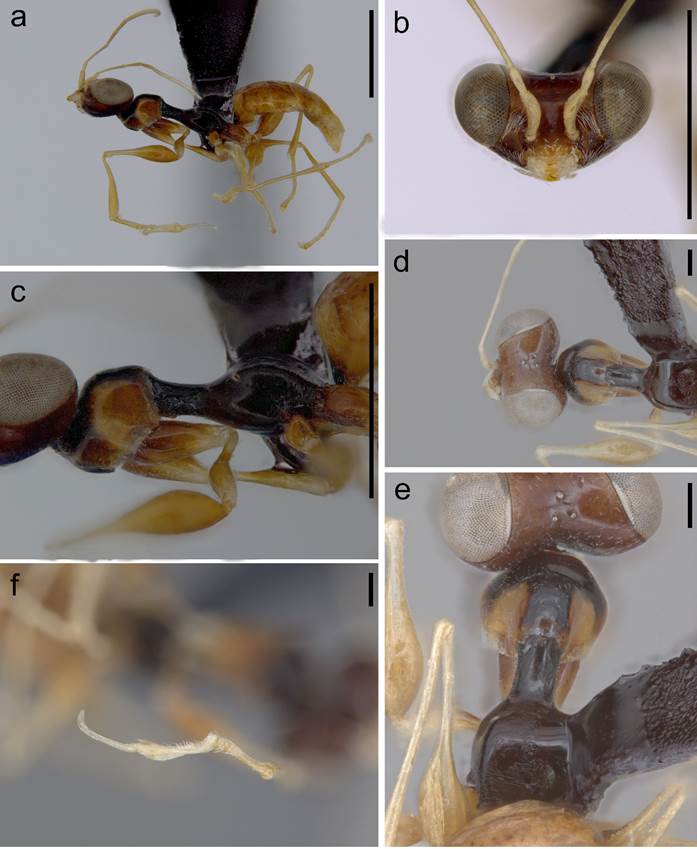
Pareucamptonyx igapoense Martins sp. nov. (Figures 2 and 3)

Pareucamptonyx igapoense Martins sp. nov. A - habitus, lateral view; B - head, frontal view; C - head and mesosoma, lateral view; D - head, dorsal view; E - head, mesosoma, and part of metasoma, dorsal view; F - chela. Scale bars: A-C = 1,0 mm; D-F = 0.2 mm.
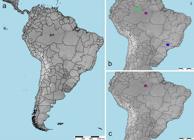
Distribution map of the Gonatopus species and Pareucamptonyx. A - South America with Brazilian states where records of the new species were found. B - Distribution of Gonatopus jadisi Martins sp. nov. holotype (red circle), paratype (blue square) and records of Gonatopus breviforcepsKieffer, 1904 from Amazonas (red square); C - Distribution of Pareucamptonyx igapoense Martins sp. nov. holotype (red circle) and paratype (blue square).
Zoobank identifier: urn:lsid:zoobank.org:act:DB42EF80-2020-400C-9EA1-13906990D0F1
Type Material: female, Brasil, Amazonas, Manaus\ Rio Tarumã-Mirim 3º2’S, 60º17’W,\ Floresta de igapó; Ecletor de árvore traps BE\ 48 A subindo,\ 22.iii.1976, Adis, J. leg., INPA-HYM\ 034970 (INPA).
Paratype: 1 female: Brasil, Amazonas, Manaus,\ Rio Tarumã-Mirim 3º2’S, 60º17’W, Floresta de igapó, Ecletor de árvore traps BE\ 49 E subindo, 17.ii.1976, Adis, J. leg., INPA-HYM\ 034971 (INPA).
Diagnosis
Head brown testaceous, except mandible whitish with teeth brown testaceous, antenna testaceous, mesosoma partially black, lateral margin of pronotum, legs, and metasoma testaceous; head, mesosoma, and metasoma with sparse pilosity; body predominantly smooth, except anterior margin of mesoscutum and posterior margin of propodeum partially rugose or with transversal carina. Occipital carina absent; frontal line incomplete near the clypeus; OL longer than POL; chela with enlarged claw with one row of five bristles; 5th protarsomere with five lamellae and distal apex with one group of 17 lamellae.
Description
Female. Apterous, body length 1,68mm. Color: Head brown testaceous; except mandible whitish with brown teeth testaceous; antenna testaceous; dorsal inner margin of eyes with a whitish macula (Figure 2a,b,d); pronotum black, except lateral surface testaceous (Figure 2c,e); mesoscutum black (Figure 2a,c,e); legs testaceous, except chela white; petiole black and metasoma testaceous. Pubescence: Head with fine and sparse pilosity, except clypeus with short pilosity; malar space with dense pilosity; gena glabrous and with sparse pilosity; pronotum with sparse and short pilosity (Figure 2a,c); mesoscutum, mesoscutellum and metanotum glabrous (Figure 2c,e); legs with short and sparse pilosity (Figure 2a); mesopleuron and metapleuron with sparse and short pilosity; propodeum glabrous; metasoma with short and sparse pilosity. Integumental sculpture: Head smooth, except clypeus (Figure 2b,d,e) and part of malar space and vertex granulate (Figure 2a); pronotum, mesoscutellum and metanotum smooth; mesoscutum predominantly smooth except some longitudinal carina on lateral surface (Figure 2c,e); mesoscutum without lateral pointed apophyses (Figure 2c,e). Mesopleuron and metapleuron smooth, except posterior surface with some sparsely located transverse carinae (Figure 2c); propodeum partially smooth and rugose, except by crossed sparse transverse carinae (Figure 2c,e). Structure and proportions: Head with vertex excavated. Ocellar ratio: OL= 4.0; POL = 3.0; OOL = 18.0. Occipital carina absent. Antennomeres in following proportions:10: 5: 19: 10: 10: 8: 6: 6: 5: 8. Flagellomeres 5-8 with rhinaria. Frontal line incomplete near the clypeus. Palpomeres formula 6:3. Protarsomeres in following proportions:11: 3: 5: 10: 20 and enlarged claw (= 17). Chela with enlarged claw with one row of five bristles (Figure 2f); inner margin of 5th protarsomere with five lamellae and distal apex with one group of 17 lamellae (Figure 2f). Tibial spurs 1/0/2.
Etymology
The name of the species is allusive to the regional Brazilian name of the ecosystem where the species was collected (igapó).
Remarks: Among the Pareucamptonyx species present in the Neotropical region, Pareucamptonyx igapoenseMartins sp. nov. is closely related to P. kumagaiae Martins, 2022, by the partially brown testaceous body, 5-8 rhinaria on the flagellomeres, the dorsal inner margin of the eyes with a whitish macula, and OL longer than POL. It differs from P. kumagaiae by the head with a smooth vertex, the whitish mandible, the malar space with dense pilosity, the propodeum with sparse carinae, the chela with an enlarged claw with one row of five bristles, the 5th protarsomere with five lamellae and the distal apex with one group of 17 lamellae.
Key to females of Neotropical species of Pareucamptonyx (Specific couplets modified based on the original key by Martins and Domahovski 2022 )
4. Body predominantly brown testaceous (figure 4a in Martins and Domahovski 2022); legs and metasoma testaceous or brown testaceous; frontal line absent or present; mesoscutum rugose (figure 9b ibid), with some irregular longitudinal carinae; chela with enlarged claw and 5th protarsomere with variable number of lamellae between 10-17 ……………… 4’
- Body predominantly black, except pronotum, legs and metasoma dark brown (figure 5a ibid); frontal line complete; mesoscutum smooth (figure 9c ibid), except some longitudinal carinae on lateral surface (figure 5d ibid); chela with inner margin of the 5th protarsomere with one row of five lamellae and two long bristles (figure 10c ibid) … P. nigerMartins 2022
4’. Head rugose, except part of face and vertex smooth; frontal line and occipital carina absent; malar space glabrous; mandible dark brown; 5th protarsomere with one row of six lamellae and three long bristles and distal apex with one group of 10 lamellae (figure 10b ibid) ..... P. kumagaiaeMartins 2022
- Head with smooth vertex; frontal line present; mandible whitish; malar space with dense pilosity; 5th protarsomere with five lamellae and distal apex with one group of 17 lamellae (Figure 2f) ……… Pareucamptonyx igapoense Martins sp. nov.
DISCUSSION
Historically, the Dryinidae family has been a neglected group due to the lack of specialists dedicated to studying it, especially the species found in the Neotropical region. In Brazil, this scenario has changed, and in recent years, there has been an increase in studies involving the biology, ecology, systematics and taxonomy of different genera in the family (e.g. Olmi and Virla 2014; Martins et al. 2015, 2020a; Martins 2022; Martins and Melo 2024; Celante et al. 2025).
Currently, 12 species belonging to Gonatopus and Pareucamptonyx are recorded for the Amazon biome (Table 1), and only one (Figure 3a) for the state of Amazonas (Coelho et al. 2011; Olmi and Virla 2014; Martins and Krinski 2016). With the description of the two new species, we expanded these figures to three species for the state of Amazonas and 14 species for the Amazon biome. Although foraging is a common survival and reproductive success strategy in Dryinidae females are frequently in search of their hosts and males are in search of females to reproduce (Martins and Domahovski 2017a,b). There are few records of apterous females of Dryinidae collected in suspended traps with vertical displacement (Martins et al. 2020a).
Species of Gonatopus and Pareucaptonyx recorded for the state of Amazonas and other Brazilian states.
Most studies involving apterous species of Esagonatopus and Gonatopus (Hymenoptera, Gonatopodinae) were carried out using Malaise traps at ground level (Martins et al. 2015; Martins 2018; Martins et al. 2020a; Martins and Domahovski 2022). This was the first study to record the vertical migration of adult apterous females of Pareucamptonyx igapoense Martins sp. nov. on tree trunks, possibly to adapt to flooded areas, as the flood of the Negro River submerges trees over 20 m high during long periods, forcing the fauna to migrate vertically (Iron and Adis 1979; Adis 1979, 1997). Vertical foraging in response to the flood pulse in floodplain forests has already been recorded for arthropod fauna in the region (Adis 1981, 1984, 1997; Adis and Mahnert 1990), but not for Dryinidae.
The occurrence of G. jadisi Martins sp. nov. in the states of Amazonas and São Paulo, respectively in the Amazon and Atlantic Forest biomes, suggests the possibility of a disjunct distribution for this species, although species of other genera, such as Dryinus, are widely distributed. For example, Dryinus striatus (Fenton) and D. ruficeps (Cameron) occur across the Amazon, Caatinga, and Atlantic Forest biomes (Martins, unpublished data). The distribution of Dryinidae species, especially those from apterous groups, remains a subject of limited comprehension, primarily due to the difficulty in collecting these insects, and the paucity of known or specific hosts for some species. Therefore, their actual distribution may be far broader than currently documented (Martins et al. 2020b, 2024a).
Our study is the first with the repatriated material from Germany described above (MLO and EMRS, personal communication). In addition to the new species of Dryinidae described here, other arthropods were also recovered, such as crustaceans and arachnids, as well as vertebrates (frogs, lizards and small fishs), all of which will be considered in other manuscripts with a more specific resolution appropriate to the taxonomic groups rescued.
It will be important to adequately manage and thoroughly process the repatriated collection, as it holds great potential for new findings of underestimated and little-studied groups in northern Brazil (Olmi and Virla 2014; Martins and Krinski 2016; Martins 2025), as well as for new location records of other groups.
CONCLUSIONS
The repatriation of a large collection of Amazonian specimens from Germany to Brazil allowed us to expand our knowledge about the Amazonian Dryinidae fauna, through the record and description of two new species, Gonatopus jadisi Martins sp. nov. and Pareucamptonyx igapoense Martins sp. nov., collected in blackwater floodplain forest (igapó), by Manaus, Amazonas, Brazil. The description of the two new species expands our knowledge about the biodiversity of the family, increasing from 12 to 14 the number of species recorded in the Amazon rainforest. Our study emphasizes the importance of international collaboration and also highlights the need for future research to contribute to the knowledge of insect biodiversity in tropical ecosystems. To date, none of the species described for the genera have been identified in the examined material, suggesting that these species are rarely collected and are primarily found in blackwater floodplain forest (igapó).
ACKNOWLEDGMENTS
Many thanks to Dr. Gabriel A.R. Melo, curator for Hymenoptera at the Coleção Padre Jesus Santiago Moure - DZUP, UFPR, for providing the infrastructure needed to develop this study. This paper was partially funded by the Conselho Nacional de Desenvolvimento Científico e Tecnológico (CNPq) stipends for E.M.R.S. (grant 301767/2024-6 PCI/INPA) and A.L.M. (grant 151844/2022-4), and MLO (Productivity grant 311016/2023-5).
REFERENCES
- Adis, J. 1977. Programa mínimo para análises de ecossistemas: Artrópodos terrestres em florestas inundáveis da Amazônia Central. Acta Amazonica 7: 223-229.
- Adis, J. 1979. Ecology and biology of Amazonian floodplains. In: Junk, W.J. (Ed.). The Central Amazon Floodplain. Ecology of a Pulsing System Ecological Studies 126, Springer, Heidelberg, p.331-334.
- Adis, J. 1981. Comparative ecological studies of the terrestrial arthropod fauna in Central Amazonian inundation-forests. Amazoniana 7: 87-183.
- Adis, J. 1984. ‘Seasonal igapó’ forests of Central Amazonian black water rivers and their terrestrial arthropod fauna. In: Sioli, H. (Ed.). The Amazon. Limnology and Landscape Ecology of a Mighty Tropical River and Its Basin Monographiae Biologicae, Springer, Dordrecht, p.245-268.
- Adis, J. 1997. Terrestrial invertebrates: Survival strategies, group spectrum, dominance and activity patterns. In: Junk, W.J. (Ed.). The Central Amazon Floodplain. Ecology of a Pulsing System Ecological Studies 126, Springer, Heidelberg, p.299-317.
- Adis, J. 2002. Amazonian Arachnida and Myriapoda. Identification Keys to All Classes, Orders, Families, Some Genera, and Lists of Known Terrestrial Species Series Faunistica, v.24. Pensoft Publishers, Sofia and Moscow, 590p.
- Adis, J; Mahnert, V. 1990. On the species composition of Pseudoscorpiones (Arachnida) from Amazonian dryland and inundation forest in Brazil. Revue Suisse de Zoologie 97: 49-53.
- Beutel, R.G.; Yavorkaya, M. I.; Mashimo, Y.; Fukui, M.; Meusemann, K. 2017. The phylogeny of Hexapoda (Arthropoda) and the evolution of megadiversity. Proceedings of Arthropodan Embryological Society of Japan 51: 1-15.
- Cameron, P. 1888. Dryinae. In: Cameron, P. (Ed.), Biologia Centrali-Americana. Insecta, Hymenoptera (Families Tenthredinidae-Chrysididae), I. R.H. Porter, London, p. 440-448.
-
Celante, G.L.; Domahovski, A.C.; Jahyny, B.J.B.; Martins, A.L. 2025. Taxonomy and biological aspects of Gonatopus Ljungh (Hymenoptera: Dryinidae): description of a new species, sexual association and record of host from Northeast Brazil. Neotropical Entomology 54: 38. doi.org/10.1007/s13744-024-01217-7
» https://doi.org/10.1007/s13744-024-01217-7 - Coelho, B.W.; Aguiar, A.P.; Engel, M.S. 2011. A survey of Dryinidae (Hymenoptera, Chrysidoidea) from Caxiuanã, Amazon Basin, with three new taxa and keys to genera and species. Zootaxa 2907: 1-21.
- Constantino, R. 2024. A importância dos insetos. In: Rafael, J.A.; Melo, G.A.R.; Carvalho, C.J.B. de; Casari, S.; Constantin o, R. (Eds.). Insetos do Brasil: Diversidade e Taxonomia, 2nda ed. Editora INPA, Manaus, p.109-113.
- Guglielmino, A.; Olmi, M.; Bückle, C. 2013. An updated host-parasite catalogue of world Dryinidae (Hymenoptera: Chrysidoidea). Zootaxa 3740: 1-113.
- Haliday, A.H. 1833. An essay on the classification of the Parasitic Hymenoptera of Britain, which corresponds with the Ichneumones minuti of Linnaeus. TheEntomological Magazine 1: 259-273.
- Harris, R.A. 1979. A glossary of surface sculpturing. Occasional Papers in Entomology 28: 1-31.
- Iron, G.; Adis, J. 1979. Evolução de florestas amazônicas inundadas, de igapó - um exemplo do rio Tarumã-Mirim. Ecologia. Acta Amazonica 9: 299-330.
- Junk, W.J.; Bayley, P.B.; Sparks, R.E. 1989. The flood pulse concept in river-floodplain systems. Canadian Special Publication of Fisheries and Aquatic Sciences 106: 110-127.
- Junk, W.J.; Soares, M.G.M.; Saint-Paul, U. 1997. The Fishes. In: Junk, W.J. (Ed.). The Central Amazon Floodplain. Ecology of a Pulsing System Ecological Studies 126, Springer, Heidelberg, p.385-408.
- Kieffer, J.J. 1904. Description de nouveaux Dryininae et Bethylinae du Musée Civique de Génes. Annali del Museo civico di Storia naturale di Genova 41: 351-412.
- Kieffer, J.J. 1906. Beschreibung neuer Proctotrypiden aus Nord-und Zentralamerika. Berliner Entomologische Zeitschrift 50: 237-290.
- Ljungh, S.J. 1810. Gonatopus, novum insectorum genus. Beiträge zur Naturkunde 2: 161-163.
- Martins, A.L.; Lara, R.I.R.; Perioto, N.W.; Olmi, M. 2015. Two new species of Dryinidae (Hymenoptera: Chrysidoidea) from areas of Atlantic Rainforest at São Paulo State, Brazil. Brazilian Journal of Biology 75: 455-459.
- Martins, A.L.; Krinski, D. 2016. First record of the parasitoid Gonatopus flavipes Olmi, 1984 (Hymenoptera, Dryinidae) in Brazil’s Amazon forest. Journal of Hymenoptera Research 50: 191-196.
- Martins, A.L.; Domahovski, A.C. 2017a. New record of Gonatopus flavoniger Olmi, 1991 (Hymenoptera: Dryinidae) from Paraná, Brazil, with notes on some aspects of its biology and morphology. Check List 13: 95-99.
- Martins, A.L.; Domahovski, A.C. 2017b. Redescription and biology of Gonatopus amazonicus Olmi (Hymenoptera, Dryinidae) from Southern Brazil. Zootaxa 4324: 592-596.
- Martins, A.L. 2018. A new species of Esagonatopus Olmi (Hymenoptera, Dryinidae) from Central Brazil. Zootaxa 4379: 441-444.
- Martins, A.L.; Domahovski, A.C.; Rendón-Mera, D.I. 2020a. Sexual association and cicadellidae hosts of Dryinidae (Hymenoptera, Chrysidoidea): description of five new species from Brazil and a synopsis of the interaction with Gyponini (Hemiptera, Membracoidea). Insect Systematic and Evolution 52: 167-200.
- Martins, A.L.; Lemes, J.R.A.; Lopes, P.R.; Penteado-Dias, A.M. 2020b. The Chrysidoidea wasps (Hymenoptera, Aculeata) in conventional coffee crops and agroforestry systems in Southeastern Brazil. Papéis Avulsos de Zoologia 60: e20206058.
- Martins, A.L. 2022. A new species of pincer wasps of Deinodryinus Perkins (Hymenoptera, Dryinidae) from the oceanic archipelago of Fernando de Noronha, Brazil. Papéis Avulsos de Zoologia 62: e202262044.
- Martins, A.L.; Domahovski, A.C. 2022. Revision of the Neotropical species of Pareucamptonyx Olmi (Hymenoptera, Dryinidae) with descriptions of new species. European Journal of Taxonomy 846: 152-176.
- Martins, A.L.; Celante, G.L.; Domahovski, A.C.; Jahyny, B.J.B. 2024a. The pincer wasps of the genus Dryinus Latreille in northeastern Brazil: a new host record and distribution for two species (Hymenoptera, Dryinidae). Journal Insect Biodiversity 55: 28-36.
- Martins, A.L.; Melo, G.A.R. 2024. Phylogenetic analysis of Neotropical Dryinus using morphological characters: new proposed classification for species groups and description of a new genus (Hymenoptera: Dryinidae). Zoological Journal of the Linnean Society 202: zlae122.
- Martins, A.L.; Muniz, D.B.; Domahovski, A.C. 2024b. Description of the male Gonatopus pinhalensis (Dryinidae, Gonatopodinae) supported by DNA barcoding, and new host records. Insect Systematics and Evolution 55: 1-14.
-
Martins, A.L. 2025. Dryinidae in Catálogo Taxonômico da Fauna do Brasil. PNUD. http://fauna.jbrj.gov.br/fauna/faunadobrasil/919 Access on: 03 Jan 2025.
» http://fauna.jbrj.gov.br/fauna/faunadobrasil/919 - Melack, J.M.; Coe, M.T. 2021. Amazon floodplain hydrology and implications for aquatic conservation. Aquatic Conservation: Marine and Freshwater Ecosystems 31: 1029-1040.
- Myster, R.W. 2018. What we know about the composition and structure of igapó forests in the Amazon Basin. The Botanical Review 84: 394-410.
- Olmi, M. 1984. A revision of the Dryinidae (Hymenoptera). Memoirs of the American Entomological Institute 37: 1-1913.
- Olmi, M. 1986. New species and genera of Dryinidae (Hymenoptera Chrysidoidea). Frustula entomologica N.S., 7-8: 63-105.
- Olmi, M. 1991“1989”. Supplement to the revision of the world Dryinidae (Hymenoptera: Chrysidoidea). Frustula entomologica N.S. 12: 109-395.
- Olmi, M. 1992. Contribution to the knowledge of the Gonatopodinae (Hymenoptera Dryinidae). Bollettino dell’Istituto di Entomologia dell’Università di Bologna 46: 109-122.
- Olmi, M. 1995. Contribution to the knowledge of the world Dryinidae (Hymenoptera Chrysidoidea). Phytophaga 6: 3-54.
- Olmi, M. 2004. Description de deux nouvelles espèces de Dryinidae (Hymenoptera, Chrysidoidea). Revue française d’Entomologie, N.S. 26 (4): 179-181.
- Olmi, M.; Virla, E.G. 2014. Dryinidae of the Neotropical Region (Hymenoptera: Chrysidoidea). Zootaxa 3792: 1-534.
- Olmi, M.; Copeland, R.S.; van Noort, S. 2019. Dryinidae of the Afrotropical region (Hymenoptera, Chrysidoidea). Zootaxa 4630: 1-619.
- Perkins, R. 1905. Leafhoppers and their natural enemies (Pt. I. Dryinidae). Report of Work of the Experiment Station of the Hawaiian Sugar Planters’ Association, Division of Entomology, Bulletin, No. 1, 1-69.
- Riolo, P.; Isidoro, N.; Ruschioni, S.; Minuz, R.L.; Bin, F.; Romani, R. 2016. Anatomy of the antennal dorsal organ in females of Neodryinus typhlocybae (Hymenoptera: Dryinidae): a peculiar sensory structure possibly involved in perception of host vibration. Journal of Morphology 277: 128-137.
-
Shorthouse, D.P. 2010. SimpleMappr. An online tool to produce publication-quality point maps. ( (https://www.simplemappr.net ). Accessed on 08 Jan 2025.
» https://www.simplemappr.net - Virla, E.G.; Espinosa, M.S.; Olmi, M. 2010 [“2008”]. A contribution to the knowledge of Dryinidae of Argentina: descriptions of the hitherto unknown males of Gonatopus argentinus Olmi and Trichogonatopus richardsi Olmi (Hymenoptera Chrysidoidea). Frustula entomologica, N. S. 31: 125-134.
Data availability
The authors state that all data supporting the findings of this study are available in the body of the article.
Edited by
-
ASSOCIATE EDITOR:
Lívia Prado https://orcid.org/0000-0003-1819-8767