 Occurrence of Echinococcus vogeli in Cuniculus paca from the Western Amazon and its implications for the health of local traditional communities
ABSTRACT
Consumption of wild animals, especially the paca (Cuniculus paca), is a common practice among traditional communities. This rodent represents the main intermediate host for Echinococcus vogeli, the etiological agent of human polycystic echinococcosis, which is a zoonosis of growing public health concern in the region. This study aimed to investigate the occurrence of E. vogeli in livers of pacas slaughtered and consumed by resident traditional communities in the Western Brazilian Amazon. The research was observational and descriptive, conducted between May 2022 and December 2023 in traditional communities of Sena Madureira and Rio Branco (State of Acre, Brazil). Household interviews were performed to characterize hunting practices and dog management, along with the collection of paca livers for parasitological and molecular analysis (amplification and sequencing of a fragment of the cox1 mtDNA). Of the 78 families interviewed, 78% reported the practice of subsistence hunting. A total of 194 dogs were recorded, 83% of which actively participated in hunting activities, and 80% often consumed raw viscera, mostly from pacas. Among the 23 livers analyzed, 48% contained hydatid cysts (ranging from 1 to 13 cysts per liver), with E. vogeli infection confirmed based on morphology and PCR. The findings suggest that feeding dogs with raw viscera may facilitate the establishment of the domestic transmission cycle of E. vogeli, thereby increasing the risk of zoonotic infection. The close contact between humans, dogs, and infected paca livers highlight the urgent need for epidemiological surveillance and educational strategies aiming at the prevention of echinococcosis in endemic areas.
Keywords:
zoonotic transmission; sociocultural factors; epidemiological surveillance; emerging parasitoses
RESUMO
O consumo de animais silvestres, especialmente a paca (Cuniculus paca), é uma prática comum entre comunidades tradicionais. Este roedor representa o principal hospedeiro intermediário do Echinococcus vogeli, agente etiológico da equinococose policística humana, uma zoonose de crescente preocupação para a saúde pública na região. Este estudo teve como objetivo investigar a ocorrência de E. vogeli em fígados de pacas abatidas e consumidas por moradores de comunidades tradicionais da Amazônia Ocidental Brasileira. A pesquisa, de caráter observacional e descritivo, foi realizada entre maio de 2022 e dezembro de 2023, em comunidades tradicionais de Sena Madureira e Rio Branco (Estado do Acre, Brasil). Foram conduzidas entrevistas domiciliares para caracterizar práticas de caça e manejo de cães, bem como coletas de fígados de pacas para análises parasitológicas e moleculares (amplificação e sequenciamento de um fragmento do mtDNA cox1). Das 78 famílias entrevistadas, 78% relataram praticar caça de subsistência. Foram contabilizados 194 cães, dos quais 83% participavam de caçadas e 80% consumiam vísceras cruas, especialmente de pacas. Dos 23 fígados analisados, 48% apresentaram cistos hidáticos (1 a 13 por fígado), com confirmação de E. vogeli por morfologia e PCR. Os resultados sugerem que alimentar cães com vísceras cruas pode facilitar o estabelecimento do ciclo de transmissão doméstico de E. vogeli, aumentando assim o risco de infecção zoonótica. O contato próximo entre humanos, cães e fígados de pacas infectados ressalta a necessidade urgente de vigilância epidemiológica e estratégias educacionais visando à prevenção da equinococose em áreas endêmicas.
Palavras-chave:
transmissão zoonótica; fatores socioculturais; vigilância epidemiológica; parasitoses emergentes
INTRODUCTION
Neotropical polycystic echinococcosis (NPE) is a zoonotic disease caused by Echinococcus vogeli, a cestode belonging to the family Taeniidae, which was described in 1972 (Rausch and Bernstein 1972). This species is endemic to the Neotropical Region, and has been reported in Brazil, Colombia, Bolivia, Peru, and Argentina (D’Alessandro and Rausch 2008). It is associated with severe infections in humans, particularly among residents of traditional communities composed of rubber tappers, riverside dwellers, farmers and indigenous populations (D’Alessandro and Rausch 2008; Soares et al. 2004; Siqueira et al. 2013). In Brazil, human cases are predominant in the northern region, especially in the states of Acre and Pará (Pastore et al. 2003; Soares et al. 2004; Siqueira et al. 2013).
The sylvatic cycle of E. vogeli includes the canid Speothos venaticus (bush dog) as definitive host and the paca (Cuniculus paca), a rodent widely distributed throughout the Amazon, as intermediate host that has an essential role for the maintenance of the parasite (Rausch and Bernstein 1972; Almeida et al. 2013; Soares et al. 2014; Souza et al. 2023). In domestic environments, domestic dogs that are common in traditional communities serve as definitive hosts by consuming raw viscera from infected pacas, a practice that supports the domestic transmission of the parasite (Neves et al. 2017; Souza et al. 2023).
In traditional Amazonian communities, subsistence hunting is a common and essential practice for household nutrition and survival, as families rely on forest resources to supplement their diets and sustain their way of life (Chaves et al. 2018; Guimarães et al. 2019; Souza et al. 2021; Sampaio et al. 2022). The paca is among the most frequently consumed wild animals by these populations, and domestic dogs are often fed with its viscera. Such a practice facilitates the introduction of E. vogeli into domestic environments and, consequently, increases the risk of human transmission (Neves et al. 2017; Souza et al. 2023).
The close relation between dogs and humans contributes to the dissemination of E. vogeli eggs, which may result in an increase of human infections by accidental ingestion of these parasite forms in contaminated soil or food (Neves et al. 2017). Understanding the life cycle of E. vogeli and its transition from sylvatic to the domestic environment is crucial for the control of NPE, as well as for improving the diagnostic methods and epidemiological surveillance strategies. The present study aimed to investigate the occurrence of E. vogeli in livers of pacas slaughtered and consumed by residents of traditional communities in the Western Brazilian Amazon.
MATERIALS AND METHODS
Study area
The study was conducted in the municipalities of Rio Branco and Sena Madureira, State of Acre, located at the Western Amazon, Brazil. Collection sites were selected based on the historical occurrence of human NPE cases and accessibility to traditional communities. In Sena Madureira, sample collections were carried out in four traditional communities: i) Cazumbá-Iracema (9°30′51″S, 69°28′20″W), a federal protected area that is part of the Western Amazon Corridor; ii) Novo Amparo (9°04’16.0”S, 68°27’02.0”W), a land settlement project and managed by the INCRA and located along the Purus River; iii) Joaquim José de Matos (9°23’35.6”S, 68°35’37.8”W), located along the BR-364 Highway at kilometer 104; and iv) São José (9°22’28.6”S, 68°43’29.0”W), situated along the Yaco River. In Rio Branco, the capital of the state of Acre, sample collection was carried out in the Vila Verde community (9°56′05″S, 68°18′15″W), located along the Transacreana Highway, a key agricultural expansion corridor connecting urban and rural areas.
Data and biological sample collection
Data on hunting practices and the biological samples were collected from 2022 to 2023. In Sena Madureira, one field expedition was conducted in each of the selected community, with support from the local health surveillance team. During household visits, a semi-structured questionnaire was administered to the head of the household to gather information on the presence of domestic dogs, hunting practices, consumption of wildlife species, and methods for disposing of viscera from hunted animals. In Rio Branco, no household visits were conducted. Samples were donated by Community Health Agents (CHAs) working in the region.
All participants received guidance on NPE and instructions on the proper preservation of Cuniculus paca livers for research purposes. After hunting and processing the animals, local residents identified and froze the livers, which were later collected by the CHAs. Samples were then transported to the Laboratory of Pathology and Parasitic Biology at the Universidade Federal do Acre, following protocols established in collaboration with the municipal health surveillance teams.
Macroscopic evaluation of livers
Livers were thawed, rinsed in 0.9% saline, and macroscopically inspected for suggestive lesions of hydatid cysts. Samples with lesions were subjected to hydatid fluid aspiration using a 1 mL syringe, and the fluid was transferred to 15 mL Falcon tubes. Fragments of the germinal membrane were collected, stored in 1.5 mL microtubes containing 70% ethanol, and kept at -20 °C for molecular analyses.
Other part of the hydatid fluid was centrifuged at 3,500 rpm for 15 minutes; the supernatant was separated and stored at -20 °C for subsequent antigen preparation. The sediment was resuspended in PBS buffer (10-fold the volume of the suspension), with 90% of the suspension fixed in an equal volume of 96% ethanol and stored at -20 °C for molecular analysis. The remaining 10% was fixed in 10% formalin (5-fold the volume of the suspension) for morphometric and morphological analysis.
Parasitological diagnosis
Hydatid fluid obtained from each liver was used for direct parasitological diagnosis and morphometry of the rostellar hooks as described by Mayuri et al. (2017). Briefly, glass slides were prepared with one drop of the sample and one drop of lactophenol and incubated for 15 minutes at room temperature. Circular movements were applied to the coverslip with a rubber pencil to facilitate the detachment of hooks from protoscoleces.
Morphological and morphometric analyses were conducted using a binocular optical microscope (Leica DM750) at magnifications of 100×, 400×, and 1,000×. Hook measurements included total length and width of the blade (Mayuri et al. 2017). Images were captured with an attached digital camera (Leica ICC50 HD) and analyzed using Leica LAS EZ software.
Molecular analyses
Genomic DNA isolation was performed from germinal membranes preserved in 70% ethanol and hydatid fluid preserved in 96% ethanol. Both samples were digested using 180 µL of PureLink® Genomic Lysis/Binding Buffer supplemented with 20 µL of proteinase K, at 55 °C for 4 hours. Subsequently, the samples were centrifuged at 12,000 x g for 3 minutes, and the resulting supernatant was stored at -20 °C. DNA was later isolated using an automated system (EXTRACTA® 32) with the Extracta® DNA and RNA Kit of Pathogens (MPTA-B01K), following the manufacturer’s instructions.
Molecular detection of Echinococcus was performed by conventional polymerase chain reaction (PCR) targeting a mitochondrial cytochrome c oxidase subunit 1 (cox1 mtDNA) gene partial region with 396 bp, using the primers cox1F (5’-TTTTTTGGGCATCCTGAGGTTTAT-3’) and cox1R (5’-TAAAGAAAGAACATAATGAAAATG-3’) (Bowles et al. 1992). Echinococcus vogeli DNA from human samples was used as a positive control and ultrapure water as a negative control.
PCR reactions (final volume of 47 µL) consisted of: 26.2 µL ultrapure water, 5.0 µL 10× buffer, 2.5 µL 50 mM MgCl₂, 5.0 µL 2 mM dNTPs, 2.5 µL of each primer (10 pmol), 0.3 µL of Taq DNA polymerase (5 U/µL), and 3.0 µL of extracted DNA, according to a protocol adapted from Sánchez et al. (2010).
Amplifications were performed in a thermal cycler (CFX96 Touch Real-Time PCR Detection System) with the following cycling conditions: initial denaturation at 95 °C for 3 minutes; 35 cycles of 95 °C for 1 minute, 56 °C for 1 minute, and 72 °C for 1 minute and 30 seconds; followed by a final extension at 72 °C for 3 minutes. Amplified products were visualized by electrophoresis on 2% agarose gel.
Sequencing and genetic diversity
Positive amplicons were purified using the PureLink™ PCR Purification Kit (Invitrogen™), following the manufacturer’s instructions and Sanger sequenced at the Fundação Oswaldo Cruz (Fiocruz) platform P01 001A RPT/FIOCRUZ. Genetic sequences contigs were assembled and edited using Geneious software v.2023.0.3 (Kearse et al. 2012). The resulting consensus sequences were compared with data available in the GenBank using the Basic Local Alignment Search Tool (BLAST) and subsequently deposited in this same database (accession numbers PX229574 - PX229580). The genetic diversity of the present sequences was calculated in terms of the number of haplotypes (H), number of polymorphic sites (S), haplotype diversity (Hd), and nucleotide diversity (π) using DNAsp, version 5.10.1 (Librado and Rozas 2009). The PopART program, version 1.7, using the median-joining method, was employed to infer the haplotype network based on cox1 mtDNA sequences of E. vogeli obtained in this study, together with additional sequences deposited in GenBank, generated from the same gene (Table S1).
Ethical considerations
This study was conducted with approval from the Sistema de Autorização e Informação em Biodiversidade (SISBIO/ICMBio) under protocol number 68547-1, the Comitê de Ética no Uso de Animais da Universidade Federal do Acre (CEUA/UFAC), protocol number 15/2022, process number 23107.015181/2022-08, and the interview data as part of the project activities approved by the Comitê de Ética em Pesquisa Envolvendo Seres Humanos do Instituto Oswaldo Cruz - CEP Fiocruz/IOC (CAAE: 57573822.2.0000.5248; approval number: 3,544,996).
RESULTS
Seventy-eight families were interviewed, of which 78% (n = 61) reported engagement in subsistence hunting of wild animals during different parts of the year. All families owned dogs that were used in hunting, fishing, and extractive activities, living freely in domestic and peridomestic environments. The number of dogs per family ranged from one to eight, resulting in a sample of 194 dogs in the present study, of which 64% were males (n = 124). Most animals (83%; n = 161) used to accompany their owners in hunting, and 80% (n = 155) consumed raw viscera from hunted animals, especially paca (Table 1).
Biological and behavioral characteristics of domestic dogs from traditional communities in the municipality of Sena Madureira, State of Acre, Brazil.
Thirty livers were analyzed, of which 77% (n = 23) from the Sena Madureira and 23% (n = 7) from Rio Branco. Hydatid cysts were identified in 37% (n = 11) livers, all from Sena Madureira, with eight from the Cazumbá-Iracema community and three from the Joaquim de Matos community. The number of cysts per liver ranged from 1 to 13, with a mean of 5 cysts, totaling 57 cysts, and diameters between 0.1 and 2.0 cm.
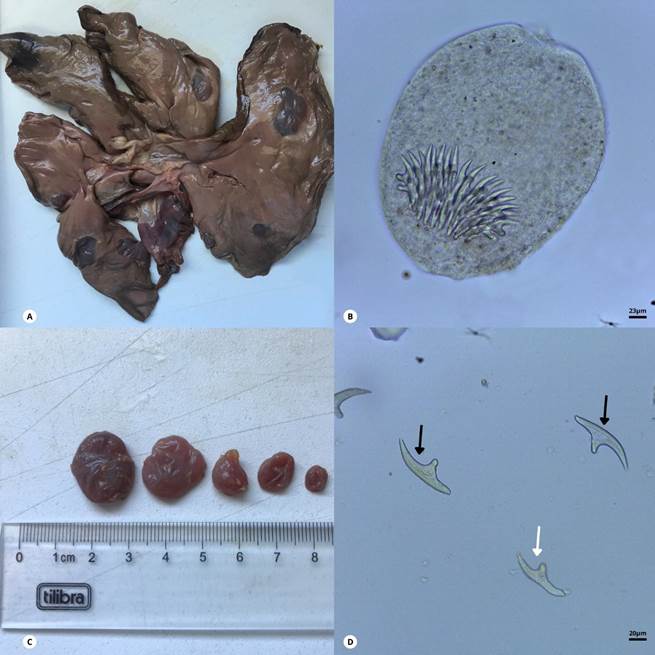
Morphological analysis revealed protoscoleces with crowns of large and small hooks (Figure 1). The larger hooks had a mean length of 42.3 ± 0.81 μm and mean width of 14.14 ± 0.48 μm, while the smaller hooks had 31.49 ± 1.54 μm of mean length and 11.53 ± 0.10 μm of mean width, measurements similar to those previously reported in the literature for E. vogeli (Table 2).
A - Livers of Cuniculus paca with Echinococcus vogeli hydatid cysts, collected from traditional communities in the municipality of Sena Madureira, State of Acre, Bazil. B - Protoscolex displaying two rows of rostellar hooks; C - Hydatid cysts measuring up to 2.0 cm in diameter; e D - Large hooks (black arrow) and small hooks (white arrow).
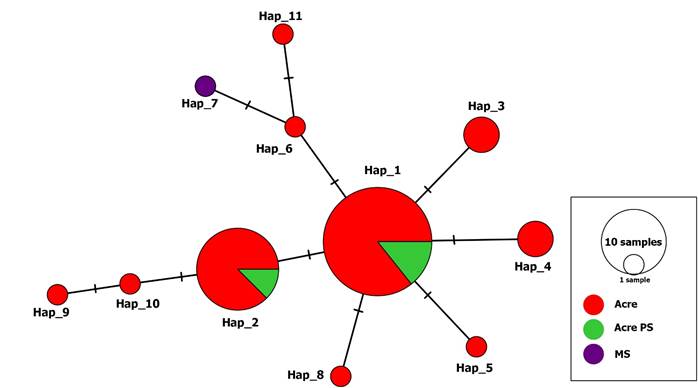
After sequencing and comparison with GenBank sequences, high similarity and identity with E. vogeli (>98% in cox1 mtDNA gene) were revealed. This confirmed the morphometric analyses and the circulation of this species in the region. The haplotype network placed the two haplotypes observed in our study with other similar haplotypes already reported in the State of Acre (Figure 2). It should be noted that in the State of Acre 10 haplotypes have been recorded, and the two haplotypes of the present sduty represented Hap_1 and Hap_2 (Figure 2).
Median-joining network of partial cox1 mitochondrial gene haplotypes of Echinococcus vogeli, based on 56 sequences from this study and GenBank. Circle sizes indicate haplotype frequencies, colors represent their geographical origins, and hash marks along the branches denote single-step mutations separating the haplotypes: Acre (red) - sequences deposited in GenBank; Acre PS (green) - sequences obtained in the present study; MS (purple) - sequence from the state of Mato Grosso do Sul (Brazil) deposited in GenBank.
DISCUSSION
This study indicates a high risk of Neotropical echinococcosis transmission in traditional communities of Sena Madureira, associated with local subsistence practices and the occurrence of E. vogeli in Cuniculus paca (paca) livers. We observed a high involvement of domestic dogs in hunting activities as well as high consumption of raw viscera of paca by them. These results clearly highlight the zoonotic risk of E. vogeli in these communities. Other results also reinforce this risk in traditional Amazonian communities (Pastore et al. 2003; Almeida et al. 2013; Neves et al. 2017; Souza et al. 2023). In this sense, health education regarding the transmission of echinococcosis and its prophylaxis is urgent in these communities.
Our findings reinforce the endemicity of E. vogeli in the municipality of Sena Madureira, State of Acre, strengthening the evidence of its active circulation in the region. These results have significant implications for local public and veterinary health, highlighting the need for surveillance and control strategies in traditional communities within the Amazon region. The presence of E. vogeli in pacas has been documented in other studies in Brazil (Meneghelli et al. 1990; Almeida et al. 2013; Souza et al. 2023; Bittencourt-Oliveira et al. 2018), yet data remain scarce, highlighting the relevance of the present study to broaden knowledge about the distribution and infection dynamics in Western Amazonia.
Detection of E. vogeli DNA using PCR represents a significant advancement for the epidemiological surveillance of NPE in the Amazon region because this method provides good sensibility and specificity. The use of mitochondrial markers, such as the cox1 mtDNA gene, has proven effective both for species identification within the genus Echinococcus and for analyzing intraspecific genetic diversity (Santos et al. 2012; Daipert-Garcia et al. 2019). The haplotypes (Hap_1 and Hap_2) found in our study were shared with E. vogeli samples previously studied from different locations in the state of Acre, and are the most frequent in the population, as demonstrated by Daipert-Garcia et al. (2019). Those haplotypes that were less frequent in Acre were not observed in our E. vogeli samples. Furthermore, we observed a lower haplotypic diversity among our sequences than what was described by Daipert-Garcia et al. (2019) in most of the localities studied. The lower genetic diversity observed in our data may be due to a more restricted number of clinical samples and locations when compared to the previous study.
The morphological characteristics of the rostellar hooks observed in the protoscoleces, combined with the molecular analysis of hydatid cysts, confirmed the presence of E. vogeli in all 11 samples with hepatic lesions from Sena Madureira. The high similarity between the sequences obtained in this study and those deposited in GenBank (98-100% identity) strengthens the species diagnosis, corroborating previous findings in the Amazon (Santos et al. 2012; Oliveira et al. 2016; Daipert-Garcia et al. 2019). The integration of molecular and morphological approaches allows for a more accurate epidemiological delineation of echinococcosis, especially in endemic areas (Daipert-Garcia et al. 2019). This study represents the first application of these methodologies in the State of Acre, contributing valuable knowledge regarding the occurrence and distribution of E. vogeli in the region.
This study reinforces the need for integrated surveillance and control strategies for echinococcosis in the Amazon region, taking into account the local sociocultural and ecological specificities. Actions, such as canine population control, the implementation of regular deworming programs, and educational actions aimed at raising the awareness about the risks associated with the consumption of raw viscera by dogs are fundamental. Furthermore, strengthening healthcare infrastructure and training professionals in rural and remote areas of the Amazon are essential to enhance the early identification of human cases of NPE and interruption of the parasite’s transmission cycle.
CONCLUSIONS
This study provides evidence of the active circulation of E. vogeli in traditional communities in Western Amazonia, demonstrating the potential for a domestic transmission cycle due to residents’ habits of feeding raw viscera to dogs. The high frequency of dogs involved in hunting activities, combined with the frequent consumption of raw viscera of paca by these domestic animals, characteristic of traditional Amazonian communities, elevates the zoonotic risk for echinococcosis in the local population. These findings highlight the need for further studies in the region as well as the urgent implementation of integrated surveillance, control, and health education strategies that are culturally and socially tailored, aiming to reduce the transmission risks of the E. vogeli to both human and canine populations.
ACKNOWLEDGEMENTS
We acknowledge the support of Laboratório de Pesquisa e Diagnóstico Molecular em Doenças Infecciosas, Centro de Infectologia Charles Mérieux - CMIC/FUNDHACRE, Núcleo de Gestão Integrada do Instituto Chico Mendes de Conservação da Biodiversidade - NGI/ICMBio of Sena Madureira and Coordenação de Aperfeiçoamento de Pessoal de Nível Superior - CAPES.
REFERENCES
- Abdul-Hadi, S.; Chacón, N.J.; Bruces, A.C.; Gutierrez, J.E.; Safar, J.A.; Egui, M.A.; et al 2007. Autochthonous polycystic hepatic echinococcosis due to Echinococcus vogeli at the Venezuela Amazon: case report. Revista da Sociedade Venezuelana de Microbiologia 27: 120-126.
- Almeida, F.; Caldas, R.; Corrêa, C.; Rodrigues-Silva, R.; Siqueira, N.; Machado-Silva, J.R. 2013. Co-infections of the cestode Echinococcus vogeli and the nematode Calodium hepaticum in the hystricomorphic rodent Agouti paca from a forest reserve in Acre, Brazil. Journal of Helminthology 87: 489-493.
- Almeida, F.; Oliveira, F.; Neves, R.; Siqueira, N.; Rodrigues-Silva, R.; Daipert-Garcia, D.; et al 2014. Morphometric characteristics of the metacestode Echinococcus vogeli Rausch & Bernstein, 1972 in human infections from the northern region of Brazil. Journal of Helminthology 89: 480-486.
- Bittencourt-Oliveira, F.; Teixeira, P.; Alencar, A.; Menezes, R.; Corrêa, C.; Neves, L.; et al 2018. First parasitological, histopathological and molecular characterization of Echinococcus vogeli Rausch and Bernstein, 1972 from Cuniculus paca Linnaeus, 1766 in the Cerrado biome (Mato Grosso do Sul, Brazil). Veterinary Parasitology 250: 35-39.
- Bowles, J.; Blair, D.; McManus, D.P. 1992. Genetic variants within the genus Echinococcus identified by mitochondrial DNA sequencing. Molecular and Biochemical Parasitology 54: 165-173.
- Chaves, W.A.; Silva, F.P.C.; Constantino, P.A.L.; Brazil, M.V.S.; Drumond, P.M. 2018. A caça e a conservação da fauna silvestre no estado do Acre. Biodiversidade Brasileira 8: 130-148.
- Daipert-Garcia, D.; Pavan, M.G.; Neves, L.B.; Almeida, F.B.; Siqueira, N.G.; Santos, G.B.; et al 2019. Genetic diversity of Echinococcus vogeli in the western Brazilian Amazon. Memórias do Instituto Oswaldo Cruz 114: e190149.
- D’Alessandro, A.; Rausch, R.L.; Cuello, C.; Aristizabal, N. 1979. Echinococcus vogeli in man, with a review of polycystic hydatid disease in Colombia and neighboring countries. American Journal of Tropical Medicine and Hygiene 28: 303-317.
- D’Alessandro, A.; Rausch, R.L. 2008. New aspects of neotropical polycystic (Echinococcus vogeli) and unicystic (Echinococcus oligarthrus) echinococcosis. Clinical Microbiology Reviews 21: 380-401.
- Guimarães, C.D.O.; Palha, M.D.C.; Tourinho, M.M. 2019. Estratégias e dinâmica de caça na ilha de Colares, Pará, Amazônia Oriental. Biota Amazônia 9: 5-10.
- Kearse, M.; Moir, R.; Wilson, A.; Stones-Havas, S.; Cheung, M.; Sturrock, S.; et al 2012. Geneious Basic: an integrated and extendable desktop software platform for the organization and analysis of sequence data. Bioinformatics 28:1647-1649.
- Knapp, J.; Chirica, M.; Simonnet, C.; Grenouillet, F.; Bart, J.M.; Sako, Y.; et al 2009. Echinococcus vogeli infection in a hunter, French Guiana. Emerging Infectious Diseases 15: 2029-2031.
- Librado, P.; Rozas, J. 2009. DnaSP v5: A Software for Comprehensive Analysis of DNA Polymorphism Data. Bioinformatics 25:1451-52.
- Mayuri, N.J.; Romani, E.S.; Coronel, G.S. 2017. Análisis morfométrico de ganchos rostelares para la identificación confirmatoria de quistes hidatídicos de Echinococcus vogeli In: Método de Ensayo MET-CNSP-139 - Edición N° 01 Lima: Centro Nacional de Salud Pública - Laboratorio de Zoonosis Parasitarias, Instituto Nacional de Salud, pp. 5-8.
- Meneghelli, U.G.; Martinelli, A.L.C.; Velludo, M.A.S.L. 1990. Cysts of Echinococcus vogeli in the liver of paca (Cuniculus paca) from the State of Acre, Brazil. Revista da Sociedade Brasileira de Medicina Tropical 23: 153-155.
- Meneghelli, U.G.; Martinelli, A.L.C.; Velludo, M.A.S.L.; Belluci, A.D.; Magro, J.E.; Barbo, M.L.P. 1992. Polycystic hydatid disease (Echinococcus vogeli): clinical, laboratory and morphological findings in nine Brazilian patients. Journal of Hepatology 14: 203-210.
- Neves, L.B.; Teixeira, P.E.F.; Silva, S.; Oliveira, F.B.; Garcia, D.D.; Almeida, F.B.; et al 2017. First molecular identification of Echinococcus vogeli and Echinococcus granulosus (sensu stricto) G1 revealed in feces of domestic dogs (Canis familiaris) from Acre, Brazil. Parasites & Vectors 10: 1-6.
- Oliveira, F.B.D. 2016. Alterações histopatológicas e identificação de helmintos por meio de análises parasitológicas e/ou moleculares em fígados de pacas (Cuniculus paca) oriundas do Acre e Mato Grosso do Sul, Brasil. Doctoral thesis. Universidade Federal do Acre, Brasil, 200p.
- Pastore, R.; Vitali, L.H.; Macedo, V.O.; Prata, A. 2003. Inquérito sorológico da infecção pelo Echinococcus sp. no município de Sena Madureira, AC. Revista da Sociedade Brasileira de Medicina Tropical 36: 473-477.
- Rausch, R.L.; Bernstein, J.J. 1972. Echinococcus vogeli sp. n. (Cestoda: Taeniidae) from the bush dog, Speothos venaticus (Lund). Journal of Parasitology 58: 915-921.
- Sampaio, R.; Morato, R.G.; Abrahams, M.I.; Peres, C.A.; Chiarello, A.G. 2022. Physical geography trumps legal protection in driving the perceived sustainability of game hunting in Amazonian local communities. Journal for Nature Conservation 67: e126175.
- Santos, G.B.; Soares, M.C.P.; Brito, E.M.F.; Rodrigues, A.L.; Siqueira, N.G.; Gomes-Gouvêa, M.S.; et al 2012. Mitochondrial and nuclear sequence polymorphisms reveal geographic structuring in Amazonian populations of Echinococcus vogeli (Cestoda: Taeniidae). International Journal for Parasitology 42: 1115-1118.
- Sánchez, E.; Cáceres, O.; Náquira, C.; Garcia, D.; Patiño, G.; Silvia, H.; Fernandes, O. 2010. Molecular characterization of Echinococcus granulosusfrom Peru by sequencing of the mitochondrial cytochrome C oxidase subunit 1 gene.Memórias do Instituto Oswaldo Cruz,105: 806-810.
- Siqueira, N.G.; Siqueira, C.M.V.M.; Rodrigues Silva, R.; Soares, M.C.P.; Póvoa, M.M. et al 2013. Polycystic echinococcosis in the state of Acre, Brazil: contribution to patient diagnosis, treatment and prognosis. Memórias do Instituto Oswaldo Cruz 108: 533540.
- Soares, M.C.P.; Moreira-Silva, C.A.; Alves, M.M.; Nunes, H.M.; Amaral, I.A.; Móia, L.J.M.P.; et al 2004. Polycystic echinococcosis in the Eastern Brazilian Amazon: an update. Revista da Sociedade Brasileira de Medicina Tropical 37: 75-83.
- Soares, M.C.P.; Souza, A.J.S.; Malheiros, A.P.; Nunes, H.M.; Carneiro, L.A.; Alves, M.M.; et al 2014. Neotropical echinococcosis: second report of Echinococcus vogeli natural infection in its main definitive host, the bush dog (Speothos venaticus). Parasitology International 63: 485-487.
- Somocurcio, J.R.; Sánchez, E.L.; Naquira, C.; Schilder, J.; Rojas, F.; Chacón, P.; et al 2004. First report of a human case of polycystic echinococcosis due to Echinococcus vogeli from a neotropical area of Peru, South America. Revista do Instituto de Medicina Tropical de São Paulo 46: 41-42.
- Souza, L.S.; Lima, M.J.; Souza, L.S.; Illarramendi, X.; Boia, M.N.; Santos, F.G.A. 2023. Subsistence hunting and the introduction of Neotropical echinococcosis into the domestic environment in the Brazilian Amazon. Revista Brasileira de Ciências Veterinárias 30: 59-63.
- Souza, L.S.; Progênio, M.; Souza, L.S.; Santos, F.G.A. 2021. Consumption of wild animals in extractive communities in the State of Acre, Brazilian Amazon. Biota Amazônia 11: 27-30.
Data availability
The data that support the findings of this study can be made available, upon reasonable request, from the corresponding author.
SUPPLEMENTARY MATERIAL
Anadão et al. Occurrence of Echinococcus vogeli in Cuniculus paca from the Western Amazon and its implications for the health of local traditional communities
Edited by
-
ASSOCIATE EDITOR:
Fernando Abad-Franchhttps://orcid.org/0000-0002-7715-0328